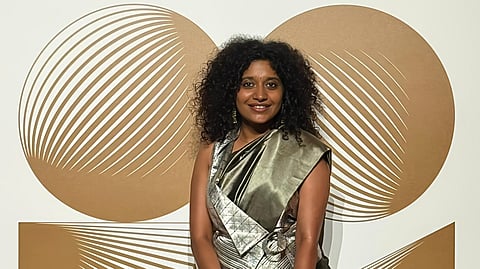


In Spying Stars, Indira Tiwari doesn’t speak for the first 45 minutes — but you can’t look away. The actor, best known for Serious Men and Gangubai Kathiawadi, inhabits Anandi, a bio-engineer returning home after years in exile, with a stillness so precise it feels orchestral. Directed by Sri Lankan filmmaker Vimukthi Jayasundara, the meditative science-fiction drama premiered in competition at the 2025 Busan International Film Festival.
The Hollywood Reporter India caught up with Tiwari immediately after Busan, as the actor spoke with the same considered pauses she brings to her screen work, equal parts philosopher and performer. During a conversation, Tiwari reflects on the weight of silence, the price of being visible, and why her idea of success has nothing to do with speed.
Edited excerpts:
'Spying Stars' is such a quiet, haunting film. For almost an hour, you don’t say a word. What was it like to perform through stillness?
Indira Tiwari: I come from theatre, so I was trained to begin with lines, with text. But when I read this script, there were maybe 60 pages and only ten with dialogue. The rest was just description and rhythm. That silence became my dialogue.
I love observing people: how they move, how they exist when no one’s watching. Silence, for me, is full of inner talk. Anandi is a scientist carrying memories, questions, and loneliness inside her. Even when she’s not speaking, her mind is moving. So, I had to find that inner hum becomes the motion beneath stillness.
Vimukthi sir asked us to cut away all excess. To be minimal but deeply present. It’s difficult but freeing. When I finally saw the film in Busan, with its music, everything made sense. The silence had come alive.
You’ve worked across very different worlds — 'Serious Men', 'Gangubai Kathiawadi', 'Spying Stars'. Is there a pattern in the kind of women you play?
IT: I realised recently that there is. All the women I’ve played — Oja, Kamli, Anandi — have their own strength, even when it’s quiet. Oja is pure and devoted, Kamli is fighting to survive, and Anandi is deeply internal. They all make choices that come from conviction.
I grew up watching strong women. My mother raised two daughters and taught us to study, to explore theatre. So, I want to portray women who are real, not ideal. For me, acting is a kind of social work. If even one person feels seen or learns something true, that’s my way of giving back.
What was it like being at Busan, and did you notice a change in how international festivals perceive Indian cinema now? Has the gaze changed or are we still exoticised?
IT: Definitely. Earlier, there was a pattern: “Indian” meant poverty, pain, or crisis. I’ve always found that limiting. But now, there’s space for different languages of storytelling — science fiction, experimental films, intimate human stories.
At Busan, our film played in the new Asian competition alongside work from Iran, Japan and Sri Lanka. I was proud to see Spying Stars there because it doesn’t fit into any box.
That said, some filmmakers still feel pressure to make “selectable” stories — about sex work or poverty — because they think that’s what festivals want. I don’t believe in that. Originality should be the only requirement.
You’ve said before that you’re not in a rush to be visible. How do you hold on to that patience?
IT: After Serious Men and Gangubai Kathiawadi, I didn’t work for almost a year. People would ask what’s next, and I had no answer. I don’t have a PR team. I don’t chase headlines. I like disappearing between projects. That’s when I live and observe.
I studied at National School of Drama, and it taught me that process matters more than results. So I’d rather do one honest film in two years than ten forgettable ones. Visibility fades; experience stays. There are moments of doubt, of course. But I remind myself that fame isn’t fulfilment. It shouldn't matter. Being present in the work is what matters.
Have you felt boxed in by mainstream Indian cinema's idea of what an actress should be?
IT: Yes, and I’ve stopped fighting it. I know I’m not conventionally glamorous, and that’s fine. I’ve been told I’m too intense, too raw. But I’d rather be raw than replaceable.
There’s a hierarchy in Mumbai between stars and actors, between "talent" and "faces" that is very clear. I’m aware of it, but I also know what I want. I don’t crave stardom; I crave longevity. The audience is changing faster than the industry. They want authenticity now, and that gives me hope.
What kind of stories do you want to tell next?
IT: I’m drawn to women who live in contradictions, who don’t explain themselves. I think Indian cinema still struggles with that. We want women to be “good” or “bad,” never both. I want to work across different languages. I am even open to doing more commercial work. I would love to do a rom-com. But substance is important. I want to live in that in-between, because that’s where truth really lives.