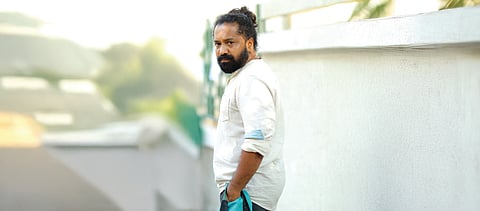


Filmmaker Jayaprakash Radhakrishnan is not new to tackling unconventional or rather, unpopular subjects. His first film Lens (2016) dealt with cyberbullying, while his 2023 neo-noir drama Thalaikoothal spoke in gruesome detail about senicide (the practice of killing the elderly). Both films found a reasonably smooth release and acceptance later.
But his latest, Kaadhal Enbadhu Podhu Udamai (which translates to 'Love is Common Property'), completed in 2022, will finally release in theatres this Valentine’s Day. The tiring process of finding a distributor was courtesy the film’s theme—of two women declaring their love for each other as one of them decides to come out to her parents.
As he finally gets ready for the release after a long battle, the director-writer opens up to The Hollywood Reporter India about the challenge of mounting Kaadhal Enbadhu Podhu Udamai, how he was asked not to make the film in Tamil, and why he feels the audience is changing today.
Edited excerpts:
You have made films that spoke about complex topics even before this. How would you compare the struggles of releasing a film about same-sex love compared to the previous subjects?
See, for me as a filmmaker, it was not at all complicated to write or even make this film. The complications started after I made it, when I wanted to release the film. Listening to the feedback and objections from the buyers I showed my movie to…that was the most difficult part.
Were you warned of these challenges?
Yes definitely, this was the movie I wanted to make after my first film Lens (2016). I had a producer who loved Lens and said he would support me with whatever film I wanted to make. We even got a solid cast together which included actors like Revathy, Parvathy and Prakash Raj. But after that, the producer backed off saying he wanted to make a more commercial film. So, I put this subject on hold and made Thalaikoothal. Later, director Jeo Baby connected with me and came on board to make a Tamil film.
Jeo Baby made Kathal: The Core, which was about a homosexual man stuck in an unhappy marriage. Don’t you think the mainstream audiences are warming up towards queer cinema? Even recent success of Sookshmadarshini in Malayalam and Kadhalikka Neramillai in Tamil augurs well, doesn’t it?
One can say that there is more awareness today. If I had made the same film in 2017, it would have been a shocker for our audience. Now it’s common to find people writing characters in same-sex relationships.
We’ve had films discuss same-sex love before this, but they seldom reach out to a large audience, getting restricted to the film festival circuit. I hear your film has been allotted 100 screens in Tamil Nadu….
I wanted a wider release and that’s why I waited this long. That’s also why I cast actors like Lijomol [Jose], Rohini and Kalesh [Ramanand]…actors the regular viewer is familiar with. Films like these will start a conversation and at the very least, we will get a realistic idea of how the viewer will react to this subject.
What were the distributors saying when you took the film to them?
In the beginning, they asked me to not even make this film in Tamil. They asked me to make it in Hindi or Malayalam. Speaking about distributors, there were a couple of them who refused to watch it because of the nature of my content. They simply said they are not even interested in watching it. Then a few others saw it and said they loved it. But they were apprehensive about the response and suggested they present the film without using the name of their home banner anywhere. There were others who also said the film would not work with our audience and called it an “art film”.
Did you consider making any changes?
Not many. But when G. Dhananjayan agreed to distribute the film, he suggested we rework the music a bit. I personally [prefer] my films to be filled with [moments of] silence.
Was casting for this film difficult?
I did approach a few big actors before Lijomol. They turned it down and said they were apprehensive because they didn’t want to act in such a film at this point in their career.
When you sat down to write the film, did you set any rules for yourself?
When people make movies about gay or lesbian love, they try to focus on suffering. Even when you look at a love story, you will see the two lovers as victims of society. Society then becomes the villain. How these lovers suffer and their efforts to reunite is what our classics are written about. Most of them are also tragedies. We call such films “poetic” or “timeless” only when there is intense suffering. But in reality, there are no clear heroes or villains.
Did you want the film to be conversational?
I wanted this film to be about acceptance. Acceptance, even before society, must begin at home. I wanted it to be a conversational film because otherwise, it would have been a three-hour film. Trying to show all of what I’ve discussed with visuals alone would have required a filmmaker with far more talent!
Did you find inspiration from Indian cinema before making Kaadhal Enbadhu Podhu Udamai?
See it first began as an idea for a music video. A friend was working on a song, and I suggested a visual of butterflies coming out of their cocoon, which would then be intercut with a woman coming out to her mother. But my friend was taken aback and said he wouldn’t even be able to show the video to his family. That extreme reaction is what got me thinking.
In terms of movies, I did watch a few to see if there were overlaps, but I couldn’t find one. But I really enjoyed Carol, the 2015 film starring Cate Blanchett and Rooney Mara.
Did you consider working with consultants to vet the script because it is a sensitive subject?
After writing, I consulted with actor/activist Malini Jeevarathnam. Even before I went to her, I met with a family that had undergone something very similar to what happens in my film. I gave them the script and I got some feedback. I didn’t want to be politically incorrect.
What are your expectations from the theatrical release?
If I can get viewers to the theatres on the first two to three days, then I feel the word of mouth will take care of the film.
Do you think we will see a future in which we see two male or female superstars acting in a same-sex love story, that too being treated like any other mainstream rom-com?
Definitely. Even when Kadhalukku Mariyadhai released in 1997, it was a big deal for a film in which an inter-faith couple decided that they would get married only after they got their parents’ approval. Eloping would have been the only option for such couples in movies back then. Now it wouldn’t even be a subject for a movie.
So, I hope same-sex love stories will become normalised. But to be fair, these things cannot be predicted. Even the reverse can take place, and we may regress as a society. Who knows?