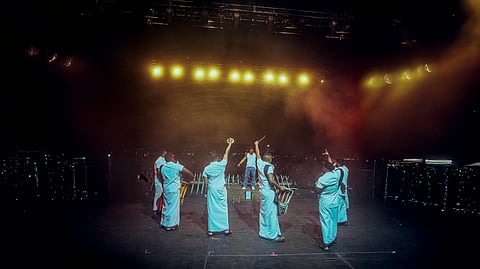


The Coachella stage marked an important milestone for Indian rapper Hanumankind. The Malayali hitmaker made his festival debut, also marking his first official performance in the US. And somewhere in this triumphant dream debut is a story of a Malayali ensemble — and more importantly, a story of a traditional Kerala percussion instrument. Kochuveettil Beats, a Malayali-American music group from Chicago, got to perform an acoustic version of Hanumankind’s “Run It Up”, along with the rapper, at the California festival in April. Jeffrey Kochuveettil, who founded the ensemble along with his brother Jonathan Kochuveettil, is pretty much still shook — not just because they got to perform at Coachella, but because their rich culture felt seen.
“This was the dream,” Jeffrey tells The Hollywood Reporter India. “First off, we thought they’ll incorporate us for a song because ‘Run It Up’ has chenda elements. But for him (Hanumankind) to say this is how I want to open my set in the US to all these people who have never seen the chenda and these elements on the stage, was unreal.”
The chenda is the real MVP at Kochuveettil Beats, a 35-member group that bridges sounds from the traditional drums with global genres such as hip-hop and Latin music at cultural festivals, weddings and corporate events. The band is named after their family, which translates to “small house” in Malayalam. The name was perfect for a group that shares the vibe of a mom-and-pop shop, Jeffrey says. “We thought we were going to struggle with this, telling some non-Malayali or non-Indian that we were called Kochuveettil,” he recalls. “But then you know we were talking through it, and we were like ‘We don’t care; you have to learn.’ The name is important to us.”
Both brothers juggle full-time roles: Jeffrey works in the health IT field as an analyst, while his brother is a practising physical therapist. But they somehow make this work. “Monday through Friday, we work in the healthcare setting, and then on Friday and Saturday, we’re practising and doing a wedding. And sometimes it’s Coachella,” he grins.
Edited excerpts from a conversation:
THR India: How did Coachella happen? How was it for you guys to be on stage like that?
Jeffrey Kochuveettil: I’ve listened to hip-hop and R&B my whole life. I never thought in my high school or college days that there would be somebody like Hanumankind. I’ve been following his music for many years and then I saw the Coachella announcement back in November. We knew we shared a common vision in that we wanted to put Kerala out there and represent the culture. We approached his team, they saw our work and knew we were offering something unique. Next thing you know, we’re on stage with Hanumankind. It was a blessing.
He’s seen our work, but until Coachella he’s never met us in person, so he was very open to it. I don’t think many people would do that; he was very collaborative and so down to earth. Right when “Run It Up” dropped in November, we did a cover of it. This is the only rap record that has a true tribute to chenda like this. The song dropped on Spotify on Thursday, and we met up Friday and recorded a remix to it and a cover.
THR India: Hanumankind also did a small introduction of the chenda before you guys began. How important was that for you as a Malayali-American musician?
JK: Him explaining that this drum was from Kerala and the rich history behind it was super important. He did not have to do that — that was his show — but he still did and we’re super appreciative of that. He told us he liked our work and emphasised how big of a debut this was. This was a once-in-a-lifetime opportunity for people to see that.
Coachella wouldn’t have been possible without the support of my wife Asha, my parents Scariakutty Thomas and Beena Thomas, and my team members, even the ones who were behind the scenes.
THR India: The chenda has deep roots in various traditional art forms from Kerala, including theyyam and kathakali. What drew you to the instrument, and what informed your innovative take on it?
JK: Our dad and some uncles from the community wanted to learn and play the chenda. So, back in 1999, my grandfather brought a chenda from Kerala when he visited us in Chicago, and we witnessed that at a very young age. I was probably seven or eight, and my brother was two or three. We developed that interest watching them practise in our house. Eventually, as we were growing, we travelled back to Kerala and developed a deep interest in wanting to learn more. We got a teacher, an aasaan, out in Kerala. So, every summer, for about two to three months, we’d learn it the proper way.
As we hit middle school and high school, we developed an interest in percussion. My brother learnt Western percussion and would blend the two, knowing the similarities and the differences between the chenda melam and the snare drum. Fast forward to 2016, we would continuously go to Kerala, learn the chenda and develop that relationship with our teacher, but then we were listening to so many genres like Malayalam music, Bollywood, hip-hop, R&B, and between me and him, we talked about how cool the chenda sounds with other genres.
THR India: What differentiates the chenda from a snare drum in terms of the sound?
JK: They are both beautiful in their own way, but there’s a different feel to the chenda and how you play it. With Western music, it’s by notation. We’re reading and studying notation. When we learnt with our aasaan, we found this difference. Some of it just has a feel to it. He’d tell me that sometimes you can’t even explain it. The energy when we play is completely different.
THR India: Tell us about your group mates. Does Kochuveettil Beats have non-desis too?
JK: We have a couple of Telugu folks and a few caucasian American folks. One of our co-founders is Bryan Hughey; we call him Bryan Hughthenparambil, which adds a Mallu-esque effect to his last name. He’s been part of our group since we started. He’s a drummer and more Malayali than a lot of us! He’d show up to a pre-wedding event in a mundu and a shirt and rock the chenda.
THR India: In your Coachella story, there is also a lesson perhaps for various emerging musicians to put themselves out there and shoot their shot. Do you agree?
JK: I remember seeing the Coachella post and thinking two unique desi artistes were performing: Hanumankind and Indo Warehouse. It was a sign. I remember telling my wife Asha that I have to reach out to them. Worst case, I get rejected, but I’m going to keep trying. We took a shot and everyone should always take their shot.
To read more exclusive stories from The Hollywood Reporter India's May-June 2025 print issue, pick up a copy of the magazine from your nearest book store or newspaper stand.
To buy the digital issue of the magazine, please click here.