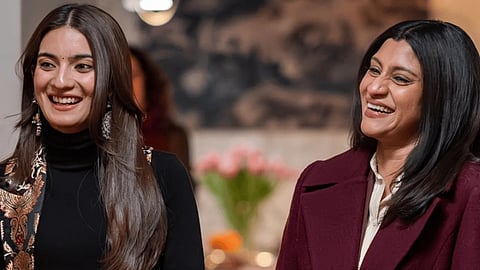


There is a familiar choreography to conversations around “important” Hindi films: the polite overture about representation, the expected nods to nuance. This one begins there and then, mercifully, refuses to behave.
The film in question, Accused, unfolds as a slow-tightening moral spiral: when respected doctor Geetika (Konkona Sen Sharma) is accused of sexual misconduct, her partner Meera (Pratibha Ranta) finds herself suspended between loyalty and doubt, love and self-preservation. What begins as a personal crisis quickly metastasises into something knottier — about power, desire and the uneasy afterlife of allegations in public space.
What follows is a careful dissection of trade-offs: how tightly you can wind an audience before they snap, why queer intimacy still arrives in measured doses, and what it means to make films in an era where the algorithm is an invisible co-producer. Director Anubhuti Kashyap speaks like someone acutely aware of vanishing attention spans; Konkona Sen Sharma remains drawn to the productive discomfort of moral grey zones; and Pratibha Ranta reveals the sincere, almost mathematical precision behind Meera’s uncertainty.
Running beneath the conversation is a question the film circles but never quite resolves: how do you tell complicated stories about women when the room — industry, audience, everyone — is still negotiating how much complexity it is willing to hold?
Edited excerpts from a conversation:
THR India: Konkona, you’ve played queer characters before, and you’ve often gravitated away from easy categorisation. There are some tropes everyone plays into, and you always play against them. What were you trying to subvert with this character?
Konkona Sen Sharma: I’m glad you feel that way. More than a conscious choice, it’s really an extension of my personality. I’m always interested in stories that are untold or under-told — not the popular narrative. Those things interest me because they’re lesser known; there are new elements to them. I prefer nuance and depth in storytelling, which is what this film had to offer and what Anubhuti has brought to it.
This was very much in keeping with my sensibilities. I don’t even do it consciously, but I hate stereotyping and generalisations. They’re boring and easy answers. It’s always nice to see how we can complicate things. It’s more fun to process, and a little discomfort is always good. You think, what if I were to say this — what would happen? It’s just more interesting.
THR India: Anubhuti, for about an hour — which is most of the runtime — the film is relentless. It keeps you on edge. That’s a tricky space because tension can become too much. When something is coiled so tightly, how do you decide how much is too much? Do you want to give the audience a breather, or just go at it?
Anubhuti Kashyap: It’s a tricky question because sometimes you do want to give the audience a breather — it depends on the kind of film. With this one, we wanted to tell a very engaging story, so we went at it relentlessly. We arrived at that after a lot of feedback. I kept taking very specific notes and showing the film at different stages to different people — asking, were you feeling relaxed here? Were you getting out of the film at this point? I would take those notes and work on them so that you don’t really get breathing space. That was the process.
But that’s not to say I don’t enjoy breathers. I personally love them. There are films where the slow burn works beautifully with the mood. This was not that film. Also, I’m trying to cater to today’s audience and their patience — or lack of it. We call it shrinking attention. So we kept it tight, so they don’t get any excuse to pause, look away, or go make tea.
THR India: But that’s also risky. If you keep them on edge for so long, the payoff has to feel worthy of the discomfort. Were you worried that if the payoff didn’t feel big enough, it might take away from all that tension?
Anubhuti: You’ve said that very well. It was a big dilemma with this film. Today we’re making films for Netflix — not purely for audiences but also for an algorithm. So where do you keep the balance? It was always at the back of my mind: if it’s too much tension, people might get exhausted and the payoff might not feel big enough. We discussed this a lot with the stakeholders and eventually arrived at the final call — to go this way rather than another.
THR India: Pratibha, your character spends the entire film walking the line between faith and doubt. You’re not fully on either side, which is difficult to sustain without becoming repetitive. How did you decide where Meera was placed in each scene?
Pratibha Ranta: For me, it was a lot of discussions with [Anubhuti] ma’am and many readings and workshops. We prepared so much. Because I knew what was happening in the story, I could build a background for myself — how Meera is feeling, what has happened before this scene.
I would create my own emotional continuity: what feeling she left the previous scene with, and what feeling she’s entering the next scene with. There’s also a lot of restraint in her because she’s processing so much and discovering herself. It was important to balance the emotions so that each scene had a slightly different energy.
Anubhuti: I must say she built a fantastic graph for Meera — when she starts having doubts, when she steps up and stands against. Sometimes she would even correct me: No, in this scene I don’t think I’ve reached that place yet where I can differ from Geetika. She did a great job.
THR India: For a film dealing with such heavy themes, there’s a striking lack of overt physical intimacy between the two characters. We don’t see enough queer stories where people are just allowed to be intimate — not necessarily sexual, but emotionally and physically close. We would like to see more visible desire between them. Was that restraint a political choice — because you feel audiences aren’t ready? And for both actors: did that lack of intimacy affect how you built chemistry?
Anubhuti: You’re right — that was a political choice. Even I would like to see more intimacy in queer stories. But in India, we’re not yet at that stage. Instead of jumping straight to the next step, we thought this could be an intermediate step — to normalise the relationship without creating discomfort for Indian audiences. The idea was to let people first accept queer relationships as normal. Then they’ll be ready for the next step.
We want more and more people to accept queer relationships. That was purely the intention.
THR India: Konkona, especially since you’ve done Geeli Puchi, where there’s so much physical intimacy — here there’s a noticeable lack. There are maybe two scenes where you’re physically together.
Konkona: We did include a kiss during the shoot — a small one — because it was a public setting and a happy announcement scene. There wasn’t much scope later because of how the drama unfolds.
Of course it’s always nice to have that intimacy. One has to see it in the context of what Anubhuti was saying about small steps. Unfortunately, sometimes one has to do that. That’s why we included the kiss — to make it normal and believable, since they are going to have a baby together. I was very happy we could include that.
Anubhuti: After the film, we’ve seen more appreciation — especially from the queer community — because more people will come and watch this film than the number who might miss the intimacy. I think that was the main reason.
Pratibha: I also felt there wasn’t much scope for intimacy as the story unfolds because something else is going on — Geetika has been accused of sexual harassment. But I do think there is beautiful emotional intimacy between Geetika and Meera. They are losing their relationship and trying to hold on to it. Of course it’s not very physical, but the emotional intimacy says a lot about their patterns. I really loved that; it felt like any other relationship.
A friend told me the best thing about the film is that it’s not preachy. It’s not on your face... it just exists. I think we have normalised it very beautifully with these small steps.
THR India: Tell us about the provocative choice of making both investigators men in a story centred on women. Why position men as interpreters of women’s lives? Was that deliberate?
Anubhuti: It was a choice — not purely for provocation but also to maintain a certain gender balance. We can’t yet have a film with 90 or 100 percent women; both genders have to be there. But yes, assigning those roles to men was deliberate. They also carry their own biases. That’s why there’s a slight difference between the two investigators in how they look at the case. That contrast was intentional.
THR India: Konkona, your character’s ambition is almost treated as evidence against her. Do you think audiences are still uncomfortable with women who want power unapologetically? Have you experienced that personally?
Konkona: I haven’t personally experienced it as much — I come with my own privileges — but that’s not to say many women in power don’t face it. Someone once said, power corrupts and absolute power corrupts absolutely — I forget who, maybe Plato… maybe Spider-Man, we don’t know. (laughs)
One way to deal with patriarchy is to humanise both women and men affected by it — not box women as saints and men as sinners. It’s more complicated.
How people react to women in power reveals more about them. Many are uncomfortable. Women are often held to higher standards — the same behaviour is called bossy in a woman but not in a man. Also, being a woman doesn’t make you impervious to human flaws. That’s part of humanising the character. Both Meera and Geetika are forced to reckon with the flaws in their relationship. I enjoyed incorporating some very toxic male behavioural patterns into this dynamic. It becomes much starker when you see it play out between two women because it’s so normalised in heterosexual relationships.
Accused will be available to stream on Netflix from February 27.