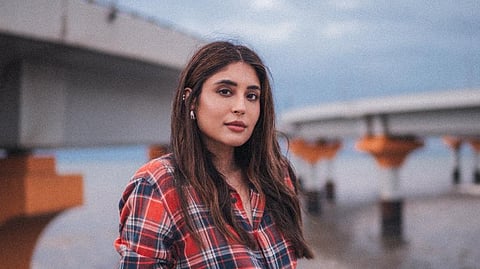


Kritika Kamra was 18 when she dropped out of design school to pursue her acting career. "I completed a single semester," laughs the actor, who was spotted by a talent scout outside the National Institute of Fashion Technology (NIFT) campus in Delhi. Several years later—a journey which took in a lengthy television career, a lukewarm Bollywood debut and a robust streaming transition—she has landed what can be called her first central leading role in a film. In Anusha Rizvi's well-reviewed The Great Shamsuddin Family (on JioHotstar), Kamra is in the thick of things: a bespectacled academic starting on a 12-hour writing binge, her peace usurped by members of her cacophonous clan.
Tracing two generations of an upper-middle-class Muslim family, it's a witty, sweet-natured film, brought to shimmering life by a large and lovable ensemble. Kamra was approached for the role of Bani Ahmed by Delhi-based casting director Dilip Shankar (Unsurprisingly, Shankar also cast for Monsoon Wedding and Delhi 6, definite texts of the self-reflexive Indian family film).
"Frankly speaking, it's tough for an actor like me to be cast in a central part," Kamra says, plainly. "There's the whole commerce of the film industry and various factors that go into casting. Even then, there are not many films being written with women at the centre." Her audition was a self-shot video of her making chai (tea), among other scenes from the script. "Dilip sent the video to Anusha and I got the part. It was gratifying to know that there are filmmakers who still trust and follow the audition process."
Excerpts from a conversation with the actor...
'The Great Shamsuddin Family' released a week after 'Dhurandhar' and picked up organically...
It’s no secret that there was no marketing for this film. We were entirely relying on word of mouth to get noticed. Since the day of release, there’s been a barrage of wonderful feedback. Ravish Kumar wrote about it. Karan Johar and Neeraj Ghaywan gave us a shoutout on social media. Varun Grover championed the film and left a beautiful review on Letterboxd. Cinephiles have written long essays on the film. The scene where my character says, “People who take care also need to be taken care”, has been shared on cinema pages, and the comments sections are flooded with beautiful messages. It’s the first time I am experiencing something like this.
What were the workshops/rehearsals like?
There were two table reads: one in Bombay, one in Delhi. Anusha lives in Delhi, and we shot the film there. The workshops were very theatre-like, actually. We were playing out whole scenes and the camera was sort of deciding what it wanted to capture. Of course, stalwarts like Farida Jalal, Dolly Ahluwalia and Sheeba Chaddha come from a background of theatre. With the kind of filmographies they have, they don’t need rehearsals with lines. So it wasn't about that. It was more about finding the rhythm. That and getting used to the technicalities, since we were confined to one location for the entire period. Unlike some films where you dress up multiple locations, the film was shot entirely in the one house in Chattarpur in South Delhi. Only the rooftop scenes were filmed in the Nizamuddin area, with the Humayun’s Tomb in the background.
What was the most emotional or memorable scene for you to perform?
It’s the scene in the dining room where Bani's elder sister Humaira (played by Juhi Babbar Soni) is speaking to Bani about what's going on in her life. I love that scene because it captures her inner life, what's going on in her head and heart. Bani’s relationship with Aditya is coming apart. Her sister, meanwhile, is not judging it but she is not very supportive either. Anusha orchestrated things in a way that we as actors really lived that moment and brought truth to it. There was not a tinge of self-pity in that scene; it felt very real. I remember getting a lump in my throat towards the end of it, really feeling it.
The one scene that felt strange is where Bani suddenly goes, "I am not a liberal". What was your reading of the moment?
Anusha is extremely nuanced with her writing. She’s also very politically aware. So when she says liberal, she is really illustrating the difference between a left-minded academic like Bani and, you know, social media liberals, which is not a crowd she identifies with. She is also a progressive liberal but as she says, she does not want to impart half-baked knowledge on every news cycle.
The word 'liberal' returns in the scene on the terrace, when the character Latika asks Bani if she got a 'TT' (Triple Talaq).
A lot of people didn't get that reference, including my own father. Triple Talaq has been a hot topic of discussion in our nation (it was criminalised by the Parliament in 2019). That scene is the culmination of microaggressions that Bani is feeling throughout the film. Earlier, in the kitchen, Latika calls her a hypocrite. And then she says, "This is such a funny interfaith marriage situation." It's like she's amused by this elopement, while the family is obviously scared. So the TT line on the terrace is basically the last straw. Bani snaps back, rightly judging that Latika is trying to be superior and is virtue signalling. This is the gaze of self-described liberals that Anusha is calling out.
What does 2026 look like for you?
My career is not decided by an agency. It is a result of my own choices. And they are very personal and instinctive to me. The Great Shamsuddin Family has emboldened my risk-taking appetite. I'm currently gearing up for another indie project that will require a physical transformation. Then there's Matka King, directed by Nagraj Manjule and co-starring Vijay Varma. I have a glamorous turn in it, in 70s' Bombay, with all the jazz and vintage cars and retro stylings. The first look will be out by early next year. It's a big show, and Nagraj sir has created a fascinating world rooted in ambition, money and class struggle.