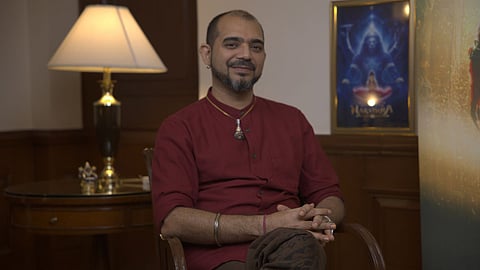


Filmmaker Ashwin Kumar isn’t playing it safe. With Mahavatar Narsimha, he’s kicking off a decade-spanning, seven-film franchise chronicling the ten avatars of Vishnu without a star-studded live-action spectacle. Instead, he is going down the full-scale 3D animated feature route. It’s a gamble, given the mixed history of animation in Indian cinema, but Kumar insists the choice was both creative and cultural.
In an interview with The Hollywood Reporter India, Kumar explains how the larger-than-life mythology of Hiranyakashipu demanded a visual language unlike anything Indian cinema has attempted before. Drawing from influences as diverse as Jurassic Park, Akira, and Demon Slayer, and backed by Hombale Films (KGF, Salaar), Kumar reveals why animation was the only medium powerful enough to bring this epic vision to life.
Edited excerpts:
This is a decade-long project spanning seven films, starting with an animated feature. Why did you choose to begin the franchise with animation, and was there ever a conversation about making it live-action instead?
It was something we thought about at a very early stage. But because the entire story is not normal, meaning, it's not grounded in regular reality, animation felt like the right fit. You’re able to produce something with interesting movement and elaboration, and it allows for a type of visual storytelling that can really enhance the concept. It's a more realistic animation that we’re working with. Basically, that means something that isn’t just playful but still rooted in animation as a serious medium. Keeping all those factors in mind, the idea was to use animation to tell this story in a way Indian cinema hasn’t done before.
Had it been just about risk or budget, we would’ve chosen live-action because usually people don’t want to invest in animation in India. Anime, although it’s a very playful and loved art form here, doesn’t have a huge establishment. But this wasn’t about risk aversion. I think live-action would’ve been the easier choice. Instead, it was a conscious decision, and for the script, animation was definitely more suited.
Given that this is a 3D animated film—and historically, 3D animation hasn’t always performed well in India—what gave you the confidence to go this route? And how did Hombale Films come on board, and what have they contributed, especially with their experience on films like KGF and Salaar?
While it’s true that 3D animation in India hasn’t quite flourished, it’s about time. This is the beginning of that endeavour. I’m confident about it because I also come from the field of animation; I’ve been doing it for most of my life. I’m also into theatre and other art forms, so I’ve seen this as the most expressive and complete medium.
Hombale Films were immediately on board because this story is rooted in our region. Their goal is to bring our scripts back to the big screen just as we’ve done before. We’ve had a long-term relationship and believe that we’ll be able to mix experiences in cinema and bring this to life together.
The franchise is set to chronicle the ten avatars of Vishnu. Will the films be interconnected in a shared universe style, or are they envisioned as standalone stories with a thematic link?
Yes, they will basically be standalone stories, but woven into one final thematic link. You can experience each of them independently, or as a part of a larger woven cinematic universe.
The antagonist in this film is Hiranyakashipu, described as the embodiment of Adharma. How did you decide on this particular character, and what was your approach to developing the mythological “villain” figure across these films?
Hiranyakashipu has a very important arc- especially in connection with Lord Vishnu. He’s a well-hinged character in the mythology, and is also the brother of Hiranyaksha; another avatar of Vishnu, the Varaha avatar, is part of his story too.
It is also said that in his next birth, he appears in the Ramayana as Kumbhkaran, the brother of Ravana. These characters are full of shakti, and they’ve been studied deeply- by scholars. The entire segment has been built with that in mind. Even their character traits have been sourced from authentic material. The goal is to bring authenticated folklore out onto the screen.
What have been some of your visual and narrative inspirations while crafting this world? Did older mythological serials or other global epics shape your vision in any way?
Watching Hollywood movies has definitely been a big part of it. Experiences like seeing epics such as the Mahabharata on the big screen made a lasting impression. A lot of the inspiration has come from childhood memories, both from Hollywood and from Japanese anime, which I’ve been a huge fan of for years.
Some of my inspirations are Terminator, Jurassic Park, Predator, Alien, Transformers, and Avatar. I'm a huge anime fan, and titles like Akira and Demon Slayer from Japan have had a strong influence too. I think it’s about time we bring that sort of scale and imagination to our own fantastic storytelling here in India.