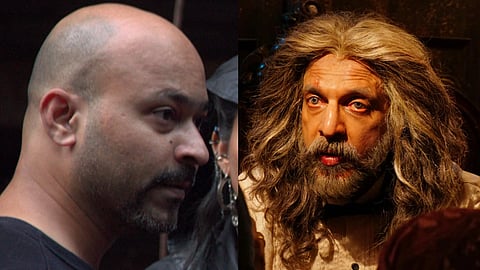


Writer-director Rahi Anil Barve’s journey in cinema is a potholed path of meticulous attention, relentless delays, appropriation of credit, and vast stretches where projects announced and shot never attain fruition.
Birthed from a 700-page storyboard, his debut Tumbbad (2018), a horror folk moral fable, took years to bloom from thought to theatre, being palmed off across seven production companies, going on the floor thrice before being pulled back. In an interview, Barve noted that there was “no frame of reference for [the producers], nothing like Tumbbad had even been tried before.”
Finally, after two-and-a-half years of post-production, when the film released, there was a whisper campaign trying to pull credit for the film’s success in different directions—Adesh Prasad is credited as co-director, Anand Gandhi as creative director, and Sohum Shah as actor-producer. (Barve is not part of the announced sequel.) The box-office returns from the film’s re-release in 2024 exceeded that of its initial theatrical run, becoming the highest-grossing re-released film in Indian cinema at that time.
Did the film’s success make Barve’s subsequent journey easier?
In an exclusive interview with THR India, he responds, “Easier? No. Just different. They take meetings faster now. Indian studios want “new” but not “too new”. They want “ambitious” but not “risky”. They want “like Tumbbad,” but also “not like Tumbbad”."
In the years since Tumbbad, Barve announced several projects. There was Pahadpangira and Pakshtirtha, which along with Tumbbad would be his “Greed Trilogy”. The former is “very much alive…trimming the budget from ₹60 to 70 crores, coordinating actor dates”, while the latter “is in the vault now. Pahadpangira needs to succeed first before this one can take flight.”
Then, there is Gulkanda Tales, a six-hour, eight-episode period sex-comedy, produced by filmmaker duo Raj Nidimoru and Krishna DK for Amazon Prime Video, made on a sweeping ₹100 crore budget. Starring Kunal Kemmu, Pankaj Tripathi, and Patralekha, the show, fully shot, is now stuck in limbo—with talks even of cancelling it altogether.
“It’s a beautiful show, ready in 2023—just caught in the wrong climate. Thanks to shifting political pressures, an entirely new war began just to get it released. Honestly, I doubt even Sacred Games could have come out today,” Barve says.
Then, in February 2025, it was announced that Barve, along with Raj & DK, was making Rakt Brahmand: The Bloody Kingdom, Netflix India’s first-ever “mega action-fantasy series”, according to Monika Shergill, Netflix India’s VP for Content. Starring Aditya Roy Kapur, Samantha Ruth Prabhu, Ali Fazal, and Wamiqa Gabbi, the show is rumoured to be in the process of being shelved. Barve made no comment about this project’s impending status, stating, “The last six years have been the hardest phase of my life.”
Now, finally, Mayasabha, Barve’s second feature film starring Jaaved Jaaferi is surfacing in theatres on January 30, 2026—a film that Barve had shot in 2018, in the six months he had after Tumbbad’s release and before Gulkanda Tales absorbed him. He describes it as “something quick and personal”, based on a story from a chapter in his book Aadimayeche.
Jaaferi came on board for Mayasabha even before Tumbbad came out. “When I met him, I saw a very obsessed man—obsessed with his film,” Jaaferi remembers. A film which takes place in 24 hours in a single location—a decrepit theatre, full of kerosene and dust—and told without flashbacks, Mayasabha is driven by the four characters, as opposed to a conventional plot. It was an intensive shoot—some days they would shoot for over 20 hours. They canned the film over 22 days.
Post that, Mayasabha sat idle until late 2023, when Gulkanda Tales was in post-production hell. With Aasif Pathan, his editor, Barve worked for a year and a half to whittle the film down from a four-hour cut to two hours.
It can be frustrating when as a filmmaker you are dabbling multiple projects, with so little to show for. “There are years when nothing moves—even after you’ve moved mountains—and hundreds of crores of work remain stuck. You start feeling like you’re rotting inside your own ambition. But then one good scene, one good frame, one good performance is enough to remind you why you do this in the first place. And honestly, that helps.”
Besides, Barve enjoys the inertia of making to tide over the sluggishness of releasing. He has also been dabbling with artificial intelligence this past year, tinkering with Gorilla software on his PC on a project. “The first 40 minutes are ready; 50 more to go. I’ve spent less than a few lakhs, working like a maniac in whatever free time I get — mostly nights. Two years ago, the same film would have cost me more than ₹6 crore and an entire team of artists. I won’t lie—making it creatively and visually is still immensely hard. Good AI filmmaking will remain rare, no matter how advanced the technology becomes.”