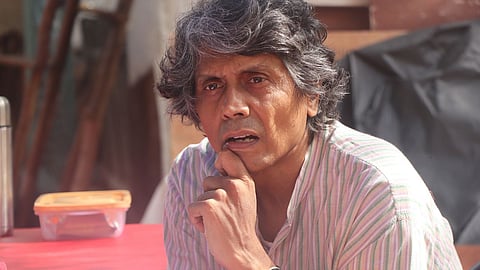


An engineering degree at Georgia Tech, a nine-to-five as an environmental consultant, followed by evenings attending the Warehouse Actors Theatre, Nagesh Kukunoor in the 1990s in the United States of America was a man straddling two worlds. When push came to shove, he picked cinema; he chose India. His debut, Hyderabad Blues (1998), tracing an Indian American’s vacation back home in Hyderabad, struggling to be both and either, inaugurated a voice that was irreverent, fresh, the kind of urban-cool that felt at ease with itself, unlike the Dharma-YRF worlds which still had one leg in tradition, trying to leap into the twenty-first century with the other, remaining foot. Kukunoor’s cinema, instead, had its ears to the ground.
Around that time, in the late 1990s, in an interview, he noted that his plan was “to sell my Indianess and put myself on the map. I finally plan to make films with American themes. After all, Hollywood is the Mecca of every film-maker.”
More than two and a half-decades later, after a career that produced magnificent pathos (Iqbal, Dor) with some strange asides (8X10 Tasveer, Mod), Kukunoor is still in India, and has made a shift to streaming, with three seasons of his “masala” —a word you would never associate with his movies—political drama City of Dreams on Jio Hotstar, and now with the release of his latest show, The Hunt: The Rajiv Gandhi Assassination Case on SonyLIV, based on Anirudhya Mitra’s book. Another show has been completed, waiting in the wings.
Inaugurating his filmography with festival darlings, and then moving to middle cinema commercial films, streaming was the third innings for Kukunoor. “A huge fan of HBO from its early years, I jumped on the streaming bandwagon,” Kukunoor notes in an interview with THR India. “Things really took off, I would finish a show, and I would rush to the next. You blink and seven years just went by and I had not made a film.”
Kukunoor had a ringside view to the streaming landscape’s evolution from its early promise, "The initial years were the most exciting phase of my life. I wrote the first season of City of Dreams with zero censorship. Take the lesbian sub-plot, I had full blown makeout scenes, things I could never do on the bade parade (big screen). But by the time season two rolls around, they are taking it down a notch, and by the time season three rolls around…,” Kukunoor shakes his head. “There is an unspoken thing that sex cannot be so visceral or blatant, so it tapers off. Even if you have a mixing of religion in names… take it out. Tone it down, blur it out, cut it out, etc. The drop has been drastic.”
With a consolidation of streaming platforms, fewer players, more fear, Kukunoor believes "we are back to the same position—we need mainstream content, can we attract a star, etc. I am back to answering a lot of the same questions that I got into this space for not wanting to answer.”
Kukunoor, though, is not a stranger to censorship. Hyderabad Blues, an 82-minute film, had 91 cuts. Kukunoor fought them to the tribunal—where a retired judge headed the panel. With the line “Dil pe mat le, haath mein le” (don’t take it to heart, take it in your hand), the Censor Board representative paused and noted, “It's a reference to masturbation,” to which Kukunoor simply said, “Yes.” Justice Lentin laughed and said, “Let it go.” This tribunal has since been abolished. Filmmakers unhappy with cuts suggested by the Censor Board now have to go directly to court.
Streaming, too, has borne the brunt of increased scrutiny. “We have been self-censoring for seven-eight years now. A script is vetted by 20 lawyers before it gets to production. After it is shot, it is vetted by another twenty before it sees the light of day, because everyone is terrified,” Kukonoor notes.
What does that do to an irreverent voice, playing on the boundaries of what is possible. Does the edge go? "It diluted my voice. I don’t see it consciously, but the changes are so minute, spread out over time. Even to me, Hyderabad Blues feels like it is from a different era,” Kukunoor responds.
It is also, perhaps, why Kukunoor has been insisting during the press junkets that The Hunt is "not a political show." He says, "It is a police procedural about a political assassination, and the hunt. I steer clear of the politics. There are hints you can pick up on. But otherwise, I didn’t touch it, because it is a minefield. It is the nature of the beast, you roll with the punches.”
When I asked him how he felt about that quote from the 1990s—its brash clarity, its Westward-facing glint, its charming hubris—Kukunoor smiles, “I still haven’t given up on that dream.”