

Screenwriter Aarsh Vora talks about his life like it’s the opening montage of a coming-of-age film. He grew up in a joint family, living in a sea-facing duplex in Napean Sea Road, Mumbai. “I am a South Bombay boy by location, not by my bank balance,” Vora jokes, insisting that he is essentially a “middle-class kid who grew up around rich people.”
"I was an asthmatic kid. I never went out to play, so I would mostly be in my room with my action figures, turning them into characters in my own stories, renting out video cassettes of films and watching one movie every week,” says Vora, who has now emerged as the go-to writer for romantic-comedies and young-adult stories in the Hindi film industry.
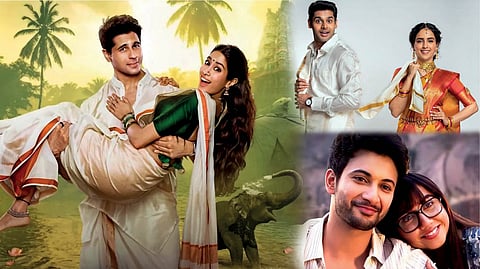
Vora has been a writer on Netflix’s hit Mismatched (2020), Karan Johar-backed Meenakshi Sundareshwar (2021), Yami Gautam-Pratik Gandhi starrer Dhoom Dhaam (2025) and the upcoming Param Sundari, which is headlined by Sidharth Malhotra and Janhvi Kapoor.
In an interview with The Hollywood Reporter India, the screenwriter talks about his journey to films, why he loves romantic movies, the challenges of penning one today and why the genre will never run out of newer conflicts.
Is it important to believe in love to write a love story?
It is extremely important for me. In some capacity, even if you’re a cynic, that cynicism has to come from the fact that you have once believed in love and that has not worked out.
But there are some people who think rom-coms are easier to write.
I have heard that as well, and it is absolutely false. Romances are driven by emotions and not logic. It’s very difficult to sell that because when your character’s decisions are driven by heart and not practicality, how do you explain that to someone? That is very tricky.
Do you feel at home writing a rom-com?
It’s my favourite genre. When I was in Whistling Woods International (the film school), all my stories were either romances or rom-coms because that’s what I also grew up watching, films like When Harry Met Sally... (1989), or anything with Hugh Grant or John Cusack. One of my professors used to say that after I graduated, I will get a table at Dharma Productions by default.
And you did write for them!
Yes. I come from the old school film romances of Yash Raj Films and Dharma [Productions]. When I started writing, my character’s motivations would always come out of love. There was a time when urban rom-coms were being made. I was an urban guy who knew the syntax of urban rom-coms very well, so I felt like these are the kind of stories I wanted to tell.
If you are having writer’s block, is there a rom-com you watch to break it?
My go-to films include 500 Days of Summer (2009), When Harry Met Sally..., Serendipity (2001) and even Casablanca (1942). There are also two Hindi films which I always go back to: Dilwale Dulhania Le Jayenge (1995) and Jab We Met (2007). I actually check the beat sheets of these films with my writing draft! Also, these films came at such a specific time in my life that they truly influenced my worldview, and subsequently, my writing.
Shah Rukh has been the benchmark for romances, but even something like a Kal Ho Naa Ho (2003) is a very cool, rom-com film for the most part.
Actually, Kal Ho Naa Ho is my favourite film of all time. I watched it on the big screen when the film was re-released and realised that it still holds. It is such a quintessential Bollywood film, which is not dated. I wouldn’t have been a filmmaker if there was no Kal Ho Naa Ho or DDLJ.
What is the key to writing a romance?
If you are writing about a generation, don’t judge it. Always understand where they are coming from. A lot of young adult shows in the country are written from a judgmental lens, looking down on their battles and conflicts. You need to be curious about them, listen to them and talk to them in their language. Mismatched, the show, doesn’t just talk like them, it talks to them, the way they want to be spoken to. It is written with a lot of sensitivity.
With romance, you have to write relatable but flawed characters and, most importantly, have a take on love. We had a certain take on long-distance relationships in Meenakshi Sundareshwar, and in Dhoom Dhaam, it was a take on arranged marriages. If you crack that through your characters, it will connect. Rishi (from Mismatched) might seem perfect, but he is flawed. He has a saviour complex. You need to have interesting characters. If that connection doesn’t happen, you will not root for a couple to get together.
The industry feels romance can’t be made today because there are newer cinematic conflicts to explore.
No, if you look around, everyone is heartbroken. There are conflicts in every relationship, and one has to find newer ways to tell them. But you just can’t be boring. The advent of social media has created more problems with romances. Today, you can talk to people through the apps, but can you understand each other? We cannot tell the same kind of rom-com anymore because people will not relate to it.
Mismatched: It connected because the story was told with a lot of empathy and spoke to the generation in a way they wanted to be spoken to.
Meenakshi Sundareshwar: The characters connected with people, as there are so many who have found themselves navigating long-distance relationships. The film just fit right in.
Dhoom Dhaam: The making of the film taught me that if you believe in an idea, never give up on it. If you have written a good film, it will find its audience.
Param Sundari: The film has an interesting comment to make about this generation and something to say that hasn’t been told so far.