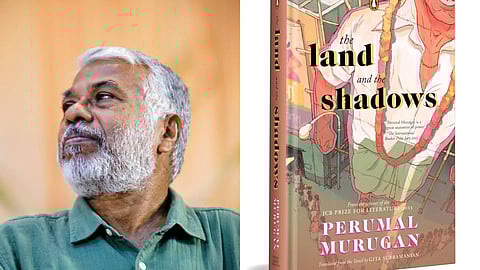


Perumal Murugan is a genre unto himself, a Tamil novelist whose translations have received attention from the International Booker and back home, from the coveted JCB Prize for Literature. His novels have courted controversy, but also deep adoration, ushering the power of the realist tradition of Tamil literature into the anglophone stage.
His latest, The Land And The Shadows is a collection of essays by Murugan, on his relationship with cinema. Growing up selling soda in cinema theaters with his father and brother, he recreates the milieu of late 1970s Karattur on the page—the idiosyncrasies, the tender exchanges, the violent confrontations, sticking posters, sneaking into shows, the logistics of cinema and cinema watching. These essays were published in Tamil as a regular column in Katchi Pizhai Thirai, 2013 onwards, translated in English for the first time.
In a conversation with Murugan, translated and edited for length and clarity, he delves into his changed relationship with the theater, contextualising the relationship between politics and cinema.
In your book you write about your film watching habits as a kid—all the films you watched, the sodas you would help sell, and the bondas that would be sold. What about now?
I still love watching movies, but I mostly watch Tamil movies, and, recently, a lot of Malayalam movies. I have watched very few movies in other languages. At festivals, perhaps, I have watched films by Kurosawa and Satyajit Ray, but comparatively, I mostly watch Tamil films.
Do you go regularly to the cinema theater?
For the past 15 years I have not been going regularly to the theater. Only if we go as a family, we go to the theater.
What kind of films—theatrical or streaming—do you watch with pleasure?
For the last two years, I have been watching a lot of great Malayalam films. Their names are not coming to me… these names just don’t stick to my head. A lot of thrillers were lovely—the Jeethu Joseph ones. Even last year, this film came out about Malaysia…
Eko?
Yes! I watched that with great pleasure. But going to the theater and watching something with joy … I can’t remember.
I ask because your love for cinema comes through in the book. But there is also a sense that with the shuttering of the theaters of your childhood, the changing landscape, your love has diminished. Or have you changed as a person?
I don’t have the time I had as a child. I have a lot of commitments; I travel a lot. I am not in my home for long, and when I am, I have a lot of writing to do. My family, too, takes my time. In between all of this, going to the theater to watch films—I only go if we go as a family.
Besides, it is very costly these days. To go as a family to watch a film, along with dinner, is a ₹2000 affair, even in a small district like Namakkal, where I live. When new films are released, we have to go to these theaters inside malls, where—unlike what I have written about—even to eat, you have to only buy the things they sell, not anything the locals sell. Even if we get mixture or murukku from home, they don’t let us. Ice cream and popcorn are being sold, and that is all that can be eaten. Even the building and structure of the theaters these days, I am not excited by. I am not satisfied by my theatrical experience.
There is a resurgence of stylised violence in Tamil cinema. Associated with that is the English lyrics. You have written about Bharathiyar’s poetry being used in Tamil cinema lyrics—and you write about this with deep joy. What do you make of this latest shift?
There is no one kind of Tamil cinema or Tamil cinema music. Before as well, there were English lyrics in Tamil movies, like Pattikada Pattanama (1972), according to the theme. Alongside, there was Bharathiyar. These two traditions existed side by side. Even now there are lovely lyricists—like Karthik Netha. Even Mari Selvaraj’s movies have lovely music. Though it is true that in the mainstream there are fewer examples. In the smaller films, like Angammal—which is based on my novel—you can see some good work.
I want to ask you about the relationship between politics and cinema, which is often spoken about vis-a-vis Tamil Nadu. You have written about MGR’s popularity in the book, something you are not able to explain, but throw in some theories—for example, how the women feel comforted by the representation of women in his movies. Now, with Vijay coming into politics, this conversation is coming back again. Why is Tamil Nadu unique in the actor-to-politician pipeline?
The Dravida Kazhagam used cinema as a medium to further their politics in the 1950s, with films like Parasakthi (1952). Cinema and politics became enmeshed. Kalaignar (M Karunanidhi, Tamil Nadu’s Chief Minister) made his living by writing for films. Even Shivaji, MGR, SSR, MK Radha—all these actors were involved in Dravidian politics, so that connection continued.
What I feel about the new crop of actors joining politics, is that they are unlike MGR—who before contesting elections and winning, was part of Dravidian politics for 30 years prior, with Anna (CN Annadurai), as an MLA, and then he separated, set up his own party, contested elections, and won, becoming Tamil Nadu’s Chief Minister.
The new actors think that having acted in films, they can now participate in politics in their free time. It is not probable that they will succeed immediately. I have my doubts about Vijay because of his inexperience in politics. MGR or Jayalalithaa or Karunanidhi were not just actors and artists, they were balancing politics and cinema simultaneously. But the actors these days... I don’t think they will have that kind of influence. Having said that, today there is a deep need for an opposition in Tamil Nadu politics, and I think Vijay—even if he doesn’t win today—could take up that position over time. But it depends on his eventual progress in the political arena.
I want to ask you about caste in the theater. You have a lovely essay about how different theater owners from different castes butt heads as they set up shop. What about the presence of caste inside the theater? MSS Pandian had written about the anxiety that theatrical spaces had for the caste elites. What was your experience?
We don’t have the concept of public spaces. Spaces are inscribed by caste—even in villages today, temples are not for every caste. Theaters became that one public space for the first time—that was important. If you pay for the ticket, you can sit wherever you want. That changed everything. Before this, there was the train that allowed mixing of castes. But as a public space, the theater did that. If you are standing in a queue for a film ticket, you cannot worry about who is standing behind and ahead of you—all you care about is that you get a ticket. If you think about caste when lining up, you won’t get a ticket.
My favourite essay was about the toilet, where the theater owner kept children armed with sticks to prevent people from defecating in the open fields, making them use the theater’s toilet, instead. The theater was reshaping public attitudes. I wanted to ask you about the role of the theaters today in changing norms.
See, now after television and now social media, fewer people are going to theaters, especially women. Before, if a film came out, to celebrate it we would all go out. That is not the case today. Maybe the young people can celebrate there. But it is no longer a space for everyone to come together.
In your last few essays, you keep arguing for realism—for “authenticity”. Your fiction writing also practices this strain of realism. Why is realism important? The stories we grew up listening to—Ramayana, Mahabharata, Silapadikaram—are full of fantasy. But your critique of films—accents are wrong, locations are unconvincing—are about realism. Why do you prefer the authentic over the cinematic?
A modern life, with modern literature and cinema, can only be expressed through realism. Before, we used to watch and read stories of heroes. Now, we hear our own stories. This is that time. There was a time when people would say actors need to be beautiful, not dark. All that broke. The people coming to watch and enjoy your films are dark-skinned. So when they see a dark hero, they see themselves in the hero. So, our day-to-day life is being represented. That is the important trend. It is the nature of our times, to see our lives being copied in our arts.