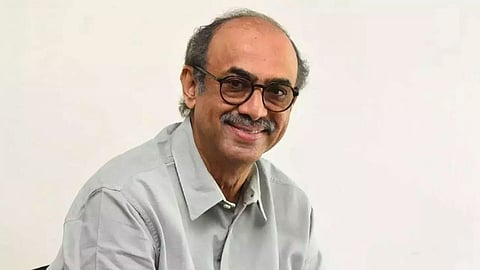


Amazon Prime Video’s Cheekatilo marks an interesting first for veteran Telugu film producer Suresh Babu. The upcoming film marks the first venture he has produced in the streaming space, an experience that he calls a learning curve. “Working with Amazon and seeing how things are done in a corporate culture was new. I wanted to see how this whole process works, because it's these large corporations that are making the volume of content today for the world, and that's the way it is going to be. There are independent producers, but within the distribution platform. I wanted to see if we can fit into this path,” he tells The Hollywood Reporter India in an interview.
These streaming giants have also changed the risk-taking abilities of producers, Babu notes. “If an OTT guy doesn't buy your movie, you don't know what to do. We were all given very handsome amounts from the OTT [platforms] earlier. So the entire cost of production rose beyond its natural level. But now, there's a pullback from them.”
Vishwadev Rachakonda, who plays a significant role in Cheekatilo alongside Sobhita Dhulipala, says working with established production houses makes an actor’s life easier.
“When you pick a subject, and when there are the right makers attached to it, like Suresh sir or Amazon Prime, you know for a fact that the product will be delivered in the best possible manner. There could be restrictions on the genre. But when these makers are involved, you can give your best, and you can be at peace that your work will be presented. There are many factors behind a film, such as picking the right release day, press interactions and so on. These micro decisions have a huge impact on how your work is presented.”
Rachakonda was last seen in 35 Chinna Katha Kaadu (2025), a slice-of-life drama co-starring Nivetha Thomas. “Ever since my last film, I’ve had some really good opportunities. If you can do your role well, I’m sure there’s more work waiting for you.”
Babu, who has been producing films ever since Venkatesh’s hit action film Bobbili Raja in 1990, discerns a scale-up in storytelling innovations, but points out a gap in growth. “We have not grown as much as we could have, or we should have. We really need to up our standards quite a bit. That search for excellence is there, but it's not at the same pace as other industrie. We need to really ramp it up, because we are capable of making global cinema,” he says. “When India as a country can send a rocket to the moon, and we do it so well, why are we not there?”
The producer also weighs in on the theatre ticket fare hikes (fares of tickets are hiked for certain big star films in various industries) prevalent in the Telugu film industry. “It's basically very controversial. Now, there are some states like Tamil Nadu, where they're fixed, and they said, we don't want a ticket hike. We want it [to be fixed] because we think that people should make [cinema] a habit, and it should not become too expensive. That’s one point of view. Now, the other point of view is we have lost a certain audience,” he says.
But even if theatres cater only to wealthier audiences, there’s still a gap that needs to be filled, he notes. “There are enough people in India who can pay high prices for high popcorn. But actually, what we really need is a mix of everything, which we are losing; the multiplex culture brought in a lot of people who are not watching films in theaters.”
As the multiplexes came in, a lot of middle and low-level cinemas had to shut down, he says. “Earlier, films were available to watch for various ticket prices between ₹20 rupees and ₹50 rupees, and those auditoriums always used to be full. Now, that's gone. So, even if I want the basic ticket, it's like ₹150 or ₹250. So the audience is just [foregoing that habit]. And as people forego it, they start getting addicted to another habit of watching it on the mobile. So as one starts watching [movies on mobile], they slowly start dislocating themselves to cinema theatres,” he says, adding that this will continue to be an ongoing conversation.