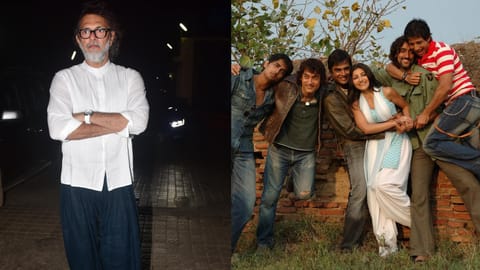


If, by some miracle, the characters in Rang De Basanti (2006) had survived their fatal fate, where would they be today? Writer-director Rakeysh Omprakash Mehra has some theories. “DJ (Aamir Khan), being from Punjab, would’ve joined the army because that’s the tradition in their families,” he says. “Aslam (Kunal Kapoor) would be an IAS or IPS officer. He was the smartest. Sonia (Soha Ali Khan) would be a journalist. Lakshman (Atul Kulkarni) would go into politics. Karan (Siddharth Suryanarayan), after serving the sentence for killing his father, would get into the social sector. Sukhi (Sharman Joshi)… well, I don’t know. He is the hardest one to say.”
The pang we feel for these imagined lives explains the enduring pull of Rang De Basanti. Mehra’s film, a brash, vivid work released 20 years ago on January 26, followed five Delhi University students who take a drastic step after their friend dies in an air crash. It is considered a landmark of mainstream filmmaking, a poem of youthful dissent that reimagined patriotism for a cynical age. The film gave a language (and a soundtrack) to protest culture in 21st century India. Its cultural imprint has survived two decades of transformative changes in Indian politics and society. Fittingly for a film that put the past in conversation with the present, its relevance has only grown in a supine Hindi cinema, beset by censorship, propaganda and moral bankruptcy on an astonishing scale.
On Rang De's 20th anniversary, Mehra spoke to THR India about the film’s galvanising power, how key scenes and characters came to be, and his measured hopes for Hindi films and the nation at large.
The first hour of 'Rang De Basanti' is a lovely, goofy ode to campus life in Delhi. It feels like the most personal and nostalgic stretch for you.
I have fond memories of my time at Shri Ram College of Commerce (SRCC) in Delhi University in the late 80s. I was a swimmer and a cricketer, and I spent a lot of time in the nets with would-be legends of Indian cricket. Politically, we were pretty aware and active. We would peacefully protest against the college and university authorities for the rights of students. We would have fierce ideological debates, then eat from the same plate in the canteen. Sometimes there would be outside elements trying to create violence, but we were not known for that.
Two events from that time shook me badly. The first was the anti-Mandal Commission protests, which began peacefully but then turned ugly and were met with heavy state repression. The other was the 1989 Tiananmen Square massacre in Beijing, China. There was the famous visual of a solitary man standing against a row of tanks. It’s one of the defining images of the 20th century, and it made its way in a translated fashion into Rang De Basanti.
The film was originally scheduled to release a week earlier on January 19, but ran into censor hurdles.
Because we were talking about a defence corruption, the CBFC asked us to get an NOC (No Objection Certificate) from the Defence Ministry. When we tried to get that, we were stonewalled by the bureaucrats. I was advised to remove references to the MiG aircraft and not call the Defence Minister by his post. Obviously, we would not succumb to that. It would defeat the whole idea of making the film. We were talking about mothers who lost their sons due to faulty aircraft. In fact, there was a documentary on NDTV called Coffins in Tricolour, which spoke about the same issue. We had absolutely fear in depicting it.
…the film was finally seen by then Defence Minister Mr. Pranab Mukherjee and the Chiefs of the Air Force, Army and Navy. They cleared it without any issue because they understood our intentions.
One of the most touching characters in the film is Laxman (Atul Kulkarni), a hateful and bigoted soul who undergoes a change of heart. How did he come about?
I was feeling certain shifts in how people were thinking and where the country was heading. I could smell it in the air. That’s how the character of Lakshman Pandey was invented. He is intolerant towards Muslims at the start of the film. The youth can get swayed by ideologies that feel like empowerment, but it’s entitlement. It’s not empowerment. In Lakshman’s case, by playing the character of Ram Prasad Bismil, a revolutionary fighter and poet, something changes in him. He ends up saying sorry to Aslam and they become best friends. They even die together in the film. The juxtaposition with the historical characters felt perfect for their relationship.
There’s a scene where DJ tells Sue (Alice Patten) that he never wants to leave the campus. He says that in the outer world, his life will have no meaning. It’s one of those moments where the film glances ahead to what awaits.
All the scenes in the film were written with heart and intuition. DJ is closely modelled on a close friend of mine who never wanted to leave the university. He did his B Com, his M Com, his doctorate… but basically, he never wanted to leave. There are many such characters who are the coolest people on campus, but when you meet them after 10 or 15 years, they have become irrelevant. So I gave that fear to DJ. He is afraid to step outside into the real world because he fears becoming an unknown. He fears he’d lose his spirit, trying to survive and make a living like the rest of us. It turned out to be a simple yet beautiful scene.
The film’s ideas and images were echoed during the protests for the verdict in the Jessica Lal murder case and other instances. It has been widely studied in Western and Indian academia for its social impact.
So the line is blurred. We borrowed from real life and then real life borrowed from us. The candlelight vigil became a nationwide idiom for protesting peacefully all over the country. Earlier, we never used to have that. The film also resonated internationally. I remember I was invited to Ohio and Michigan Universities in the American Midwest. The students there had created 10 small plays out of the film, talking about discrimination and their own problems. A choir of 165 people sang the title song. It was a tearful moment for me. The film had this umbilical cord with the youth that went beyond India.
It’s generally held that a film like 'Rang De Basanti' cannot be made in the current sociopolitical environment. How does that make you feel?
I really don't get it. The times do change, and they keep on changing. Even this time shall pass. One cannot always react in frustration and angst. It is an imperative of art and artists to tell their stories under any circumstance. Sociopolitical cinema of this kind will always have an important role to play. Even if 10 per cent of it is anti-establishment, it can still be made. When we look back at this period, it wouldn’t feel like a big deal. I’ve recently worked out a script which I’ll be shooting next. It’s about the role of social media. I also want to make a film on farmer suicides, and the impact it will have on our lives. So I am doing my thing and not holding back.
Do you think the idea of dissent has been delegitimised to a point where it’s become impossible to speak one’s mind? AR Rahman recently had to apologise after talking about his experiences in the industry.
I cannot speak for anyone else. I have friends in the establishment who love the work I have been doing. I feel that, more than filmmakers, it is the journalism of this country which needs to wake up. That’s where we find our true heroes. Journalism is the fourth pillar of our democracy, not the film industry. The film industry can be a soft target. It has been used and misused down the ages. A lot of folks from the industry have used their popularity to enter politics without serving the nation being at the core of it. I can only think of Sunil Dutt saab who did it for the right reason. But for the country to be on the right track, it’s the journalists who need to course-correct. I really want to talk to them and ask, brother, what’s going on?