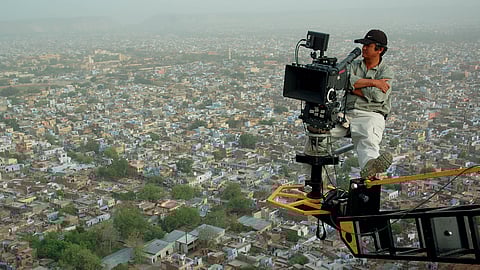


I had worked with Rakeysh Omprakash Mehra on a lot of ad films before Rang De Basanti. When he called me for this project, I was immediately intrigued. What struck me was the concept of the past and present being enacted by the same actors. That was an unusual, exciting challenge — how do you visually distinguish two timelines that are connected, yet separate?
Rakeysh and I spent long hours talking about this. The first decision was to give the past a very distinct look. The obvious thing would have been to go sepia, but I didn’t want that. I come from Kalimpong — my father ran a photo studio there — and I grew up in a darkroom, processing black-and-white photos. Those old photographs often turned yellow with age, and I thought, “that’s the look.” I told my digital intermediate colourist, Ken Metzker, that I wanted it to feel like an old hand-painted photograph — black and white, but with the faces delicately tinted. It shouldn’t look naturalistic, but almost like watercolour on monochrome.
The other big choice was lensing. In the past, I shot tighter, more solitary frames. Single close-ups, a telephoto intimacy. The present, on the other hand, was wide, vibrant, full of bodies in the frame. You almost never see an isolated close-up of a character in the “now” portions. It was always a group, always together, to capture their camaraderie. And then, as the story gets more serious, as the group’s idealism hardens into action, the present-day images slowly start to resemble the past — the shots become tighter, more solitary. The past and present literally start to bleed into each other, visually.
Colour-wise, I went the other way, completely opposite from the past. If the past was limited and monochromatic, the present was vibrant, unrestrained. I didn’t restrict myself to a specific palette; I let the frames burst with colour. The energy of youth is in those frames not just because of colour, but because of the way they were composed — groups running, laughing, living. The camera was with them, not separate from them.
One of the most challenging sequences for me was the All India Radio climax because it moves from night to dawn to day, all in one flow. We shot that entirely in a studio, which meant we had to create those transitions with light alone. Later, a fellow cinematographer (I won’t name him) told me he thought I’d made a mistake, that there was a continuity error because it looked like we’d lost the light between shots. I had to tell him, “No, that was all intentional. And by the way, it was shot indoors.” He couldn’t believe it. To me, that was the best compliment I could have received that it felt so real someone assumed nature had done the job for me.
The candle march was another scene where light was crucial. We shot it at dawn, which meant we had to be ready with everything in advance. It took a while to set up the equipment, manage the crew, prepare the actors, because the window of that soft light is so short. Some British assistant directors had come in for the film, and they were stunned by the chaos of it — the shouting, the rush to get it done. Later, one of them came up to me and said, “This could never have happened in the UK.” He meant it as a compliment. Sometimes you need that chaos to catch the magic in time.
Delhi’s heat was relentless. I remember one day, it was unbearably hot, and I saw Rakeysh sitting cross-legged on the burning floor. I don’t know if he was trying to encourage me or just showing solidarity, but it made me buck up and keep going. I come from the hills, so I am not used to this kind of heat, but I was too close to the film to give up.
There are other moments I’m proud of, like the hanging scene that everyone thought had been shot outdoors at dawn. It wasn’t. It was a studio floor, lit to feel like the early morning. Those are the quiet wins of cinematography — when nobody notices that you’ve tricked them.
Rang De Basanti was not a film that we rushed through. We shot for over 100 days. If light was going, we waited, or we shot something else. Everyone was committed to giving the film time. It was a film made with care, and I think you can see that in the images.
To read more exclusive stories from The Hollywood Reporter India's November 2025 print issue, pick up a copy of the magazine from your nearest book store or newspaper stand.
To buy the digital issue of the magazine, please click here.