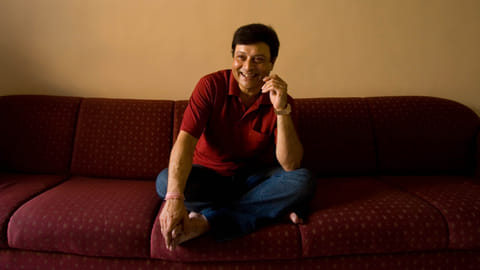

Actor Sachin Pilgaonkar was only about 10 years old when he was cast as Kishan in the Meena Kumari and Dharmendra-starrer Majhli Didi. The 1967 Hindi film, based on a story by early-20th-century novelist Sarat Chandra Chattopadhyay, was not Pilgaonkar’s first — but his first day on set would make it one of his most unforgettable.
"When I signed the film, I barely had any idea of the director, Hrishi da’s [Hrishikesh Mukherjee] prowess. I don’t recollect having watched any of Meena ji’s work either before I met her on set,” says Pilgaonkar. In Majhli Didi, he was playing an orphan whose paradisal bond with his middle sister, portrayed by Kumari, was the central arc of the film. “After a few days of work, Meena ji called me aside and asked me what my mother tongue is. What language do I speak at home?” says Pilgaonkar.

A quintessential Maharashtrian boy who would generally speak Marathi outside of his shifts on Bollywood sets, he recollects, “She (Kumari) then asked me as to when I speak Hindustani. I didn’t quite get what that meant. She simplified it and asked about Hindi. Outside of the studios, without prescribed dialogues, I never spoke Hindi — I admitted.”
Kumari asked Pilgaonkar to bring his parents over to meet her the next day for a chat. “Just like a call from the principal’s office, it got me quite nervous. I told my parents, and got them along the next day.”
To Pilgaonkar’s parents, Kumari spoke about his potential. “She told them how she believed I was meant for bigger things — bigger dreams than being a child actor. She gently let them know, when I spoke Hindustani, a Marathiness tailed behind — it was clear that Hindi wasn’t the language I felt at home in.”
Pilgaonkar’s father suggested a moulvi — a tutor to teach the child “Urdu zabaan”. Kumari promised to look for one, and teach Pilgaonkar the language herself in the meantime. School timings and shoot schedules were discussed, and four-day-a-week classes were chalked up. Pilgaonkar took Urdu lessons from Kumari for about two-and-a-half years. She would arrange a pick-up from his house in Mumbai’s Shivaji Park and take him to her own residence in Juhu for two hours each day.
“Air-conditioned cars weren’t a thing back then,” says Pilgaonkar, “but a long limousine-esque vehicle would come. I would sit at the back, roll down the windows, and revel in the city air brushing across my face throughout the lingering ride.” Once at Kumari’s bungalow in Janki Kutir, Pilgaonkar would not just jump into Urdu lessons. The first hour would be spent playing table tennis.
“It was her favourite sport, and she had a fancy ping-pong table. I had a great time getting into the game, too.” And right after, Kumari would start with the boy on his spoken Urdu. But Pilgaonkar’s heart was taken by table tennis more than Urdu lessons. Away from the constant limelight and ceaseless stardom, Kumari had become Pilgaonkar’s “Meena Aapa”.
However, his requests to play were firmly denied and eventually abandoned. “She had reminded me why I was coming over — not to play table tennis, but to learn a language.” Hour-long classes taught Pilgaonkar how to differentiate his /k/, from the more aspirated /kh/, and enunciate his /chh/ (a sound between “ch” and “sh”). He was introduced to the classic repertoire of Urdu literature — all orally.
Kumari never taught Pilgaonkar to read or write the language. “She wanted me to focus on the spoken bits of Urdu for my acting career. Meena Aapa once said, ‘When you speak the language, people on the streets should turn around and check out who is speaking it.’ She wanted me to be that good,” Pilgaonkar says in Urdu expressions both familiar and novel.
“I asked her often, if this would truly benefit me. She would always say that if her lessons worked and I put in the effort, I would one day remember her as my Aapa, the one who left something with me.” For Pilgaonkar, not a day goes by without thinking about his Meena Kumari. “She gave me something that no one can rob me of. It goes with me when I go.”
Kumari passed away in 1972, and by the beginning of the ‘70s, she had stopped accepting visitors at home. “I was acting on stage, at Ravindra Natya Mandir, when the news of her passing reached me — I remember clearly. Before my last appearance in the play, I heard murmurs backstage. It shook me completely. We had a beautiful relationship; she had always loved and respected me as her younger brother.”
Pilgaonkar, who still had a scene to perform in front of a live audience, was nonplussed. “Meena Aapa’s words are all I remembered — through the ups and downs of life, you must keep doing what matters. And that’s what I did.” His father was waiting for him in the wings as the play concluded. After a hug and some tears, Pilgaonkar travelled to Kumari’s latest address on Carter Road and saw her for the very last time.
Encompassing Pilgaonkar’s career and personal life, Urdu became a force majeure. Delving deep into the history and usage, he discovered how intrinsic Urdu was to India and it’s socio-political becoming. In his own words, the language drove him insane in the best ways and rendered him a poet. “Urdu always makes poets — some good, and some like me,” he says with a laugh.
Even today, Pilgaonkar reads and writes his shers and shayaris under the pen name “Shafaq,” albeit in Devanagari script. In a Marathi musical drama titled Katyar Kaljat Ghusali (2015), Pilgaonkar played a Muslim classical singer from Bareilly, one who had arrived in Maharashtra with no prior exposure to Marathi.
Without an Urdu dialogue writer on the crew, Pilgaonkar took it upon himself to translate his part from Hindi. He performed the entire part in Urdu, with some help from his friend, Tehseen Munawar, and received critical acclaim and awards. “I had always wondered why Urdu had come into my life and stayed on — and that one film gave me my answer.”
To read more exclusive stories from The Hollywood Reporter India's August 2025 print issue, pick up a copy of the magazine from your nearest book store or newspaper stand.
To buy the digital issue of the magazine, please click here.