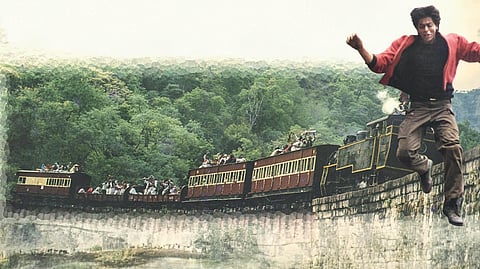


Wherever I go — Japan, London, Los Angeles — people ask me about “Chaiyya Chaiyya”. Sometimes they don’t remember the name of the film, but they remember that song. It has somehow travelled beyond language, beyond borders. So I thought, maybe it’s time I talked about it.
Mani Ratnam had wanted to make Dil Se.. for a long time. Before the film, I had shot a 16mm documentary around Old and New Delhi. It was very minimal with available light — handheld, raw. Mani saw it and said, “Let’s shoot the Delhi portions like this. Real, stripped down, rooted.” And that set the tone.
With “Chaiyya Chaiyya”, we knew we were attempting something unusual. We travelled a lot by train just to find out where we could shoot the song. Mani and I kept asking ourselves: Why are we doing this on a train? Once we found the why — because we wanted to capture the nostalgic feeling of a first train journey, we wanted to capture the madness — everything else followed. We shot a part of the song on top of a moving train, because no first train journey is complete without sitting on top. We finally landed on this stretch in the Nilgiri mountains, with the Ooty train. Mani and I had faced a lot of trouble when we were shooting the train sequence in Iruvar (1997), so we knew the hurdles of doing this.
But it had the right texture of being misty and dramatic. It was perfect.
This was ’97 or ’98. We didn’t have the kind of gear we have now. I had one light, which I only used inside the tunnel. The rest was all natural light. No generators, no rigs. Just the sun, the train, and us.
Shah Rukh Khan was incredibly busy, but he was fully committed. Farah Khan choreographed the song in just about four days. Malaika Arora danced barefoot on the train — I think this was one of her first projects. What you see in the song is exactly what we shot. No camera tricks.
The dancers were in harnesses. But Shah Rukh and Malaika weren’t. So, they just trusted their balance.
People don’t realise: the camera was shaking constantly. Of course it was — it was on a moving train. But I locked it down so that the vibrations became part of the movement. The camera moved with the motion of the train and felt organic.
We shot it in two days flat. We had to. You can’t spend too long dancing on a train. After we wrapped, we headed straight to a train station to shoot the next scene. It was complicated but it was great fun, actually.
One of my favourite shots was done tracking the train with a jeep. We were following Shah Rukh and Malaika as they danced — very tricky to pull off, but when we saw the rushes, it just worked.
I remember being at the Independent Spirit Awards for The Terrorist, and the team behind Dancer in the Dark told me they
were inspired by “Chaiyya Chaiyya” for their train sequence. In Japan, the Society of Cinematographers sang the song to me — in Japanese.
So yes, the song really did travel. It crossed language barriers. The moment you hear the beat, you know. A.R. Rahman’s music, Shah Rukh’s energy come together and there’s electricity in it. In Dil Se.., each song has its own journey, and they have a different look, and a different approach. Like in “Satrangi Re”, one day we were shooting in snow. The next, we were travelling across states. We were discovering the film as we shot it. There was no time to lock everything in advance, so we found locations on the go. It made the process feel like a journey for us too.
To read more exclusive stories from The Hollywood Reporter India's May-June 2025 print issue, pick up a copy of the magazine from your nearest book store or newspaper stand.
To buy the digital issue of the magazine, please click here.