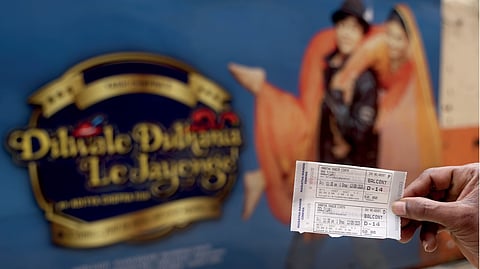

It was the usual morning scene at any standalone theatre in Mumbai. People ambling about, short queues for tickets, the staff still cleaning the aftermath of the previous day and passers-by dropping in to check new posters. What was unusual, though, was that almost everyone present was there for a film that released in 1995.
Dilwale Dulhania Le Jayenge (DDLJ) starring Shah Rukh Khan and Kajol will complete its 30th year on October 20 and has been running for as many years at Mumbai’s Maratha Mandir theatre in Byculla. The fans were nonchalant. For some of them, watching this film here has become a part of life, an ordinary act like going for a weekly haircut or the occasional pav bhaji treat. They do not think of how this could be a world record — it holds the title for the longest-running film in Indian cinema history, with a continuous screening at Maratha Mandir since October 1995, having surpassed over 1,500 weeks by now, eclipsing Sholay’s five-year run at another Mumbai theatre — or the cultural imprint DDLJ has left on society.

Most do not care for its cinematic merits either. “It just makes me happy,” says Somnath Shinde from Nashik, who works as a driver. When the burden of work seems too much, he tells his boss that he will be off for a few hours, buys a regular ₹50 ticket and goes to watch DDLJ. The film now is like the retelling of an epic for him. He knows the story, every scene and every dialogue by heart. “I sometimes tell the lines before the actors,” he says.
Shinde is 52 years old; like many fans of DDLJ, he was in his early 20s when it released. “The scenes of foreign locations in Switzerland and London made me want to go abroad,” he says. The faded velvet seats of Maratha Mandir with its high ceilings, wood finish and lingering scent of popcorn and snacks have become his quiet escape. Built in the late 1950s, it’s a place where time seems to loop, like the film itself.
The walls outside are adorned with fading posters and some new releases. There are more characters like Shinde, many drawn back by the pull of nostalgia, seeking echoes of their own past in the on-screen romance of Raj and Simran. One is technology professional Souham Dash, who was in his mother’s lap when he watched the film for the first time. Now in his 30s, Dash recalls that fuzzy memory with a smile. “I don’t remember much from that day, but the music stayed with me, like a lullaby from my childhood,” he says. He watched it many times on TV later, during lazy afternoons at home, and in 2022, he finally made the pilgrimage to Maratha Mandir.
The experience hit differently there: the big screen, the shared laughter, cheering and whistles in the dark hall. Dash credits the film for shaping his own love story. He married his best friend, inspired by DDLJ’s theme of friendship blooming into romance. “Raj and Simran start as friends, teasing each other across Europe. It showed me that true love builds on trust and fun,” he says.
At ₹50 a ticket, it’s easy for Shinde or the 21-year-old management student, Rakesh Yadav, who travels all the way from Bhandup (east of Mumbai) to catch a show now and then. The journey takes over an hour on crowded local trains, but Yadav doesn’t mind. “I can’t afford OTT subscriptions with all the fees,” he admits. “Here, for ₹50, I get three hours of fun.”
The theatre, with its grand arched entrance facing the bustling Mumbai Central, stands as a sentinel of old Mumbai charm amid the skyscrapers now slowly transforming its look. It wears its association with the cult of DDLJ proudly with its different posters plastered and framed.
Here, fans like Priya Sharma find their way back to family stories and personal dreams, even from afar. Sharma, a 28-year-old pharmacist now living in Ottawa, Canada, but born and raised in Mumbai, carries that same nostalgia. “I’ve honestly lost count of how many times I’ve seen DDLJ,” she says.
Sharma remembers it playing on TV regularly and watching it with her family was one of her core childhood memories. She’d picture herself as Simran, travelling solo across Europe. “And of course, I had a huge crush on Shah Rukh Khan back then,” she says. Sharma’s always loved romantic films and feels DDLJ is what really set the tone for that.
Growing up in Mumbai, she’d always heard about Maratha Mandir, so when she finally went there in 2021 with a friend, she was thrilled. “Wow, the energy inside was something else,” she says. “People from different corners of the city were just soaking it all in together. The vibe in the theatre gave us goosebumps, like people cheering, laughing and whistling at Amrish Puri’s dialogues. It felt less like watching a film and more like being part of a celebration.”
Maratha Mandir’s manager, Manoj Pandey, has been around for over 15 years. But the magic pull of this film still amazes him. “Some people even book the whole gallery for a personal show,” he says. “They want DDLJ as a part of their special days.” “We’ve had fans from abroad fly in just for this. One group from the US booked the upper deck last year for a reunion. They sang along to every song.” Pandey remembers the outcry in 2015 when the theatre briefly considered pulling the film after 20 years. Fans protested outside, petitions flooded in, and the movie returned, stronger.
Before that, during a single-screen theatre strike in 2011, the producer of the film, Yash Chopra, personally requested the management of the theatre to find a way to not break the continuity of the screening. And the show went on. “It’s more than the money now,” he says. “The ₹50 ticket keeps it accessible, and people come for different reasons but most often for the memories.”
On days like the quiet Friday morning when I visited Maratha Mandir, like clockwork, the staff were getting the theatre ready for the 11:30 am matinee, the only show DDLJ gets. Yet, it drew a crowd. There were students skipping class, workers on a break, young couples and groups of boys. For many of them, as cinema watching in India shifts towards much more expensive multiplexes and the landscape of it moving ahead, without heeding to them, watching DDLJ again is like a quiet act of protest.
“We don’t have the new facilities like watching films on our mobiles. And the films now [he points at the poster of the new release, Baaghi 4] don’t have that family feeling,” Shinde says, before he queues up for the day’s show.
To read more exclusive stories from The Hollywood Reporter India's October 2025 print issue, pick up a copy of the magazine from your nearest book store or newspaper stand.
To buy the digital issue of the magazine, please click here.