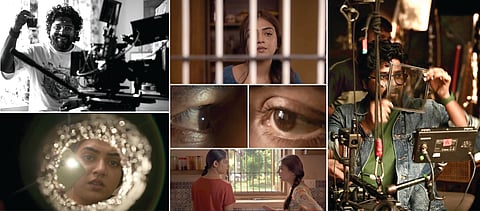


For a cinematographer fresh off the success of two hits in 2024 – Thalavan and Sookshmadarshini —Sharan speaks more like a screenplay writer. When he starts to talk about his journey in cinema, he takes us back to the answer sheet that got him suspended in his first year of college. He had been obsessed with Mammootty’s just-released Big B(2007) and when a tough question stumped him, he answered by writing the entire storyline of the Amal Neerad film.
Big B was shot by Sameer Thahir, who would later become Sharan’s guru. “And to think I would be trusted to shoot Sookshmadarshini, a film produced by my gurus, Sameerikka and Shyjukka (Shyju Khalid), is real validation for the 18-year-old me, transformed by the visuals of Big B.”
As Sookshmadarshini continues to find love on Disney+ Hotstar, THR India speaks to the DP about the hit Malayalam movie's many creative decisions.
Edited excerpts:
Some of the great cinematographers of the Malayalam industry, including Shyju Khalid and Sameer Thahir, are famous for being extremely choosy. You too seem to have followed in their path by doing just a film or two each year…
(Laughs) I too have become a bit like them. My idea is to choose from the sensible projects coming my way and to work in films I feel I can contribute to in a healthy way. I must feel like I’m learning something new.
We often hear of actors and even directors getting stereotyped. Does that happen to cinematographers?
Yes, it does. After Thalavan, a lot of scripts that came my way were all thrillers. Earlier, when Ambili released, I was approached for two to three road movies. But I didn’t want to repeat myself.
The producers of Sookshmadarshini are both cinematographers; how different are the conversations when a project begins with people who have worked in the same technical department as you?
Right from the start, we knew Sookshmadarshini was not going to be an easy shoot. There are elements in the script that are easy to understand when you read, but hard to translate visually. For example, a lot of scenes need to be communicated from one window to another, as Nazirya’s character Priyadarshini observes her new neighbour. The setup for these scenes is usually Priyadarshini looking through her kitchen window into various rooms in Manuel’s (Basil Joseph) house . Now you can repeat these two or three times, but after that the visuals can become boring. We had to find ways to break that.
How did you do that?
To begin with, we wanted it to first look like a feel-good film. We wanted to slowly build it up into a thriller, gradually as the mood changes. The colour palette too was decided based on this.
Could you give me an example?
The colour red can be seen throughout the film in almost every scene. In the earlier, happier portions, the reds are subtle, like the colour of a costume or as a part of the background. As the film becomes tense, we slowly dial it up to brighter shades of red. Like in that bathroom sequence in the second half with Manuel and Dr.John (Siddharth Bharathan), almost like we’re conveying that something very dangerous is going to happen.
Despite this transition, the film doesn’t look too unrealistic…
That was another challenge. When you’re trying to play with such ideas, it is very easy for the entire film to look artificial. We wanted to avoid that, which is why we ended up shooting in a real housing colony. After we read the script, we started looking around for a place that would accommodate all these scenes. That’s why you do not get that “set-like” feeling.
Even though most scenes are set indoors, and in all practicality, two rooms.
Yes. Instead of building entire sets, we built a couple of smaller parts, mainly to recreate the windows. Geographically, we’re trying to cover a big space so it’s important that we got the eye-line just right because Priyadarshini is reacting to a lot of events from her vantage point. To maintain that, we built sets of windows in different scales and sizes.
What were some of the tricks to break the monotony of a character staring into another house?
We thought of windows as a visual metaphor. This thought freed us to give the film an additional visual layer. Like you said, it is a film about a curious person observing her neighbour, so we wanted to play on the idea of a pair of eyes being everywhere. For this, even in simpler scenes, we’d shoot from inside the car window or place the camera inside the refrigerator. This creates the visual element of a microscope, like in the film’s title.
What about the last 15 minutes? Did you feel you could go all out for the big ending?
Yes. MC (the film’s director) and I felt we could stylise the final payoff to make it bigger than the rest of the film. This was also the only time in which we’ve used low-angle shots for Nazriya. For Basil, we tried all sorts of angles because he’s a mysterious character.
How do you convey a character being mysterious with the camera?
For Priyadarshini, her home and her neighbourhood are a happy place and that’s how we’ve shown it. But Basil’s character of Manuel is different. From the outside, Manuel’s house looks just as happy and neat as Priyadarshini’s house. But it’s when you see the indoors that you get an idea of who Manuel is.
Just like his house, Manuel looks very decent on the outside... but on the inside, he can be unpleasant and disorienting. This was also reflected even in our lensing decisions.
Could you explain this further?
When we show Manuel or his weirdo cousin Dr. John from inside the house, we’ve tried to use a lot of wide-angle lenses. The wide angles make their faces fill the whole frame, giving you an enlarged image that make them look like a caricature. But when we see them outside of their house, the lensing is softer and gentle, because they must keep the veneer of decency.
Even with critics and viewers, do you think they misunderstand the meaning of good cinematography? Isn’t good cinematography more than many beautiful looking frames?
True. A lot of people think beauty is cinematography. They feel cinematography is good only when they see a lot of extreme wide shots of mountains and lakes. But those shots need to also have life, especially when we’re shooting movement. There’s no harm in using beautiful shots, but that must balance with what the script is demanding. In that sense, a beautiful shot is one that gets you hooked onto the emotion that the scene is trying to convey.
What is a film you’d say has great cinematography?
I love Mani Ratnam’s Guru (2006), shot by Rajiv Menon. It’s a film that gets the blend just right without ever taking you away from the story. I have felt the same in the works of Santosh Sivan and Emmanuel Lubezki too. The beauty of their camerawork is something you feel. You do not have to hit pause or take a screenshot to notice the beauty. That, I feel, is the magic.