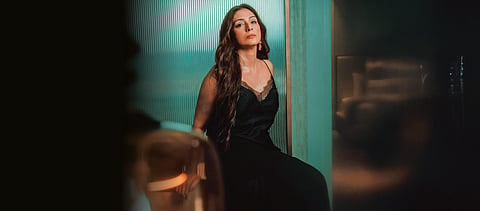


Since the world reopened after the COVID-19 pandemic, Tabu has been on a streak, delivering back-to-back films across a variety of genres: Bhool Bhulaiyaa 2 (2022), Drishyam 2 (2022), Kuttey (2023), Bholaa (2023), Khufiya (2023), Crew (2024), and Auron Mein Kahan Dum Tha (2024).
To cap off 2024, she took on a pivotal international role in HBO’s Dune: Prophecy, playing Sister Francesca, a character who arrives in the penultimate episode and disrupts the balance of power in the capital.
Draw parallels, and she’s quick to puncture blanket statements about her artistry or stardom, insisting that she has never tried to be anything other than herself. “I can’t bring extra parts with me or leave parts of myself behind,” she says. It’s a philosophy that informs her choices, grounding her in an industry obsessed with reinvention. Tabu’s strength lies in her consistency, not in resisting change, but in being wholly, authentically herself through it all.
In a conversation with The Hollywood Reporter India, the actor spoke about stardom, her inherited flair for languages, and the sacrifices made.
Edited excerpts from the conversation:
THR: You’re a rare brand of actor in this country, where your stardom rests entirely on your artistry. The commercial or critical reception of your films doesn’t change how people perceive you as an actor. How have you managed that? Have you not had the pressure to conform to traditions and norms?
Tabu: No, never. What haven’t I conformed to?
THR: When it was the era of the “pious heroine” in the early 2000s, you weren’t the pious heroine. When there was an obsession with youth, you weren’t playing characters younger than your actual age. It feels like a rebellion. But doesn’t that come with a flip side?
Tabu: You know, now that you’re saying it, I’m also looking at it like that. I’m able to look at myself and my journey through this lens of not conforming to anything that was happening. But it wasn’t an act of rebellion.
Maybe it is such a deep, intrinsic part of my DNA that I’m not even conscious of it. My actions, decisions, and conduct have been in a way that seemed non-conforming because I was genuinely not conforming. Not that I was doing it to tell people, “I don’t want to conform.” I have nothing against that. It’s not even a big deal for me in my head. But in the context of the film industry, it feels like a big deal because the stakes are always so high, especially for an actress’s career.
This is very individual and personal. This is what I believe in. I don’t think there’s only one way or only one person’s way to do it. Don’t tell me that, because that’s not how I think. Essentially, your journey, conduct, image, or reputation is a reflection of how you think. If I’ve led my life or career in a certain way till now, it means that this is who I am. These are the micro-parts of the macro-organism that is me. Everything has come out of how I think.
I’m not saying everyone thinks or feels this way, but for me, everything that promises me a new experience is always exciting.
THR: You’ve worked on films in so many different languages. Do you have a knack for languages? Does it come naturally to you, or is it something you have to put a lot of effort into?
Tabu: Last night, I was telling my mom — just generally talking about how we inherit things from parents and all — and I said, “Mummy, I’m so lucky that I have a flair for languages. I don’t know from where it comes in the family, but whoever is responsible for giving me this DNA of being good with languages, I’m really thankful [to them] because it has really, really helped me so much in my career and in my personal development.”
I love learning languages. I love speaking in different languages. I like to hear myself in different languages. You really feel like a different person when you speak a new language. I find that really interesting — how we emote in different languages and how the rhythm of every language is different.
My Telugu was very good growing up because we had to study Telugu as our second language [in school] since I studied in Hyderabad. I had friends with whom I spoke only in Telugu, and my Telugu became good. I started speaking Marathi when I came to Bombay; my aunt is a Maharashtrian. In fact, we shot Astitva (2000) in two languages. With Bangla (for Abar Aranye, 2003), I told Goutam [Ghose, the director,] that my only condition for doing it was that he would allow me to dub it in Bangla. And I dubbed for myself in Bangla. Then, when I did Ala Vaikunthapurramuloo (2020), I told Trivikram Srinivas, “Nobody has allowed me to dub in Telugu. I’ve done so many Telugu films, but please allow me to dub.” He said, “Ma’am, you will dub your own voice. Who will stop you?”
I’ve done two levels of Spanish, which, of course, I don’t remember. [Laughs.] I did French also. I speak okay-okay Tamil, but I can manage to learn dialogue in it. Malayalam is a language I find difficult, but I still manage.
I must say that I’m grateful for this gift from God.
THR: People have different personalities for every language they speak. Does your process of approaching how to say a dialogue also change with the language because the rhythm changes?
Tabu: It does because the ear is different for different languages — the audience’s ear. The stresses, the notations, the rhythm. They are used to a certain rhythm and subtle grammar. When you are acting in a different language, you go by the director’s path, more or less. Of course, you will certainly have your own way of stressing and speaking.
I don’t know if it holds true now because I feel that there’s a lot more fluidity in how people also perceive sound. We are used to so many different accents now. You get it only after staying in that culture for years or having an ear for the rhythm of that state or region. There’s a typical way. But sometimes, when you don’t speak like that, it’s also interesting. It depends on where the director and the writer want to take you or how much they want to explore that.
THR: This brings me to Dune: Prophecy, the HBO show. Everyone there has a British accent. Does that change how you speak as well?
Tabu: If the makers want that, yes. Otherwise, why?
THR: Were you asked to have an accent?
Tabu: No, not at all. It was never even part of any conversation. It didn’t even come up. Now that people are talking about it, I’m realising it. But till now, I didn’t even think about it. It felt like the most natural thing for me to talk the way I talk.
I was not asked to change anything. I was part of this show because of whoever I am and whatever I’ve done. Nobody was expecting me to be anything else apart from myself.
THR: Are you looking forward to headlining a long-format streaming show? We haven’t seen you in one in recent times.
Tabu: That’s because I have refused 37 shows — 3,700, actually. [Laughs.] I refused every show that came to me in the past 10 years. There’s no particular reason. I’m completely open to doing a great show. Something must not have worked out.
THR: So you like the format and aren’t averse to it?
Tabu: Not at all. I think it’s fantastic. I think it gives you the chance to be engaged in one thing for a long time, and that could be really good. But the downside of doing OTTs is that you’re engaged for a really long time in terms of dates. That could also be a good thing.
THR: And your audience gets to see more of you. That’s always a good thing.
Tabu: Most definitely. I would love to do something, but it has to be something that is new for me and for the audience. I don’t want to do predictable or repetitive stuff. If something amazing or outstanding comes along, why not?
THR: What are you working on next?
Tabu: Bhooth Bangla — I’m excited because I’m working with Priyadarshan and Akshay [Kumar] after Hera Pheri (2000), and with Ekta [Kapoor] immediately after Crew (2024).
It’s really strange because I feel like I’m going home. I haven’t worked with Akshay or Priyadarshan for so many years. I haven’t even met Akshay in these past years, but there’s a comfort. It doesn’t feel like, “Oh my God, there’s something new starting”, because these are people I’ve known for so long. I’m curious to see how it unfolds working with these two after so many years. I feel very at home.
THR: In the process of becoming Tabu, the widely admired actor, what’s something you feel that you lost or had to let go of along the way?
Tabu: I would have said travel, but I shouldn’t because I travelled more than I could have if I was not an actress.
But it’s sleep. [Laughs.] I sacrificed a lot of sleep. That’s the only thing I try to make up for. I don’t think it’s been possible for any film person to regularly get eight hours of sleep throughout their life. For all the lost hours of sleep, I want to make up for it whenever I get a chance.
I’m saying it as a joke, but there’s nothing else.
To read more exclusive stories from The Hollywood Reporter India's February 2025 print issue, pick up a copy of the magazine from your nearest book store or newspaper stand
To buy the digital issue of the magazine, please click here.