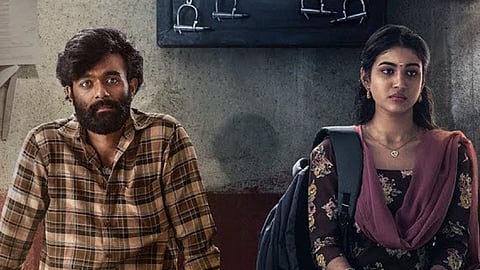


Kannada filmmaker-turned-producer Tharun Sudhir believes Elumale cannot be set anywhere but Chamarajanagara, the city in Karnataka that shares its border with Salem in Tamil Nadu. Set in these bounds, the upcoming Kannada film explores a tender cross-border romance between a couple navigating differences and a charged real-life event from 2004.
“You cannot pick Elumale and set it elsewhere. It needs to happen in that region,” says Sudhir in an interview with The Hollywood Reporter India. Original stories from Karnataka may perhaps be the solution for the industry’s dry spell, which several filmmakers allude to as an inconsistency. “Su From So was a realistic story woven around a real town in coastal Karnataka. They didn't try to do anything else. If you bring in subjects like this, on whatever scale, it makes a difference. Even films like Kantara and Kaatera were able to make an impact because of this reason. Anything that connects to people and feels original will work.”
Co-starring Raanna, Priyanka Achar, Jagapathi Babu, and Kishore, Elumale is up for release on September 5. The thriller is directed by Punit Rangaswamy, who assisted Sudhir in Kaatera, the 2023 film, which turned out to be the highest-grossing Kannada film that year. “We all love cinema so much, and it gets difficult to keep convincing producers every time we see talent in someone. When we know a director’s potential, why not back it ourselves?”
Excerpts from an interview:
How did you come to be associated with Elumale?
Punit used to discuss his thoughts and ideas with me during the filming of Kaatera, and in that process, I liked one idea. I was interested in the idea's backdrop. So I told him to make a script out of it. During the filming of Kaatera, we started working on the script, and I guided him. Once Kaatera was done, he came up with the script. Once the script was firm, I felt like it was a great story that needed to be told. And if I could produce it, it would be good because convincing someone else would be difficult, as it is a new subject.
What was it like to set a romance in the landscape of a thriller?
The film is based on a real incident from 2004, which happened on the border of Karnataka and Tamil Nadu. The incident quickly became a nationwide news story, and there are a lot of documentaries on it, but no one has adapted it in the form of a love story. This love story is a thriller. It is an edge-of-the-seat love story, let me put it that way.
Usually, when you make a cross-border love story, people depict it in controversial lines. But this story did not have any such things. It is not based on the ongoing water issue between the two states or honour killing. This is not a typical love story. The story happens mainly in one night. When you see this couple for the first time on screen, they are already in love. There is not a lot of backstory. It is just a 130-minute film, but you will feel all the emotions of the film through this couple.
With a one-night film, performers are often deal-breakers. Can you speak t us about the film’s cast?
The story demanded new faces because audiences cannot expect anything from the characters. Another criterion was to get great performers. Raanna was in a movie called Ek Love Ya (2022 Kannada film) before, which required him to depict multiple shades. Priyanka won the Kannada reality show Mahanati last year, for which I was a judge. I wanted to balance these newcomers with strong supporting actors who added value to the screen. So we approached Jagapathi Babu sir, Kishore and Nagabharna sir.
What are your thoughts on Kannada cinema’s consistency problem? Is this lull indicative of something larger?
Every industry goes through such phases. Should we follow trends or create trends? There is confusion happening among filmmakers navigating these questions. In that process, there are a few misfires. In Karnataka, especially Bengaluru and Mysuru, people watch a lot of other-language films. This, in turn, makes the competition tough. In Tamil, people want to watch native, common-man stories. In Telugu, they like glamour, colour and lavish things. Here, audiences watch films from all languages. So our makers get confused as to what the audience wants. They try to do everything.
Are Kannadiga audiences waiting to see more stories from different parts of their state?
Of course. Even when you're doing pan-Indian films, you're only dubbing these films for people to understand. Just because these films bring in audiences from different industries, it doesn't mean we need to put something in the story just for their liking. Instead, you do something of your own, which is what KGF achieved. If we can crack that, it'll be great.