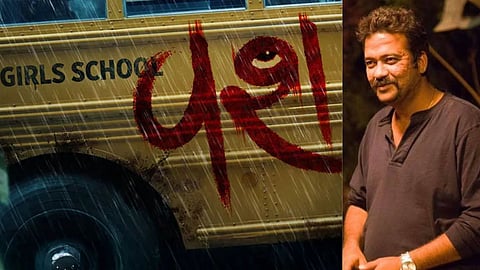


For more than a decade, filmmaker Krishnadev Yagnik has been a restless presence in Gujarati cinema, pushing against the industry’s prevailing reputation for frothy family dramas and moral comedies. With Vash (2023), a low-budget chiller about a father who must rescue his teenage daughter from the grip of a black magician, Yagnik forged a template of horror rooted in Gujarati vernacular life but resonant with primal unease. Bollywood soon came calling: Shaitaan, a Hindi remake starring Ajay Devgn and R. Madhavan, proved an unexpected hit during a slow period. In its wake, Yagnik has returned with Vash: Level 2, a sequel whose brutality and scale mark a startling escalation.
If the first Vash derived its horror from the violation of a single girl’s body and will, Level 2 multiplies that premise a hundredfold. “When Vash released, I had no thought of a sequel,” Yagnik tells The Hollywood Reporter India. “But when Shaitaan worked across India, the confidence grew. If one girl’s mind could be controlled, what if raised the stakes to 200?” That notion led him to stage his follow-up in a girls’ school, where a sinister guru named Pratap extends his dominion over the bodies of dozens of schoolgirls.
The movie opens with deceptive lightness: sunny corridors, carefree chatter, young women inhabiting the familiar banality of adolescence. Only gradually does the dread seep in. “In Vash, I had to start with the villain to pull the audience in,” Yagnik explains. “This time I felt confident enough not to. We could begin with the girls, with their world, and let the horror arrive later.” The result is a dissonant experience: a horror film drenched not in shadows but in daylight, where the glare of the sun only intensifies the nightmare. “Innocent girls in broad daylight facing something horrific,” he says, “feels scarier than horror at night.”
Much of the terror lies in the orchestration. Yagnik and his team cast nearly 100 young women, most without professional training, and subjected them to weeks of workshops in what he calls the “stages of possession”: the tightening of muscles, the shallow breaths, the escalation from trembling to convulsion. “Every girl knew exactly what stage she was meant to be at in each frame,” he says. The sheer logistical difficulty—50 or 60 girls visible in a single wide shot, each needing to remain in character—becomes a kind of aesthetic principle. A slow tracking camera surveys the chaos with eerie steadiness, as if daring us to look away.
In the most chilling sequence of Vash Level 2, the possessed girls are unleashed into the city streets, a swarm of bodies attacking everything in their path including men who would ordinarily prey upon them. The moment crackles with ambiguity: the spectacle of female violence is at once horrifying and cathartic. “The villain’s mentality is to dominate women and prove them inferior,” Yagnik says. “But it’s not about lust—it’s about power. That’s why the obsession is always with girls, never boys.” And yet, in staging these young women as both victims and agents of terror, the film invites us to read their actions as a warped reclamation of strength.
For all its operatic violence, Level 2 remains tethered to the emotional thread of its predecessor: the father who once rescued his daughter, now weathered but unbowed. Yagnik describes him as “the only one who has truly faced this evil before. He knows how to deal with such men—not with anger, but with calm, calculated resolve.” In a genre that so often prizes hysteria, the father’s stoicism registers as a radical choice.
Yagnik is quick to resist talk of a sprawling franchise. “Maybe in a few years we might think about it,” he shrugs. “For now, I’ve poured everything into this sequel.” Indeed, there is an almost grudging air to the continuation, as though he were compelled less by market trends than by the terrifying logic of his own premise. Unlike many sequels, which strain to justify their existence, Level 2 feels fated—an unwelcome but inevitable return of the repressed.
The film’s success has thrust Gujarati cinema into a national conversation that has long excluded it. While Tamil, Telugu, and Malayalam industries have enjoyed pan-Indian recognition, Gujarati cinema has been pigeonholed as provincial. Yagnik bristles at the stereotype. “It’s not true that Gujarati audiences only want family dramas,” he says. “When KGF or Baahubali released, theatres here were full.” With Vash and now its sequel, he has wagered that audiences beyond Gujarat are ready for something darker. That gamble appears to be paying off.
To watch Vash: Level 2 is to submit to a blunt, bruising force. Its violence is relentless, its allegory unsubtle. But there is a grim integrity to Yagnik’s vision, a refusal to retreat from the implications of his conceit. In an era of horror franchises that grow bloated with lore, he has doubled down on the elemental: the terror of possession, the violation of autonomy, the spectacle of innocence turned malevolent. “Good cinema will always find its audience,” he says simply.