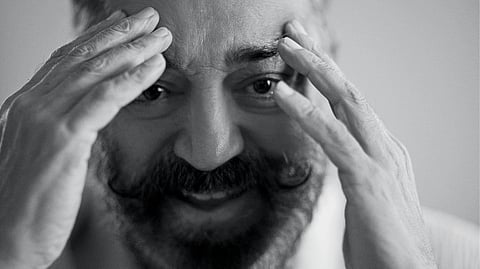


It doesn’t take an astute aesthete to tell you that no two Kamal Haasan performances in his 234-film career are the same. Yet, it is just as fascinating to learn that no two Kamal Haasan interviews are the same either. The master conversationalist weaves in trivia about how runner Jesse Owens “shamed Hitler for his racism” in his answer about how an environment is as important as training for an aspiring actor. He references Socrates and Steven Spielberg in another answer, right after he correlates his ability to write lyrics for movies to an old childhood habit of writing risqué limericks. Minutes later, Haasan slips in a fable that could be developed into a philosophical mini-series. “…The story of young rishis who go into the mountains to seek God, only to realise there is no God. And then they come back to start a religion.”
Said interview is taking place in one of Kamal Haasan’s two offices located in the heart of Chennai in an area called Alwarpet. His fans call him the “Andavar of Alwarpet” or “the god of Alwarpet”, a moniker that the famous atheist has always rejected. Both offices are less than a kilometre apart, each representing two overlapping identities of the legend: that of a politician and that of a filmmaking institution. One of these two offices is the headquarters of his political party, the Makkal Needhi Maiam (Centre for People’s Justice), which was also Haasan’s childhood home in Chennai.
The Hollywood Reporter India meets him at the newly built corporate office of his production and distribution company Raj Kamal Films International, which is as good as a shrine built to celebrate his journey in cinema, and, in turn, also becomes the journey of Tamil cinema itself.
Right at the heart of this office is a decades-old Moviola editing system. Moving this rare Moviola, even by an inch, requires permission directly from the man himself. But these are not rules that are being followed out of discipline or fear. His respect for cinema is infectious, not just to anyone who works there, but even to those who visit. Instead of curtains, the windows of the office have been laminated with translucent pages of the screenplays of his films like Thevar Magan (1992) and Kuruthipunal (1995). And as the man walks past, rays of sunlight project dialogues from these screenplays onto him — befitting symbolism for how this actor was always backed by words.
The occasion for this interview is his collaboration with Mani Ratnam for Thug Life, which releases on 5 June. The last time they worked together was 38 years ago, when they made Nayakan (1987), the evergreen classic that features on Time magazine’s All-Time 100 list of the greatest films made since 1923. The film also brought Kamal Haasan his second National Award for best actor. He would go on to win one more nine years later for Indian (1996).
When Haasan takes us back to 1987, to being on the set of a Mani Ratnam film for the first time, he recalls the exact incident that made him realise he was working with a great director. “We’d been talking cinema for years, but when we actually came into the field, that was the actual proof of the pudding. I’d come from another shoot, and I was very excited to join his set because I rarely got to do films like these (Nayakan). People like him, Balu Mahendra and my guru K. Balachander, these were my only sanctuaries. But on the set on day one, we were shooting the brothel sequence where the dance is happening. For the scene, my assistant Selva [Janagaraj] leans in and tells me that everything is ready upstairs and there’s no dialogue. So, I rolled my eyes as if to ask ‘What now?’ Mani came to me and said, ‘Can you give me an Indian expression?’ I smiled, because rolling one’s eyes is a very American thing and we picked it up from American movies. So, I Indianised it. Then I knew I got a guy there. Lifting weight is a great art, but you need a spotter, or you’ll die doing it.”
It’s a feeling he’s been holding on to for more than three decades, even if they did not collaborate after the film’s success. “We have spoken about cinema for such a long time. Every time we talk, we don’t gossip or discuss industry politics, but the kinds of films we are working on. We discuss what we’re making next and at times realise that there could be similarities, especially when it comes to thoughts. We talk about it and then decide to take different directions. We haven’t commercialised this combination, and now we have done it [with Thug Life]. We are think-alikes and not look-alikes. That’s how you find friends from different hues and philosophies.”
Even Thug Life is a film that can be called a collaboration in the purest form, including the way it was written by both Kamal Haasan and Mani Ratnam. Speaking about the writing process, he adds that he and Mani Ratnam share the same wavelength, even if they don’t share the same vocabulary. “When I say we wrote it together, it’s not the noise of two pens scribbling together. I finished what I perceived would be a good film to make. I finished a script, and it was called ‘Amar Hai’, which is a pun. A man who is believed to be dead is not dead. His name is ‘Amar’, and that is the problem. I had etched it, and then Mani took it as an idea and went on to embellish it.”
Haasan talks about how they could bring in all those years of conversations and friendship into the making of their latest. He explains how they had even developed a secret language of their own on set, one that did not require many words, but was a connection noticed by those around them. He says, “It might be something small like the crinkle of an eye and Mani will notice it. And when I tell Mani what I feel about a scene, he’ll take a break and think about it. In that exchange, we might end up changing the meaning and the syntax of that entire scene, but no one has understood what we’ve said to each other.”
Debut as a child actor in Kalathur Kannamma —won the President’s Gold Medal at the age of 6
The number of National Film Awards he has won for best actor — the second most won by an actor
Kamal Haasan’s age when he completed his 100th film, Raaja Paarvai, in 1981
Films featuring Kamal Haasan have been submitted to the Academy Awards for best foreign language film — the most for an Indian actor
Films in his 65-year career
Their mutual respect becomes obvious the moment Mani Ratnam pays a brief visit to the Raj Kamal office, a few hours later. The jokes and the stories also begin to sound different once he arrives, taking the form of casual banter between longtime friends. Haasan jokes to Ratnam about an incident from the late ’70s that taught him about the speed at which Malayalam movie sets operated at then. It was on the sets of an I.V. Sasi movie, as Haasan readied himself for a second shot after feeling unhappy with the take he had just delivered. By the time he looked up to shoot the same scene again, he noticed that the director and his crew had already dismantled the setup and moved on to the next scene.
Ratnam too started his career in the Kannada and Malayalam movie industries, before making his first Tamil film, Pagal Nilavu, in 1985. The frantic pace with which Ratnam shoots his films is also a thing of legend, which again may be attributed to the tiny budgets and prolific pace with which Malayalam films were being shot. As for Haasan’s Malayalam cinema phase, the numbers speak for themselves. He shot as many as 14 films in 1975. In ’76, he completed 18 films. He would go on to do 19 films the following year and in 1978, he ended the year having completed 22 films.
“I never thought of that as work. I went into Malayalam cinema so that I could hone my craft. Here (in Tamil cinema), it is all about commerce, so it will never go out of that groove. Great music, but it’s still running on a groove, without any improvisation. I was not keen on listening to gramophone records, so I went to another place. I don’t consider that phase as goals reached or [a showcase of] my talent. That [was a] training period. I knew it even then,” he says.
Haasan speaks of this phase as one that changed his attitude towards cinema, one that made him feel grateful, just for the experience. “I found many Yusuf saabs (Dilip Kumars) in Malayalam. There is only one man in Hindi, but there were many such actors in Malayalam, and they were not even considered top actors there. Rarely did one actor come to the top like Sathyan master did. We call him ‘master’ because he brought about a certain verve to the performance, which I’d seen only in Dilip saab. But they were still two very different performances and languages.”
It was around this phase of his career, when Haasan was around the age of 19, that he began to nurse the dream of also becoming a director. During this period, he recalls narrating scripts to his friends Balu Mahendra, R.C. Sakthi and K. Balachander, while even considering the option of abandoning acting altogether to become a full-time director. “We (Balachander and Haasan) were walking during the dub of a movie, and he asked what I was planning to do with my life. I said I was embarrassed to tell him and then confessed that I wanted to become a director like him. He said, ‘Fool! You can, but don’t become a director who will come to the studio in an autorickshaw. That’s where it will lead you. I know you! So, you first build a house. Stardom doesn’t come to everybody.’ ”
Haasan admits that he wasn’t even a star at that point, explaining how Balachander’s words sounded like a premonition. He was playing the villain then, long before he played the lead and this was when Balachander urged Haasan to focus on his acting alone. “I do not say this often in interviews because people feel it’s all been my endeavour. But if I had made that mistake, he (Balachander) would have been right. I would have died in an autorickshaw — leave alone reach the studio in one. I’ve seen many friends die like that. That’s why I’m grateful to Mr. Balachander because I could have gone down that route. I would have died with my angst and my unfilled dreams, without anyone recognising my body.”
Kamal Haasan would wait for two more decades to become a director with the Hindi film Chachi 420 (1997). In all, he has only directed five films, even though he has written many, many more. With the numerous hats he has worn during this career, the master has managed to satisfy audiences for 65 years. But he says, “You can’t make all of them happy, especially when you believe in something. Above all, you will have to answer to yourself. The audience is my primary goal because there is an exchange of money. Without money, what we call talent or applause comes from belief in yourself. They say you must believe in something. I believe in this, for I do not believe in gods. So, I’m not distracted. The only superpower I have to contend with is inside my head. It will punish me, it will insult me, it will appreciate me, but I do not know what will happen. I’m answerable to that power and I will not worship any other.”
By the end of the evening, there’s a feeling of having learnt as much about life itself as you have about the man. As a listener, you also begin to understand why Haasan’s interviews often tend to be as layered and though-provoking as his movies, with the full gravity of its depth only revealing itself as layers get peeled away with time and the listener’s own maturity levels. But as students of his cinema and philosophy, it’s most appropriate to understand the quality of his answers by borrowing words he uses to describe his guru.
He says, “My life has been a virtuous cycle — not a vicious cycle. What I have learnt is not even acting. It’s a duty to the next generation. It is more important than art because you can Google a lot of your doubts today. He (Balachander) was my Google. But to be like that, you will have to have so much data within you. When you do not have data, you will get angry [when questioned] — like some leaders do. And when a man has enough data, any question is welcome because [the asker] is only clarifying.” The legend believes the next generation will be a lot taller because they will be standing on his hefty shoulders. But for the moment, Haasan underscores how his success has only followed his constant and consistent pursuit of excellence. He says, “I always believe that there is no need for luck for those who deserve it.”