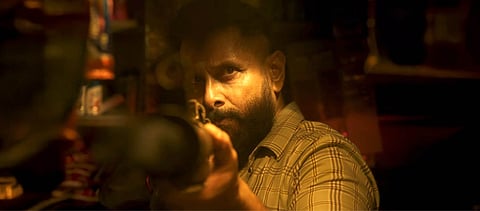


11 years and five films later, it’s still impossible to predict what kind of filmmaker SU Arun Kumar is. With genres, settings, styles and high points changing with every film, he says a process of self-discovery is a given with each new project of his. A day before the release of Veera Dheera Sooran: Part 2, the director breaks apart myths about his writing process, the failure that changed him, and how he will never compromise.
Edited excerpts from an interview:
Veera Dheera Sooran: Part 2 is your fifth film. But it’s still very hard to place you as a director given how the genre shifts with every film…
I am not able to predict myself as a director either. I think I want to keep jumping genres with each film. Broadly, all my films are dramas but the excitement for me to get into a new film stems from the joy of entering a new world. I don’t want to feel like I’m making the same film twice.
Do you get tired of that genre after you finish a film?
Yes yes, I do.
Do you also get tired of watching movies in that particular genre?
No. I might not want to make another film, but I keep watching films in that genre. Whenever I go online, I keep looking for drama or thrillers. Even if I’m shifting from one style of drama to another while writing, I want all the aspects of it to be different. So, if I’ve set this film in a village, then I want my next to be in an urban or suburban setting, because I love the process of finding my film.
What do you mean by “finding your film”?
Let me give you an example. Let’s say I’m trying to make a thriller; then there are set formats that dictate how the climax should be or how the introduction should be or what the conflict must entail. If I sense that pattern forming in my head, I think it's too boring. I really have to struggle through the writing, and I should find it hard to find my film’s thesis.
Thesis is an interesting word to describe it. What would you say is the ‘thesis’ of Chithha?
Chithha began with the idea of making a film for actor Siddharth. Then I wanted it to be a common man script for him because he has always been perceived as a "chocolate boy." But I wanted people to recognise his performance. So, the imagery that gave birth to Chithha was of a guy who was travelling on a bike with lots of groceries, with a box on the side. He also looked like a government employee.
What about the additional details?
From that imagery, we keep adding layers. I then got started with research about child abuse and child safety. But when you add that to the image I wanted for Siddharth, I knew beforehand that it must not be a film about him exacting revenge. Because revenge is never a solution.
But then, how does one go about expanding that thought with the image?
That is still a thin one liner, and a script cannot be made with just that. Then when we start writing, we do a lot of research, and we meet people who’ve been through similar trials in life. That’s what led me to the belief that such a film about child abuse must end with a small smile emerging from the face of the little girl who had to undergo the trial. Not a man succeeding in revenge.
Can you describe the point at which you felt that you had “found” Chithha?
It was during the writing phase. Like most writers, I too have found myself ending up with the process of writing in the same way my contemporary Tamil directors wrote. So, when I took that four-year gap before Chithha, I wanted to relearn the process of writing. Initially, I did not always think writing was the heart of filmmaking. Until then, I’d write a one-liner based on a real-life event and then decide the film’s first, second and then third acts. After that, you take this structure and place it on a beat sheet to see if it covers everything. Once you go to the sets, you then see the film expand from script to screen until you finally realise what your film has turned into.
And then?
With Chithha, I decided that the film needs to be made within the writing phase. It took 20 drafts to write and after that, in the process of making it, I felt nothing. I was very confident.
Was Veera Dheera Sooran the same?
It was entirely different. I feel this film is still growing. I thought I had learnt something while making Chithha, but I had to re-learn everything again for Veera Dheera Sooran. During postproduction, I felt as though I had learnt nothing from my films before. Whatever you predict, the film you make will take you to problems that are entirely new.
That must have been nerve-wracking...
It’s exciting! I can't think of finding any other job that gives you this level of excitement. See, I’m idle for long stretches of time otherwise and when I write, I take six months to get to the thesis and then six more to write the script. I’m super lazy. But after that, I become a totally different person while shooting. I surprise myself with who I become during filming.
Your previous film Chithha spoke about the pointlessness of revenge and it’s a noble thought. But Veera Dheera Sooran is with a big star, with big action sequences. Didn’t you have to dilute your thoughts about revenge, which forms the basis of most mass films?
Of course I must hold on to my values. For the sake of pleasing the so-called audience, I do not think I can compromise. Nobody actively comes to the theater to watch my films, but I feel there are probably four to five people who want to watch the film because I’ve made it. If I make a film with that compromise, it becomes a major disappointment for them. I then stand to lose even those four or five viewers I’ve earned in these 11 years.
Does that mean you will never go against something you’ve said in your films?
I can but only if that’s a part of the learning process. Let’s say I made a mistake in Sethupathi. There’s nothing wrong in me fixing that. Now after I made Chithha, how can I ever make a film glorifying a rapist? How will someone forgive me? How will my mom forgive me?
A lot of the interviews about Veera Dheera Sooran have discussed the 15-minute long take. How do you decide if a scene deserves to be shot as a long take or not?
When I write, I force myself to kill the director. I may be fascinated by a shot or the staging, but I do not want staging to take over the emotion of my scene. But when I was writing for the long-take scene, I started going to several festivals in Madurai. Madurai is famous for festivals and I’m used to it, but as a researcher, I felt that I hadn’t seen this thiruvizha (festival) in a film.
I’ve felt the impact of a festival coming alive is better in indie films when the setup is low-key with smaller stars, and when they shoot with hidden cameras. I wanted to shoot that scene like I was inside the thiruvizha.
How did you pull that off with a big star?
We decided to recreate the entire festival with our actors. We then decided to not take a single top-angle shot, so there are no drones, jimmy jibs or wide shots. I wanted the characters’ suffocation to translate to the audience. Not cutting during a take is what makes a moment real. But these were all calls I made after I learnt the emotion of that scene. I might be greedy, but I want the viewers to forget that they’re watching a long take.
I heard that you broke down after you got the single take.
I couldn’t sleep for days leading up to that shoot. When I closed my eyes, all I could see was the choreography of that scene.
In another note, what are the films of Suraj Venjaramoodu that made you want to cast him?
So many, right from Thondimuthalum Drikshakshiyum. I’m a great fan. If you look at last year’s Adios Amigo, any actor will want to do the role Asif Ali played because there is scope for acting. But look at Suraj; he is mostly silent, and he has nothing to do except travel with Asif. There are not too many layers, and he must be silent. That’s when I realised he understands cinema is a way very few people try to understand it. With such actors, work becomes simple.
Finally, you spoke at length about the transformation you went through before Chithha. But in your analysis, what went wrong with your film Sindhubaadh (2019)?
Sindhubaadh is what made me who I am now. If Sindhubaadh had become a hit, I couldn’t have made Chithha. The film’s failure made me sit up and rethink what I want from cinema. It made me find myself.