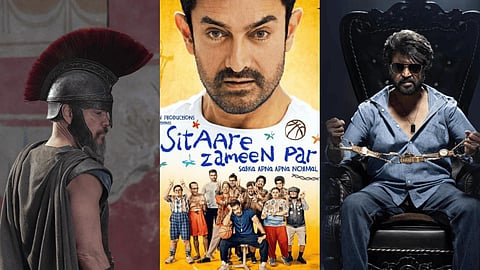


In July, when Aamir Khan announced that he was bringing his comedy Sitaare Zameen Par to his pay-per-view movie channel on YouTube for ₹100, it shook the industry. Those in support hailed the superstar for his revolutionary move, which not only attempted to give creators more liberty and power but also take control away from streamers.
The detractors, however, said dropping a film digitally, even PVOD (premium video on demand, where a viewer has to pay for early access) just 41 days after a theatrical release would discourage viewers from going to cinemas. It was billed as the ultimate cardinal sin for the film industry.
But beyond the hyperbole criticism and the muffled support, industry leaders, including studio executives and exhibitors, feel the problem Bollywood is facing is multifold: creating content that isn’t universal, ineffective marketing, and inaccessibility in remote regions.
The long-running debate in the Hindi film industry has been about films releasing on an OTT platform eight weeks after their theatrical release. Many, including Khan, batted for a longer window between theatrical release and a streaming drop date, so that the audience felt compelled to watch a film on the big screen, instead of waiting just two months to watch it on their devices.
Sitaare Zameen Par could have been an exception in India as far as the PVOD model goes, but globally, just this year, two tentpole films were available on demand within 40 days of their blockbuster theatrical run: Superman and Jurassic World Rebirth.
At the Big Cine Expo 2025 in Chennai, where the who’s who of cinema exhibition were present, The Hollywood Reporter India asked Rahul Puri, Managing Director, Mukta A2 Cinemas, whether PVOD could become the norm in a market like India, where even a big-ticket Hindi film like War 2 could be available on streaming just a month after its theatrical release, without any protest from the industry.
“A producer would want to maximum their profits. If they put a film in theatres, which does fantastically well in the four weeks and starts exhausting later, the exhibitors can be okay with the film coming on a PVOD format. That is, if they have made enough money,” Puri said.
Puri added that Khan had pulled off something similar even with 3 Idiots, which didn’t premiere on TV for almost six-eight months. This, he said, was the choice of the producer, who didn’t want to come too soon to TV despite, what he believes, big fat cheques being offered by satellite channels to buy the film.
“But it was his choice to decline that. Similarly, there have been other producers who have put the film on TV within four weeks as well. The point is, as cinema owners, we are not as worried about when a film is going to come during that window as we are about whether the producer has done enough to create intrigue, to get people into my theatres. That’s the question.”
During a session at the Big Cine Expo, Denzil Dias, vice president and managing director, India Theatrical, Warner Bros. Discovery, spoke about how AI can help the industry in terms of marketing.
“AI helps you track the right target audience. There are tools globally that can tell you when the right time is to send a message to your audience. For example, if someone wants to watch F1 in an IMAX cinema, then AI tools can tell you that you can send a message to your audience, two hours before showtime, in a five-km radius. Solutions like that are possible,” Dias says.
Puri said film marketing needs to create a build-up like the iPhone launch, where anticipation is drummed up and a FOMO event is created, which happened successfully with Hollywood titles like F1 or the masterstroke of opening pre-sales for Christopher Nolan’s highly anticipated film The Odyssey, a staggering year in advance in select IMAX screens across the US.
According to The Hollywood Reporter, once the tickets went live for The Odyssey, they were resold for a whopping ₹26,000 to ₹34,000 over the average ticket price of around ₹2,200.
THR India asked Preetham Daniel, vice president, Theatre Development at IMAX, India, APAC, Australia & New Zealand, whether India, with its inherent appetite for blockbuster cinema, could ever hope to replicate this feat.
“Why can’t a movie like Baahubali or the next S.S. Rajamouli film be on the same lines as The Odyssey?” Daniel asked, adding that the larger question would be how one “packages” a film like that. With a movie like The Odyssey, there is a big name attached in the form of Nolan, followed by the use of tech (it is the first blockbuster entirely shot with 70 mm IMAX film cameras), and then there’s the story, Daniel explains.
“As long as we have all these three elements within the film, it’s possible. So, a movie mounted on the scale of a Baahubali can do that. Or Ramayana, for example, which is the first Indian film to be filmed for IMAX. It’ll be a great movie to resonate with the Indian audience. Can it be done? Absolutely.”
In 2023, when Shah Rukh Khan’s comeback Pathaan hit the big screens, it scripted history by becoming the first Hindi film to cross ₹500 crores net at the domestic box office. The same year, three other Hindi films achieved the milestone, Gadar 2, Jawan, and Ranbir Kapoor-led Animal, signalling that the box office ceiling had gone up higher post-pandemic as the previous highest grossing Hindi film was Dangal (2016), which had netted around ₹390 crores.
But higher box-office doesn’t mean a jump in footfall, noted Devang Sampat, Managing Director, Cinépolis India, who says that the exhibition sector has lost 20 per cent of the attendance it witnessed pre-pandemic. So, while the number of movies hitting the ₹500 crore-mark have increased, with Stree 2 (2024) and Chhavaa (2025) also joining the club, they have come with reduced footfalls.
“If we had 1,00,000 people coming to the cinema hall at any given screen pre-pandemic, that has now become 80,000. To make footfall higher, we need effort from multiple stakeholders, from the content producer to a cinema exhibitor, because the operating costs have also increased over the years. So, tracking footfalls is far more important now,” Sampat says.
Industry insiders have long argued that one of the ways to increase footfall is to reduce ticket prices. Exorbitant tickets, they believe, have ensured that the audience stays away from cinema halls, preferring to watch movies on OTT instead.
Sushil Chaudhary, founder and CEO of PictureTime, a mobile theatre company which sets up inflatable theatres in tier-3 and -4 towns, noted that some recent films, which had average critical reception, still ran with packed shows at his cinemas in remote regions, including Ladakh, because the audience in underserved regions simply just want to experience the big screen spectacle.
Citing an example of Rajinikanth’s Coolie, Chaudhary said the film ran on full occupancy in his 140-seat inflatable cinema hall in Bommidi, a small town located over 300 kilometres from Chennai.
“All four days of Coolie were houseful. It wasn’t just because the tickets were affordable, but also because it was accessible. When we talk about footfall, it has to be looked at holistically; every remote region needs to come alive to contribute to the overall growth of the industry. Even in Sardarsheher, Nagaur, we received calls to screen F1 and other Hollywood films. They didn’t care that it was the dubbed version or original language — they simply wanted to access it.”
To read more exclusive stories from The Hollywood Reporter India's October 2025 print issue, pick up a copy of the magazine from your nearest book store or newspaper stand.
To buy the digital issue of the magazine, please click here.