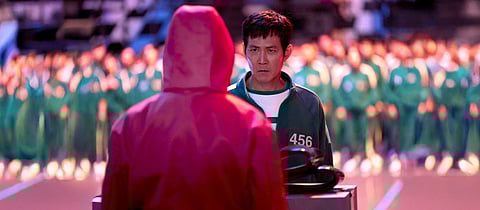


The latest season of Squid Game has set a new record at Netflix. The dystopian South Korean action drama has garnered 60.1 million views within its first three days of release, according to the streamer's latest Top 10 rankings.
The concluding chapter of the thriller, which premiered last Friday, has reportedly already climbed to No. 7 on Netflix’s list of most popular non-English TV series of all time. The show ranked as the No. 1 show in 93 countries and accumulated 368.4 million hours of watch time since its 27 June release, according to The Independent.
By comparison, according to several reports, Season 2 of Squid Game, which debuted in December, recorded 68 million views in its first four days, overtaking Wednesday's records. The second part of the latest season documents the journey of Gi-hun (Lee Jung-jae), who, having taken a viscerally darker turn, returns to the tragic games to burn its operations to the ground. The season also explores the power dynamics between Gi-hun and the Front Man, played by Lee Byung-hun.
Three years and six Emmy wins later, Squid Game is no longer just a show — it’s a global phenomenon. And with Season 3, the series returned more timely than ever. Where Season 2 probed democratic processes through elections, the new chapter entered the void of human nature itself — exploring desensitisation and moral collapse, above all else.
If Season 3 feels darker, that’s by design. In an interview with The Hollywood Reporter India, creator and director Hwang Dong-hyuk explains that he didn’t rely on overt filmmaking tricks, but rather, on what he explains as the emotional architecture. The visual language mirrors internal torment. “The version of Gi-hun you will see in the third season is the darkest version of him that you've ever seen,” he says. “He has no words or dialogue, and all of his emotions are conveyed through his eyes or facial expressions. He seems to be stuck — locked up in a dark abyss.”
For Lee Jung-jae, who plays Gi-hun, the journey into darkness demanded extraordinary discipline — both emotionally and physically. “I tried to maintain Gi-hun’s emotional state as closely and as much as possible,” he explains. “I did constant image training in order to stay in Gi-hun’s mind so that even by me sitting there, you can feel like you get the actual Gi-hun.”