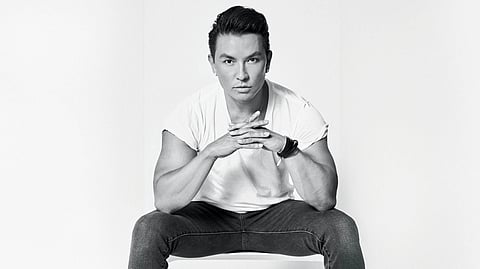


Fashion isn’t just fabric — it’s identity, belonging and resistance all stitched together. Inherently personal and indisputably political. And few designers understand that better than Prabal Gurung.
The Singapore-born, Nepal-raised couturier was once a queer, immigrant boy from Kathmandu who secretly dreamed of seeing his world represented in global fashion. Today, his vision has been worn by celebrities across the world — including former first lady of the United States, Michelle Obama; pop star Shakira; actor Alia Bhatt and most recently, actor-singer Diljit Dosanjh at his debut Met Gala, to name a few.
“I am here to demand a world where all voices are not just included, but celebrated,” says Gurung, who is fuelled in equal parts by empathy and hunger. “Laying the groundwork for the next generation of creators who deserve to see themselves reflected at the highest echelons of fashion, just as they are.”
After graduating from the National Institute of Fashion Technology in New Delhi, and working under fashion icons Cynthia Rowley and Bill Blass, the designer launched his namesake label in 2009 because he didn’t see the women who raised him — strong, brown, multifaceted — in the world of high fashion.
He adds, “I didn’t just want to design clothes. I wanted to carve out space for their stories, their complexities, their beauty. I wanted to offer a vision that didn’t just speak to the ideal, but to the real.”
And that, he certainly has, having styled multiple muses for the 2025 Met Gala, namely, writer Chimamanda Ngozi Adichie, Diljit Dosanjh, model Precious Lee, Nicole Scherzinger, Shakira, actor Tessa Thompson and philanthropist Amanda Fuhrman. Based on a WWD report, his looks generated approximately $5 million in media impact value. But the real power wasn’t in the numbers — it was in the stories his designs carried, and the people they represented.
When Gurung speaks of his stories, the one closest to his heart is about reclamation — of identity, of voice, of space. It’s the one woven into Dosanjh’s Met Gala debut, and the one he tells unflinchingly in his recent memoir, Walk Like a Girl.
“For so long, I performed the version of myself that the world found easiest to digest — less foreign, less flamboyant, less loud. But writing Walk Like a Girl felt like peeling back every mask I’d ever worn,” he says. “It wasn’t about reinventing my identity — it was about returning to it. Every sentence became an act of reclamation.”
He writes about the pain of being othered while carrying with him the joy of being different. The designer now knows that the very things he was shamed for — his queerness, brownness, femininity — are the source of his power.
In fact, his early work was often described as “feminine, but fierce”, a phrase that became the armour he wore — “chiffon with defiance, tulle with conviction”. But what these descriptions failed to capture was the fire beneath
it all.
“In a society that linked femininity to fragility, I chose to make softness a radical act of power. It was an act of resistance, an invitation to redefine strength on my own terms. Over time, I’ve evolved beyond that label, but I’ll never forget how that phrase was the spark that ignited my journey,” Gurung explains. Because in doing so, he found his voice.
However, the designer who’s now known for celebrating his roots, feared tokenisation in his early years. He recalls, “I worried that if I brought too much of Nepal or India into the room, they would shut its doors.” But the fabric of his homeland is not a trend, it’s a treasure. And today the designer has begun to incorporate more Nepali textiles, Indian handwork and philosophies into his collections. Not as spectacle, but as homage.
“I return to Nepal and India not as an outsider trying to fit in, but as a storyteller reclaiming his roots,” he says.
Gurung did reclaim his roots, mostly famously in his Spring 2020 collection. Perhaps, his most misunderstood, yet most impactful one so far.
Titled “Who Gets to Be American?”, it was a tribute to the immigrant experience, which was met with mixed reactions. While some called it too political or too overt in its commentary, for him, it was always about identity, belonging and the courage to claim space in a world that didn’t make room for him.
Despite not being universally loved, it is the show the designer remains most proud of. He understands that, sometimes, being ahead of the curve means being misunderstood. “What I saw as an act of celebration of diversity and resilience was reduced to a simple political statement,” he explains. But it was a pivotal moment in the dialogue about who gets to be part of the narrative and define the culture, and how one belongs to a country.
“In the years that followed, I saw how this collection inspired conversations that were essential and needed,” he reminisces. “It became a conversation starter — and, in a way, set the stage for the [2021] Met Gala exhibition that followed, which was about embracing the full spectrum of what it means to be American.”
Five years later, Gurung brought that spirit of reclamation to the Met Gala once again — this time with Dosanjh. The actor and singer made history as the first man in the 76-year legacy of the Met Gala to wear a turban on those iconic steps. Draped in a traditional sherwani, layered with a cape embroidered in Gurmukhi script, and of course, the aforementioned turban, Dosanjh was one of the most talked about stars that night.
Gurung recalls, “I will never forget what it felt like to watch him climb those Met steps, the flashing lights of the paparazzi glinting off the embroidery, the jewellery, the turban like a crown. That moment — that image — will live forever. And if even one South Asian child saw themselves in it, then we did something right.”
Another look that drew eyes and applause was Shakira’s. For her, Gurung envisioned a gown that embodied duality — her softness and strength, sensuality and sovereignty. The result? A sculptural custom creation in bubble-gum pink, with hourglass cut-outs at the waist and a tiered train that swept across the carpet like a wave of feminine power. Bold without being loud, sensual without apology, regal without restraint. As the designer puts it, “That’s the magic only Shakira can bring — she doesn’t just wear the dress, she becomes it.”
Of course, the glamour has its chaos. “There’s always one gown that refuses to behave until the very last moment,” he laughs. “The challenge was in the balance — structure without stiffness, power without weight.” But that’s what fashion is. It’s a constant tension between control and chaos. And sometimes, the most breathtaking pieces are born in that very intersection, pieces that can be described only as transcendent.
How does one find that balance, though?
“That balance is my truth,” says the designer. The fusion of the two worlds that live within him. “Raised by women who wore their hearts on their sleeves, crying without shame and fighting without apology, I learned early that beauty can hold strength,” he explains, having grown up at the crossroads of East and West, where the softness of tradition meets the sharpness of modernity, the graceful flow of saris meet the precision of tailored suits.
“I was taught that structure can carry surrender and that fluidity can embody power — and in my work, I bring those worlds together. It’s the way the silk moves, the way the fabric holds its shape, but also gives way to a kind of quiet surrender. It’s the energy of a woman who is both grounded in her strength and free in her expression — not one or the other, but both.” After all, the modern woman no longer needs to choose between grace and power, no longer is bound by those binaries.
And to that end, he remembers the ones who shaped him. While Cynthia Rowley taught him to dream and romanticise, Bill Blass taught him how to edit and refine. He credits the Bill Bass atelier, specifically, for having taught him the art of craftsmanship — the fact that fashion isn’t just about vision, but the precision of execution, the discipline, the mastery.
As Gurung puts it, “The power of a great garment lies in its ability to speak volumes in the softest, most intimate way.” He is the storyteller he is because of all the seamstresses and tailors he’s worked with, who, he says, were poets in their own right.
In his story, queerness, race and the immigrant identity aren’t treated as afterthoughts. They form the very spine of his work. And while the world’s A-list now wears his designs, he admits the climb has come with loneliness.
“When you speak the truth in rooms built on silence, the echoes can be deafening. But as my platform grows, so does my responsibility,” Gurung believes, with a touch of his trademark idealism. “After all, I didn’t survive everything I did just to play it safe. I speak these truths not because it’s easy, but because someone out there, watching quietly, might need permission to speak theirs too.”
The success that once meant acceptance in his early years, now feels like freedom. Freedom to tell the truth. Freedom to take up space. Freedom to walk into a room not wondering if he belongs — instead, looking out for who else he can bring in with him.
“Most of all,” he says, “success means legacy. Not in headlines or hashtags, but in how deeply I loved, how loudly I told the truth, and how many doors I left open behind me.”
What was the vision? “Diljit and I had one shared intention: to put a proud Punjabi — unapologetically brown, stylish, spiritual and rooted — at the centre of global fashion’s most-watched stage. Not muted, not diluted. He didn’t want to just ‘slay’ or ‘go viral’. He wanted to represent something deeper — his community, culture, faith, history. And I knew then that we weren’t just designing for the Met Gala, we were designing for every South Asian person who had never seen themselves reflected in a space like that.”
How did you bring that to life? “We started with the sherwani or angrakha, a garment that carries centuries of tradition, power and ceremony. But we wanted to reimagine it. Not westernise it, not costume it. We cut it with the clean lines of precision of Savile Row tailoring and constructed it in ivory raw silk — a deliberate nod to purity and legacy. The hand-embroidery was done in Mumbai, utilising a blend of metallic resham thread and zardozi work, layered with heritage-inspired floral motifs reminiscent of phulkari. Embroidered on the cape was a blessing in Gurmukhi — a sacred reminder carried close to the soul. The turban was the most crucial piece. We knew it had to be flawless. It was custom dyed to match the exact tone of the sherwani and tied in a style traditional to Punjab. No reinterpretations. No Western styling tricks. Just dignity, power and authenticity.”
What was your reaction to him seeing him walk the steps? “When he stepped onto the red carpet — tall, luminous, still — it felt like time paused. It was quiet, almost spiritual. Amidst the spectacle and noise, there he was: a Sikh man, draped in heritage, commanding attention without saying a word. That moment wasn’t just about fashion. It was about reclamation. It was about saying: We are here. We have always been here. And we deserve to take up space in beauty, in luxury, in history — not just as inspiration, but as origin.
To read more exclusive stories from The Hollywood Reporter India's May-June 2025 print issue, pick up a copy of the magazine from your nearest book store or newspaper stand.
To buy the digital issue of the magazine, please click here.