

Back in 2011, The Guardian ran a piece marvelling at how outrageously pop stars — Lady Gaga in particular — were dressing at the time. It positioned her theatrics as a radical departure from the eras of Britney Spears and Madonna, and posed a cheeky question just below the headline: How much more bizarre can their outfits get?
As it turns out, not much.
International female pop stars today — Sabrina Carpenter, Taylor Swift, Olivia Rodrigo — largely stick to a uniform of glittering bodysuits with thigh-high boots. Even veterans like Shakira, Jennifer Lopez and Beyoncé have gravitated toward the same silhouette. All the better to stomp around on stage with.
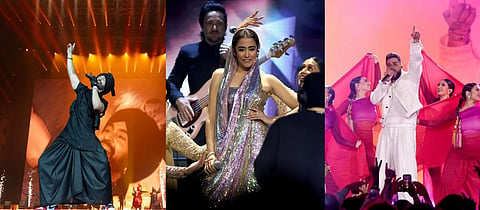
Indian pop, however, is telling a very different story. From Jonita Gandhi and Jasleen Royal to Diljit Dosanjh, Anuv Jain, AP Dhillon and Karan Aujla, there is no singular look to conform to. Instead, there is experimentation, individuality, and a refreshing refusal to dress for global palatability.
Clothes may not make the man — or the woman — but in pop culture, fashion has always created the icon.
The same Guardian article also made note of the fact that in the early 2000s, musicians typically aligned themselves with designers who shared their aesthetics. By the 2010s, however, that changed. For instance, when Giorgio Armani dressed Lady Gaga for the 2010 Grammy Awards, it felt less like Gaga adapting to Armani’s language and more like the designer stepping outside his own.
Much like Gaga, singer Jonita Gandhi — best known for hits such as “Arabic Kuthu (Halamithi Habibo)” from Beast and “What Jhumka?” from Rocky Aur Rani Kii Prem Kahaani — was closely involved in the creative process when she wore label Shantnu Nikhil for her performances at India Couture Week in July, and again when she opened for Enrique Iglesias at his Mumbai concert last October.
Unlike Gaga’s approach, however, Gandhi believes collaboration is where magic happens. “I usually come in with references and a sense of the vibe I want,” says Gandhi. “But I also love giving stylists and designers the space to interpret my personality and push things further.”
Her stylist, Vedica Vora, echoes that sentiment. “It’s critical that the creative wavelengths [of the artiste and the designer] match,” she says. “Shantnu and Nikhil’s mastery of silhouette and construction made them the perfect choice [for a performance that was] opening for Enrique.”
That type of creative chemistry was also evident in the looks that designer Raghavendra Rathore crafted for Diljit Dosanjh’s Dil-Luminati Tour last year. In an interview with The Hollywood Reporter India last November he recalled, “With every show, the team learned more about what worked best for [Dosanjh] and his stage persona. What emerged was a unique ‘Diljit’ style, synonymous with the Rathore trademark.”
Indian designers have often created stage outfits for international stars as well — whether it’s Falguni Shane Peacock for Lady Gaga in 2011, Gaurav Gupta for Beyoncé’s Renaissance Tour in 2023, or Anamika Khanna for Shakira’s Las Mujeres Ya No Lloran World Tour in 2025.
“But it’s not like I give a design, and [Shakira] just wears it,” says Khanna, emphasising that the process is a collaboration through and through. What stood out for her in particular was the level of precision and attention to detail that the
look demanded.
She explains, “We have to [keep in mind] where the light will catch when a fringe moves, how it will hold up when she sits or how it will photograph with movement. It’s not just about designing an outfit, it’s a science.”
Indeed, designing stage wear is a technical craft that demands a level of expertise few possess — which is why international pop stars often rely on bodysuits. They’re practical and minimise the risk of wardrobe malfunctions. Replicating that same functionality for Indian pop stars — and their more intricate outfits — comes with its own set of challenges.
Movement is essential in stage wear, but Vora admits it brings technical challenges. “I think the biggest challenge would be ensuring that everything is sewn or pinned to perfection, so the artiste isn’t feeling restricted or having to hold back,” she explains.
Gandhi has also incorporated more movement into her live set, which means she needs to be able to breathe, move, dance and sing freely without having to adjust her outfit. She notes that her in-ear monitor must also fit comfortably inside her outfit, and none of it should threaten to fall apart. Gandhi also avoids wearing stilettoes and ensures that the fabric is neither restrictive nor too heavy. Perhaps the most important bit, she says, is, “It has to look good under stage lights.”
Breathability is a priority Rathore also emphasises. “We used a mix of breathable silks, cottons and jacquards, all chosen for their ability to hold up during a physically demanding performance while still looking luxurious. Hand embroidery, metallic detailing, and other techniques were key to ensuring Diljit looked his best from every angle, especially under bright stage lights.”
After choosing the fabric, attention turns to its construction and customisation.
Singer Shalmali Kholgade — who famously sang “Balam Pichkari” from Yeh Jawaani Hai Deewani and “Lat Lag Gayee,” from Race 2 — recalls why one of her recent stage looks from the Myntra Glamstream Festival last November in Mumbai worked so well for her. She’d bought sage-coloured mesh fabric in Paris earlier last year. Using that fabric, her designer and stylist, Neha Chaudhary, put together a boxy crop top with padded shoulders; her date of birth was embroidered on the back to add an even more personalised touch. But the part she loved most was the shorts which had a detachable frill, so it appeared to be a skirt.
“My choreographies require me to be able to kick and squat, so if I wear a skirt on stage, it needs to either be a ‘skort’ or a flared skirt that can fit tights inside.” Other specifications include footwear that can only have up to three-inch heels, and a plastic guard that goes behind her earrings, so they don’t fly off mid-performance.
Back in the 2000s, pop stars intentionally wore outfits that could easily be replicated by fans or sold in stores. In the 2010s, they wore outfits that were theatrical in nature, impossible to recreate. But in this decade, it’s something else entirely.
Instead of looking outwards to what is conventionally sexy or kitsch, they’re looking inwards. And looking to go viral on social media. Stage looks become part of the story fans associate with a performance or an era, after all. “In the social media age, visuals live long after the show through photos, videos and reels,” Gandhi says.
She notes that to create these technically precise yet viral looks, she draws inspiration from artistes who are fearless with fashion. What’s striking about today’s pop ecosystem is how much it owes to artistes of the past — and to each other. From Britney Spears’ ubiquitous school-girl outfit that defined late ’90s pop culture, to Madonna channelling Marilyn Monroe’s Hollywood glamour in her “Material Girl” look, referencing classic style in a way that renewed it for her generation — these are not isolated moments but cornerstones in a long network of influence.
Contemporary stars such as Sabrina Carpenter have taken this a step further: at the 2025 Video Music Awards, she paid direct homage to multiple pop icons in one night, echoing Cher, Britney and Madonna in outfits that were both nostalgic and certain to go viral on Instagram.
Each look is a curated artifact that references not just trends, but history, genre, identity and community. This isn’t accidental. The designers, stylists, choreographers, make-up artists, photographers, fan creators and internet culture all feed into how a stage look is born — and how it’s remembered.
It takes a village because fashion, like music, is collaborative: it’s shaped by community, conversation and continuity.
To read more exclusive stories from The Hollywood Reporter India's January 2026 print issue, pick up a copy of the magazine from your nearest book store or newspaper stand.
To buy the digital issue of the magazine, please click here.