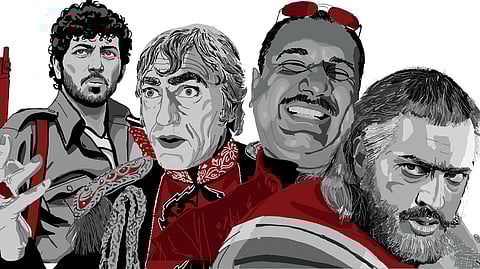


Consider the monster. Gabbar Singh in Sholay (1975) wears an olive-green safari suit resembling military fatigues, hard black combat boots, and a rusted cartridge belt slung along his side. He looks like El Indio (from A Few Dollars More) mixed with Fidel Castro. His plodding, deliberate walk is less of a plundering dacoit’s than a renegade general or warlord’s. It all makes a kind of subliminal sense: if the film’s heroes are honest policemen and courageous ex-criminals, shouldn’t Gabbar represent a force much larger than them?
The ‘look’ of an iconic Hindi film villain is a costumer’s playground. It is an invitation to run wild, to be camp and unfettered and outright ridiculous, to give capes to scoundrels and a Nazi-coded fur hat to a mob boss in Mumbai. And yet, for all their imaginative excess, these costumes have tinctures of truth. When a villain lacks a backstory — the best of them often do — the way they dress and move can crucially fill us in.
Gabbar, for instance, wasn’t stitched entirely out of thin air. The Chambal dacoits that inspired the character really did wear contraband uniforms sourced from the police or army, as Tarun Kumar Bhadury wrote in his seminal text Abhishapta Chambal (which means Cursed Chambal; it is said that Amjad Khan, in preparation for the role, read the book).
Despite his astronomical influence on popular culture, Gabbar is hardly the apex of sartorial villainy in Hindi films. That crown rests deservedly with Amrish Puri, with his remarkable gallery of despots and thugs, feudal chieftains and oppressive patriarchs. His Mogambo from Mr. India (1987) is perhaps the purest crystallisation of a comic book-inspired supervillain: a terrorist dressed in military regalia, funny blonde curlicues on his head, waving a spectre over a map of India as he plans bombings and missile attacks.
Madhav Agasti, a veteran dressmaker and costume designer in Mumbai, created several iconic outfits over the decades. For Mogambo, director Shekhar Kapur presented him with a unique challenge: the villain had to resemble both a ‘foreign’ general and an Indian zamindar (landlord). “I used an all-black coat as well as breeches and long riding boots that zamindars in the colonial era would wear,” Agasti, now 77, says. “The Western vibe came from the epaulettes on his shoulder straps.” The entire ensemble was created under ₹25,000. When Puri saw the costume, he approvingly told Agasti, “Mogambo… khush hua.”
Agasti’s lifelong partnership with Puri is a treasure trove of bold ideas and practical solutions. For General Dong, the comically flashy dictator played by Puri in the 1992 action film Tahalka, Agasti based the look on Ugandan military commander Idi Amin. The India-hating patriarch in Gadar: Ek Prem Katha (2001) was modelled on Zia-ul-Haq, in dark austere sherwanis and Karakul hats, while the Maharashtrian politician in Nayak (2001) was fashioned, amazingly, on late Tamil Nadu chief minister Karunanidhi (the character drapes a shawl around his neck like the DMK leader, though he does not wear his distinctive black glasses). At times, this osmosis would flow in the opposite direction. “Actors wanted to look like politicians and politicians wanted to look like actors,” says Agasti, who also dressed famous leaders such as Bal Thackeray and L.K. Advani.
A giant like Amrish Puri walked so that actors such as Danny Denzongpa, Sadashiv Amrapurkar and Gulshan Grover could run. Grover, feted by his sobriquet ‘Bad Man’, got that name playing a gangster in Subhash Ghai’s Ram Lakhan (1987). The film is a shock to modern eyes, with the sort of chintzy, exaggerated costuming that prevailed in the late ’80s and ’90s. The full name of Grover’s character is Kesariya Vilayati, and he dresses to that description. Grover affects a mullet, frumpy coats of varying greyness and a checkered shawl flung over his right shoulder.
“No character is created in isolation,” Grover says. “Vilayat (foreign) at that time meant London, and there was a fascination with Western fashion trends like stripes and checks. It had penetrated to the most rustic corners of India.”
Grover agrees that, unlike the Mogambos and General Dongs of old, the modern, information-age villain has to ‘blend in’, not ‘stand out’. In the high-tech thriller 16 December (2002), Grover’s lone-wolf terrorist is scary precisely because he adheres to no fixed form. His character, Dost Khan, is a cypher and a shapeshifter. A master of disguises straight out of a Frederick Forsyth novel, he dresses as a ragpicker, a military commander, a high-ranking diplomat and — in the film’s iconic finale — a suave rock drummer. “There was a scene right before the climax where Dost Khan comes out of a place of worship and gives away all his earthly belongings to a beggar,” Grover shares. “The makers edited it out because they felt it would tie him down to a religious group.”
The advent of the multiplex era rewrote the rules of realism in Hindi cinema. Suddenly, our villains (and heroes) belonged to distinct identities, ideologies and geographies. Kishan Khurana in Khosla Ka Ghosla (2006) is a Punjabi property dealer and land shark who torments a middle-class family in Delhi. As played by Boman Irani, Khurana has a scummy, duplicitous manner and a nouveau-riche dressing sense: silk-satin shirts, kurtas, shades. He is the embodiment of a class predator, weighing down with his hulking presence on Anupam Kher’s soft-spoken retiree.
“The painting in Khurana’s office of a deer being mauled by a lion set the tone for the character,” costume designers Manoshi Nath and Rushi Sharma reveal. They avoided bright colours, working with fabrics and silhouettes that contrasted with the hot summers of Delhi. Interestingly, late in the film, Khurana’s fashion sense does an about-turn when he meets Sethi (Navin Nischol), a wealthy NRI looking to sell off his ancestral land (in truth, he’s a theatre actor sent in to out-con Khurana).
“Khurana must impress Sethi and thus we see him next in a golfer outfit: cap, shorts, tee, shoes et al. This is his understanding of classy old money, and he manages to look ridiculous in that as well.”
Nath and Sharma also created the costumes for Rajkumar Hirani’s PK (2014), the last Hindi film in popular memory to wrestle with religion and blind faith, when it was still conceivable to do so. The film’s villain, played by Saurabh Shukla, is a religious guru and televangelist, immaculately turned out in diaphanous white gowns. The colour choice was deliberate, referenced from politicians and godmen around the world.
“We wanted to portray the dichotomy of purity: white to accentuate the illusion of purity with a clean, shaven head and long tilak, red beads which covered Swamiji’s entire right forearm, the hand which holds power. It was a simple yet powerful look against the atrangi (colourful) alien, PK.”
The contemporary Hindi film villain moves between the flashy and the familiar. In Dhurandhar (2025), now the second highest-grossing Hindi film of all time, Akshaye Khanna stole the show as a Karachi gangster in natty black Pathani suits. Though he’s based on a real person, everything from his Sher-e-Baloch outfit to the name Rehman ‘Dacait’ has a flavouring of myth. The film paradoxically feeds off the energy — in internet parlance, ‘the aura’ — of characters we are meant to abhor.
Grover says he leapt for joy watching a film that paid such close attention to crafting its villains. “It’s keeping up a tradition that we started,” he says.
To read more exclusive stories from The Hollywood Reporter India's February 2026 print issue, pick up a copy of the magazine from your nearest book store or newspaper stand.
To buy the digital issue of the magazine, please click here.