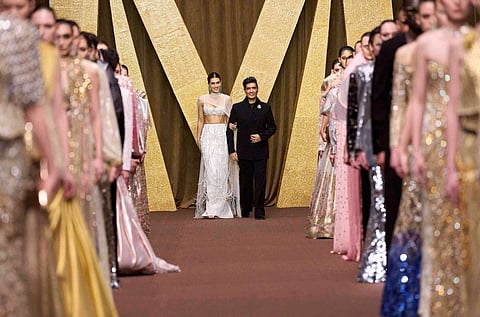


Right before Manish Malhotra’s show — closing Dubai Fashion Week for the second year running — one could sense the build-up. The front row filled up fast, cameras panned the crowd, and clients turned up already wearing his newest pieces. From Dubai Bling’s Farhana Bodi to Heeramandi’s Taha Shah Badussha, the guest list alone signalled what the show represented: visibility, scale and a designer who knows how to hold a room.
On the other hand, Krésha Bajaj’s presentation, the night before, had felt different from the outset. It was quieter, more contained. The focus was on the detailing, the embroidery, the way a personal narrative was said through fabric. After the show, the questions directed to her weren't about scale and celebrity, but about her process instead.
Seen together, the contrast was telling. At Dubai Fashion Week, Indian fashion didn't show up as one fixed idea of itself. It arrived in different registers. Malhotra worked from a place of confidence and market instinct, and Bajaj from personal storytelling. The platform didn't flatten those differences — it allowed them to coexist.
For Malhotra, this freedom translated into a command over his craft. His Dubai Fashion Week showcase — titled 'Inaya: The India Story' was an celebration of Indian artisanship rendered legible to a Middle Eastern audience attuned to opulence.
“For me, it's about Indian crafts. This collection had Chikankari from Mijwan [Welfare Society], the NGO that I run with actor Shabana Azmi, Kashmiri thread work and in all the Jalabias, there was traditional handicraft.” he said.
The process, he noted, was deliberate and restrained: “We worked on this collection for three months. This was an absolute romance with heritage, culture, pearls, that sort of softness. It was lighter, yet opulent.”
That balance — between lightness and excess, heritage and global interest — is what gives Malhotra’s work its fluency in Dubai.
“We did an entire run through of all the looks in Mumbai, styling it. And I don't want to over-style the looks. I wanted each piece to speak,” he explained, adding, “It's very important as we enter the 21st year of our label to take a lot of our culture and work of our craftspeople with us on the global stage.” Even the introduction of accessories — belts and bags as a new business vertical — signals a designer thinking not just about a show, but about sustained presence. This comes two years after the designer set up his international flagship store in the city.
It also happens to be exactly what Jacob Abrian, Founder and CEO of the Arab Fashion Council, loves most about Indian designers. “We love the know-how that Indian designers bring when it comes to preserving the culture,” he says. “So often, the only way for designers to produce massively is by letting go of craftsmanship. What Indian designers are bringing to us is an awareness that culture can be preserved and at the same time be appealing to the world; be commercial.”
That sense of ease also extended to the runway experience itself, articulated by Malhotra's showstopper Kriti Sanon. “The only time I've loved pearls is when he's made an outfit. I love the drama with the pearls hanging, and [the fact that it’s still] subtle and easy to wear. I felt like I was gliding on the ramp,” she said.
She continued, “As I was walking, I could feel the pearls bouncing, having the same energy as the song.” For Sanon, Malhotra’s strength lies in translation rather than nostalgia: “Manish always takes something ethnic from our Indian heritage and adds a modern, global lens to it; a twist with Manish Malhotra’s magical touch.”
Speaking of the music, he closed the show with “Ramba Ho” from Dhurandhar, everyone clapping along. “While you're watching an amalgamation of different schools of embroidery, the music has to be fun,” Malhotra said. “When I say the India story, India is incomplete without Bollywood and my career is incomplete without Bollywood as well and the kind of music I've loved and grown up on. So getting that in, mixing it, making fun was the most important thing.”
Sanon described it simply: “There was a bit of a retro techno kind of a vibe going on which is very cool and fun.” Bollywood here was not a gimmick but a language — one that Dubai understands without explanation.
If Malhotra’s freedom was about scale and assurance, Kresha Bajaj’s was about slowing down to experiment, to resist spectacle. Presenting her collection 'Tempered' at Dubai Fashion Week for the second time, Bajaj framed the show not as arrival but as continuation. “The only show that I've done in India so far was in 2014 where I was barely six months old as a brand. But hopefully in the future,” she said, situating Dubai as a space where her work can evolve without premature pressure.
Storytelling remains central to her practice. “It stems from the idea that we are all born ordinary. And then we become extraordinary because we are tempered with. We go through things like death, heartbreak, injury that makes us extraordinary,” she explained.
That philosophy translated into material play rather than visual excess. “That's the concept that we played with with our materials for this collection. It's primarily an autumn-winter collection and we've tempered with leather, with fabric to make it like lace, with metal. It’s interesting to see how you can push a material and change it to work like something different.” In a fashion week often associated with bling, Bajaj’s work asserted that restraint, too, has a place.
Notably, she has resisted the gravitational pull of cinema despite her proximity to it. Asked about designing for films, she was unequivocal: “No, I haven't actually. I'm engrossed in what I'm doing right now and I'm enjoying it.” Her relationship with celebrity remains personal.
“Yes, Samantha [Ruth Prabhu]. She's my best friend, my muse and it's always a pleasure and always exciting to keep experimenting with her.” The focus, instead, is on building steadily. “I'm excited that I have brought back ready-to-wear into the brand. That's how I had started many many years ago. We've just opened the store in Delhi and we have some really exciting international collaborations coming up.”
The fact that Malhotra and Bajaj can share the same platform without being flattened into a single narrative speaks to the ecosystem Dubai Fashion Week is consciously building. According to Jacob Abrian, co-founder of the Arab Fashion Council, the emphasis is on preservation — of craft, of capital, of creative longevity.
Abrian situates India as both inspiration and mirror. “India for us is this very rich place in terms of culture, architecture, colours, inspiration only from the landscape, from the spices, from the savoir faire, from the diversity of people. The world is in India in terms of languages, skin color, facial features. It's true for Dubai as well and that's why Dubai is a second home for the Indian designers.”
That affinity is matched by the rigour of a strict application process, said Abrian, detailing a system that evaluates image, commercial readiness and financial sustainability. “For a designer to travel outside home in order to put on a fashion show is not an economical process. It is expensive. And if you are not ready to go through that route, it would be harming the designer if we accept the designer to be on board.”
Protection, rather than promise, underpins the model. “Not because we want to limit you, we want to protect you,” Abrian said. “Because so many designers we've seen have gone to fashion weeks in Europe and that has been the end of their fashion designer life because they were not able to continue affording.” This extends to the rejection of spectacle for its own sake. “The designer is not designing for a showstopper, but for the community. You are not going to be successful as a brand because who will make you alive, who is going to make you sustainable as a brand, is the community that is going to care for you.”
In this context, celebrity becomes incidental rather than central. “This is not really the culture in this part of the world,” Abrian said of showstoppers. “Even with so many international designers like Hermés from the region that they showcase in Paris, showstoppers are not really the most important factor for them.” Dubai, he added, is already accustomed to scale. “Trust me, people don't always feel impressed because Dubai has hosted almost the most important events around the world.”
What emerges, then, is not a homogenised fashion moment, but freedom. For Malhotra, Dubai rewards mastery, visibility and cultural fluency. For Bajaj, it offers space to test ideas without distortion. And for the ecosystem that holds them both, the objective is clear: to ensure that creativity is not punished by financial overreach, and that Indian fashion can expand globally without losing its touch. At Dubai Fashion Week, Indian designers are not being asked to become something else. They are being allowed to become more themselves.