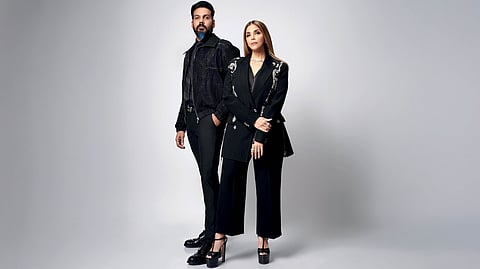


Long before Indian fashion went global — even before international red carpets were flooded with homegrown names and before luxury houses began eyeing India’s swelling creative class — one Mumbai-bred label had already cracked Hollywood’s code.
The moment they didn’t know they’d been waiting for came quietly at 6:30 a.m. on an ordinary morning in 2010, when designer Falguni Peacock picked up a call from a Los Angeles stylist. “We’d like you to design options for Fergie,” the voice on the other end said. “She’s performing at the FIFA World Cup. We need them in South Africa in seven days.”
Falguni didn’t blink. “Before you wake up, you will have the sketches.”
Two days later, four handcrafted performance looks were ready — feathers, crystals, movement, drama — all unmistakeably from label Falguni Shane Peacock. Fergie wore every one of them. The designers didn’t get the outfits back (“These are pieces they keep,” Falguni says), but they gained something far more valuable: certainty.
“That was the moment we realised — this is what we’re meant to do.”
What followed was a head-spinning run: Beyoncé’s music videos, photoshoots with Rihanna, Lady Gaga’s avant-garde appearances — over 200 stars dressed between 2010 and 2015 alone, and nearly 50 concerts outfitted in their maximalist, blingy aesthetic.
And the most unforgettable moment of all? A night in New York, back in 2012, when Paris Hilton whisked them into Lady Gaga’s perfume launch. The singer, encased in a giant egg, stretched out her hand as fashion royalty queued to greet her. “We wondered if we should do it too,” Shane Peacock recalls. “Paris said — ‘No, you shouldn’t.’ And guess who was also in line? Marc Jacobs.”
But that’s the thing about Falguni Shane Peacock — the couple has always been both inside the room and outside the rulebook, making news as lately as last month when RPSG Ventures acquired a 40 per cent stake in their label at an enterprise value of ₹455.17 crore.
The Peacocks didn’t start with a map. They started, as Shane puts it, “by just going with the flow.” Orders came unexpectedly. Buyers from international retail stores like Harrods showed up for their 10 a.m. debut show at Wills Lifestyle India Fashion Week in 2006 — a graveyard slot on a Sunday morning. Six international buyers attended. All six placed orders.
The same year, Harrods sent a contract so thick it could be mistaken for a script. Everything was skewed in the store’s favour, Shane says. “But we didn’t care.” It was Harrods. Their names lit up a huge counter in the London store. Life changed overnight.
Their big Hollywood ‘break’ came organically, through a chain of people who simply liked what they saw. At their New York Fashion Week previews, stylists from Los Angeles would walk in, circle pieces with sharp fingers, and say: “I need this for Beyoncé. Keep that for this video shoot.”
Their collections were built with performance in mind — body-skimming bodysuits, iridescent sequins, feathers engineered to move with choreography. “It was a mix of red carpet and performance looks,” Falguni says. “And [the latter] were almost always customised.”
There was validation everywhere — the kind most designers dream about. American comedienne and actor Joan Rivers attended their shows. Hilton championed them early on. Gaga told them, “Of course I know you guys.”
The brand’s earliest identity was pure resort wear — prints, kaftans, easy-going silhouettes. Their Miami Fashion Week show in 2008 helped push their retail footprint to nearly 30 international stores in a single year. “A Miami[-based] stylist told us our resort wear would sell there,” Shane says. “They were right.”
Another turning point arrived the next year at London Fashion Week, where their easy, resort silhouettes suddenly felt out of place. “London wanted edge,” Shane says. “People would show up in painted faces or with literal boats on their heads. That city changed how we looked at fashion.”
It was there — amid the grit, the nightlife, the boundary-pushing aesthetic — that they carved what they now call their design DNA. “We sat down and refined everything,” Falguni says.
They showed nine or 10 seasons in London, before expanding to New York — drawn by the gravitational pull of the celebrities based there. Opening a New York office became necessary. “Stylists would say it’d be easier if someone could pick up and drop pieces,” Shane says. “So, we set it up.”
Their global momentum was explosive. But yet another turning point was waiting, this time in their own country.
By 2017, international markets were slowing, but India was booming. And for the first time, they paused long enough to ask: What if we build something big here?
“When we returned to India, we realised the market’s potential,” Falguni says. “If we’re here, we must be the best.”
Despite entering late — in a landscape dominated by designers such as Sabyasachi, Tarun Tahiliani and Abu Jani-Sandeep Khosla — they reinvented themselves yet again and “shed their old skin.” They reimagined their visual language for Indian couture. And India responded with appetite.
Stores followed — first Delhi in 2017, then Mumbai in 2019 with a stunning bridal flagship store designed by Gauri Khan. Their first India Couture Week (ICW) collection — in 2018 — was a runaway success. More opened rapidly. Their 10th store will open early next year — all built without external funding. Today, they retail from nearly 80 stores across the world.
Somewhere along the ride, they even launched The Peacock Magazine.
“We wanted to tell our own stories,” says Shane.
Their first cover star? Sonakshi Sinha, in 2017. Five years later came a travel magazine. Their controversial, viral youth cover — featuring Ahaan Panday, Tanya Shroff, Alanna Panday and Aaliyah Kashyap — was their boldest bet. “My team said, ‘Sir, these are kids.’” Shane says. “I said, these kids are the future. Ahaan is going to be a superstar.”
He wasn’t wrong.
Ask Shane his design philosophy when designing for celebrities and he answers without hesitation: “It’s never about the clothes. It’s about the personality.”
Consider their recent shoot with Vidya Balan for The Peacock Magazine in July this year. Balan is an actor synonymous with traditional Indian silhouettes. When she asked for saris, Shane pushed her toward westernwear. “She wasn’t sure,” he says. “But she trusted us.”
The results went viral. Vidya called them later, stunned. “She said she had never even received so many calls for a movie look,” Shane says. “Strangers were telling her she looked incredible.”
Celebrity work hinges on instinct, chemistry, and timing. Their showstoppers reflect this. “We hadn’t used a male showstopper in years,” Shane says. “But Akshay Kumar made sense.”
He hadn’t walked a ramp in about a decade. The last time he did, it was for them — in March 2014 at the McDowell Signature Derby, where he walked down the runway with actor Raveena Tandon.
“I told him, ‘We’re giving you a simple white sherwani. No design, no colour.’” The look became one of their most-ordered pieces.
One of their most surreal experiences arrived during the Covid-19 pandemic. With runway shows halted, they wanted to create a couture film — but not just anywhere.
“Shane suddenly said — let’s shoot at the Taj Mahal,” Falguni recalls. “I told him he was crazy.”
He wasn’t. In 2020, with the site nearly empty due to lockdown restrictions, they managed to secure permission through the Archaeological Survey of India and key ministers. “They closed the Taj Mahal for three to fours hours for us,” she says. “They said this usually only happens for presidents and prime ministers.”
Their crew of 40 shot at the Taj, then at Mehtab Bagh the next evening. “Nothing is touched up,” Falguni says, showing a photo. “It was magical.” The result: they presented their FDCI India Couture Week 2020 couture line-up ‘Love Is’ through a fashion film (which is now available to watch on YouTube).
For the designer duo, Mumbai is still home. Inside Lakshmi Industrial Estate, their factories house 900 artisans — many who’ve been with them for over 22 years.
The question then arises: what’s next for the brand that does it all? Well, everything. And then some more.
Their recent ICW show marked their return to Indian couture with full force. They continue retailing globally — the U.S., Europe, Singapore, Australia. A new store opens early next year. Their advanced contemporary line arrives in February. And next month, work begins on their Paris collection.
“We typically work six months in advance,” Shane says. “There’s too much happening.”
But that’s the only way Falguni Shane Peacock know how to operate: at full throttle.
And on the subject of imitation — a problem every successful designer faces — they remain unfazed. “If you don’t want to be imitated,” Shane shrugs, “don’t be in the business.”
Falguni adds, “They can copy. We’ll keep creating.” There’s no dearth of creativity here.
To read more exclusive stories from The Hollywood Reporter India's December 2025 print issue, pick up a copy of the magazine from your nearest book store or newspaper stand.
To buy the digital issue of the magazine, please click here.