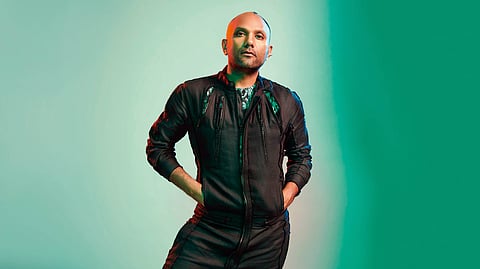


The Internet loves a label — and Gaurav Gupta has earned more than a few: “avant-garde”, “rule-breaker”, “the future of couture”. But none of them quite capture the essence of a designer who draws inspiration from everything — time, movement, art, surrealism, architecture, nature, the cosmos. His world is one that’s driven by intuition, not intent — where nothing is absolute and everything is fluid.
It’s this transcendental quality — the way he balances form and flow — that has drawn celebrities from across the globe to his creations. Most recently, and perhaps most memorably, Gupta designed Aishwarya Rai Bachchan’s dramatic black gown for Cannes this year — a striking departure from her usual choices, one that instantly went viral.
“When I met Aishwarya, I’d taken a few samples from some of my Paris collections and some of my early work. We decided on the embroidery and colour we liked, but I was clear — I wanted to do black,” recalls the designer. “Also, after a few years of Aishwarya wearing larger-than-life silhouettes, I wanted something elegant and timeless for her. That’s the conversation we had when we started.” The finishing touch? A distinctly Indian element — brocade — woven into the structure.
From Bachchan to Beyoncé (for her Renaissance Tour in 2023), Cardi B (for the Grammys in 2023), and Megan Thee Stallion (for the Oscars in 2022), Gupta’s gowns have been bringing both form and flow to international
red carpets.
Though couture became his calling, Gupta’s creative roots run far deeper. “I come from a business family in steel, but I was always artistic — into music, dance, painting. I even studied sculpture as a subject in school,” he says. But he chose fashion because of a deal he made with his father — that he’d attend a prestigious college if he got in, which he did, before founding his eponymous label in 2005 with his brother, Saurabh.
The Central Saint Martins and National Institute of Fashion Technology alumnus spent his childhood around metal sheets which found its way into his couture language; one that has proved to be quite a celebrity favourite today.
One of Gupta’s earliest celebrity moments came when Cardi B wore one of his sculptural creations in her “No Love” music video in 2022. This collaboration was facilitated by Hema Bose, founder of the Los Angeles-based luxury consultancy Maison Bose, with whom Gupta began working in 2019.
“Hema was in touch with (Cardi’s stylist) Kollin Carter and we custom-made that for her music video. He saw some of our sculpted pieces in our showroom in LA and wanted a more exaggerated version of it. And just after that, Megan Thee Stallion wore us for the Oscars.” Carter also attended Gupta’s first couture show in Paris and just four days later, Cardi B wore him at the Grammy Awards. “Sometimes celebrities wear an existing garment and other times it’s custom-made. It depends on the occasion, the talent, and on the dress itself,” he explains.
Speaking of customisation, for Kiara Advani’s Met Gala debut this year, Gupta worked closely with stylist Anaita Shroff Adajania at his Kala Ghoda store, in Mumbai. “We tried a few outfits on Kiara and she was personally involved throughout the process. We had to make a form exactly to her measurement, but it was challenging because her body is growing as well.” Eventually, to ensure that the mum-to-be was comfortable, they ended up making a second breastplate at the very last minute.
One high-profile moment that didn’t pan out was Halle Berry’s planned appearance in Gupta at the Cannes Film Festival opening night, where she was a jury member. “This was the first time a dress code was given for something like this. We were all surprised because her being one of the main jury members, it would have been a big moment.” He added, “Hema had already secured this with Halle Berry, but certain things are not in our control. Our whole Cannes season was planned with that big impact right from the first opening night.”
But what the designer enjoys most about red-carpet fashion today is the sheer variety and strong sense of individuality he sees. “It’s become much more innovative,” he says. “What I’d change? How last-minute it all tends to be. While some plan in advance, things keep changing.”
Despite the mishaps, Berry did wear Gupta to a later Cannes event, alongside other stars, Ishaan Khatter and Bachchan.
This year, most of Gupta’s celebrity clientele reached out to him after his Spring/Summer 2025 show in Paris in January.
“My last Paris collection is something all of my actor friends have messaged me about,” Gupta tells The Hollywood Reporter India. “They said it was the best thing they’d ever seen. I see actors as artists and that collection hit a very personal, deep, emotional note with them.”
Titled 'Across the Flame,' the couture line was a powerful story of catharsis, resilience and survival. In 2024, Gupta’s wife, poet and author Navkirat Sodhi, survived a devastating fire — an experience that became the basis of the collection. She later opened his Paris show in January, walking the runway in a cream gown that revealed her scars. As she walked, she said, “It happened in less than five seconds. But stranger things have happened to stranger beings on their way to dispel the dark.”
The show, an emotional reckoning for both Gupta and Sodhi, left many in tears. “Backstage, my team said the audience was walking out crying,” Gupta recalls. The collection featured ethereal silhouettes symbolising stages of their healing journey — flame-like drapes, sculptural forms, corseted bodices fused with denim and brocade, and Indian elements like ghungroos.
Gupta remembers the reactions post the show, saying, “We had like 3,000 comments on one post.”
He added, “We were so overwhelmed that we had to go into hiding, especially because we were already so sensitive after the accident. But it was a major part of our healing to share our pain with everybody in the world.” They received letters from burn survivors and amputees saying that they had inspired hope and strength in them all.
Deeming the collection to be a portal in fashion, he believes the industry has not been showcasing collections as spiritual and emotional as this was, not in a long time, and certainly not in Paris. And that’s what inspires his celebrity clientele too — “the uniqueness of our storytelling, and of the craft.”
Gupta draws inspiration from fashion’s most iconic names — Alexander McQueen, Vivienne Westwood, Hussein Chalayan (whom he interned with in London), Rei Kawakubo, Junya Watanabe, Yohji Yamamoto, John Galliano and Elsa Schiaparelli. Running out of breath, he adds, “You can’t just love one designer. It’s like saying you like one filmmaker. How
is it possible?”
But he doesn’t necessarily speak their design language. When asked how he balances form and structure — tell-tale signs of his couture — Gupta shrugs: “I don’t know. It just happens. I don’t follow rules. I’ve made my own rules, my own patterns, my own drapes.”
Gupta is quick to point out how his innovations have shifted Indian fashion: “Saree gowns? We commercialised them. We brought in ruffles — and now there are so many ugly versions of them. We did embroidery on menswear jackets in a futuristic way, and now it’s being copied everywhere.”
So extensively, in fact, that Gupta filed nine cases in the Delhi High Court against counterfeiters, seeking ₹2 crore in damages from each. As reported by The Economic Times in 2024, the court acknowledged the intellectual property rights of Reflect Sculpt Pvt Ltd, the parent company of Gaurav Gupta Couture, and restrained violators from manufacturing and selling fakes. The defendants destroyed the counterfeits and pulled related content offline.
But has the designer ever seen these copies up close?
“Yeah, I have,” Gupta recalls with a laugh. “One time when I was sourcing in Lajpat Nagar [in New Delhi], I saw one of my embroidery patches and I’m sure it was made in China. I thought, wow, I’ve definitely made it.”
He keeps noticing them in shop windows as he’s driving by, and his legal team keeps sending out notices. They’ve sent hundreds to date. He adds, “It depends on the level of copies. If it is something which we feel like is imitation, then we take action.”
The line between inspiration and imitation is drawn by the intellectual property (IP) system that is handled by his legal team.
Gupta’s commitment to originality also extends to the materials he uses. “We use a lot of natural fabrics — silk and cotton — compared to many international brands in India. That makes our garments inherently more sustainable,” he says.
Since couture isn’t disposable, his creations don’t end up in landfills. “These are modern heirlooms, meant to be passed down. Even our packaging is made from upcycled ocean and landfill plastic — our jacket covers say, ‘I used to be a plastic bottle.’” He follows a zero-waste policy in production: fabric cuttings are reused in new garments.
In an industry often driven by trends and timelines, Gupta stands defiantly outside the clock. His work is not just fashion, but an evolving language — one that speaks stories of survival, redefining red-carpet glamour. Gupta continues to defend his creative integrity — proof that the most powerful design comes from a place of truth.
Favourite pieces in your wardrobe? Rick Owens shoes (like the ones I wore with Aishwarya at Cannes), deconstructed jackets, cotton jumpsuits.
Your most cherished collection? My first collection in Paris called ‘Shunya’, also ‘Jyotirgamaya’ and ‘Hiranyagarbha’. When I’m showing collections in India, I like doing European or alien themes; when I’m doing so in Paris, I like Indian themes with western silhouettes.
Would you ever want to design costumes for movies? Yeah, for sure. A fantasy one, or I’ll just make my own film. I would have loved to make clothes for Game of Thrones, Star Wars or Dune.