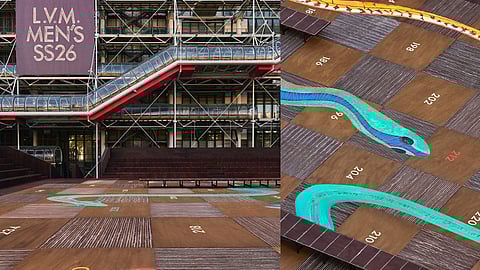

Indian representation is at an all-time high this year at the SS26 collections showcased at Paris Fashion Week. On June 24, 2025, Pharrell Williams unveiled his Louis Vuitton Spring/Summer 2026 menswear collection outside Paris’s Centre Pompidou, turning the plaza into a monumental Moksha Patam (the ancient Indian precursor to Snakes & Ladders). The runway was reimagined as a sprawling Moksha Patam board, India’s ancient precursor to Snakes and Ladders—commissioned in collaboration with acclaimed architect Bijoy Jain of Studio Mumbai. Handcrafted in India using timber and natural pigments, the set wasn’t merely symbolic; it became a living map of philosophical dualities—of virtue and vice, of ascent and descent, of the playful and the divine.
In private messages exchanged before the show, Pharrell described it as “dandyism redefined,” hinging on soft tailoring and colours “inspired by India.” His fixation on the Darjeeling palette, the layered saffron, mustard, forest green, and earthy russet tones that first caught the eye in The Darjeeling Limited—filtered into silken cargo pants, cropped pleated trousers, and air-light tunics. Directed by Wes Anderson and released in 2007, the film follows three estranged brothers on a soul-searching train journey across India, steeped in themes of spiritual disorientation, familial tension, and cultural curiosity. Its saturated visuals, ornate luggage, and slow-burn storytelling created a romanticised, if stylised, portrait of India, one that Pharrell recontextualised with a newer lens. The result felt less like costume, more like conversation: a curated chromatic homage that danced between the spirited zest of Himalayan life and the quiet codes of contemporary haute couture.
But the accessories showcased in the show were the real manifesto. Speedy bags, carry-ons, and carry-on trunks wore subtle Indian motifs with elephants, palm trees and snakes. The references were clear: this was India through Pharrell’s eyes, filtered through the lens of heritage, travel, and maximalism.
The trunks themselves were nothing if not showstopping. Some kept it sleek in coppery monogram canvas, an ode to Louis Vuitton’s bestsellers. Others were fully encrusted with pearls, crystals, and metallic hardware, like heirlooms straight from a Maharaja’s wardrobe.
Yet another ode to India came through the show’s soundtrack, crafted in collaboration with musical legend A.R. Rahman, who was also in attendance. Working closely with Pharrell, Rahman composed a track that layered Punjabi lyrics with gospel tones and live drums. The front row brought together some of the biggest names across fashion, music, and film. Jay-Z and Beyoncé led the line-up, alongside Bradley Cooper, Pusha T, Future, J-Hope, and Jackson Wang. On the Indian side, actor Ishaan Khatter, performer Nora Fatehi, and Maharaja Padmanabh Singh (Pacho) made notable appearances.
Pharrell’s Vuitton SS26 tapped into the zeitgeist and put Indian creativity front and center. With architect Bijoy Jain designing the runway and A.R. Rahman crafting a custom Punjabi score, the show didn’t just take inspiration from India, it worked with it. For Vuitton, it marked a more thoughtful way forward. And for India, it was long overdue.
