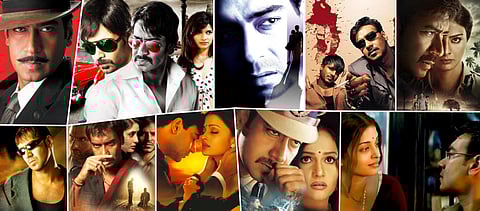


Action and Ajay Devgn are old soulmates. He started out as an action hero; his leg-split entry while straddling two bikes in Phool Aur Kaante (1991) remains one of the most recognisable career-intro shots in the Hindi pop-cultural canon. He is the son of veteran stunt choreographer Veeru Devgan. He is a technically sound action film-maker himself, having designed movies around mountaineering (Shivaay), airplanes (Runway 34) and cold-blooded combat (Bholaa). His most successful character is supercop Bajirao Singham, Rohit Shetty’s car-smashing and perversely pulpy paean to police brutality.
Ironically, Devgn’s action heritage is the reason that his departures from the genre — the comedy, romance and family dramas — hit differently. A roster spanning more than three decades is no mean feat. But, contrary to perception, it’s artistic ambition that has sustained this career. The actor within the action has shaped an uncanny marriage between grafter and star. If you think of peak Ajay Devgn, it’s that trademark look of anguish — and not some gravity-defying stunt or political punchline — that comes to mind. The anguish of a lover (Hum Dil De Chuke Sanam, Raincoat), a son (Zakhm, ), a father (Drishyam, Shaitaan), a gangster (Company), a mentor (Omkara), a patriot (Maidaan) and a man (Bhoot). It’s the versatility of this anguish — the emotive action in a career built on physicality — that reveals more than a nationalism-era and prestige-age poster hero.
On the eve of Singham Again, Shetty’s Ramayana-coded new installment in his Cop Universe, it’s a good time to reminisce about Devgn’s finest performances:
10. The Legend of Bhagat Singh (2002)
The Legend of Bhagat Singh may have been the best of the three Bhagat Singh movies in 2002, but it’s far from director Rajkumar Santoshi’s finest work. Yet, a glimpse of a young Bhagat Singh in Shoojit Sircar’s Sardar Udham (2021) becomes a reminder of the mainstream aura — the sheer commercial volume — that Devgn brought to his rendition of the freedom fighter. There’s something about the way Devgn plays serious men; he modulates his voice and focuses on intonation until there’s little spontaneity left. The acting is visible. But this performative tone supplies Bhagat Singh’s role with the drive of an ideology that’s often staged as an antidote to Gandhi’s idealism. You can tell that the character is putting on a show of charisma in a country that’s torn between two brands of patriotism. It’s this simulated nature of Devgn’s revolutionary — which, back then, was shaped by sincerity rather than agenda — that has secured a newer meaning in a post-truth India.
9. Drishyam (2015)
From acting alongside Malayalam superstar Mohanlal in Company to starring in the Hindi remake of a Mohanlal hit, Devgn’s career comes full circle in Drishyam, a film in which his character’s cinephilia supplies the moral struggle of his fatherhood. He lends a poignant anti-hero vibe to Vijay Salgaonkar, a Bollywood fan who uses his learnings from fiction to shield his family from the reality of a murder investigation. The essence of this performance is rooted in Devgn’s filmography — the inherent goodness of the conflicted men he plays is replaced by the inherent darkness of a good man. The film’s suspense is shaped by a sort of vulnerable virility: he plays Salgaonkar as someone who knows he’s an Average Joe in the land of Bajirao Singham. It’s a fine portrait of conspiratory guilt, urgency, as well as an irrational parental madness that became a cash-grabbing formula in both Drishyam 2 and Shaitaan. Drishyam isn’t a patch on the original, but Devgn leads a potent cast to craft a domestic thriller — one that sets the stage for Tabbar (2021), the definitive incarnation of this premise.
8. Once Upon a Time in Mumbaai (2010)
Over the course of his career, Devgn has made the recurring role of the “honourable gangster” his own. Even though his most popular character is a Maharashtrian cop with swag, it’s his renditions of principled baddies — large-hearted dons and conscientious crooks — that make for his most striking turns. From Company and Omkara and Gangubai Kathiawadi, his pitch has often swayed between stoic and sullen. But it’s his embrace of camp in Milan Luthria’s Once Upon a Time in Mumbaai that takes the masala cake. As a (very) dramatised version of Bombay mafia leader Haji Mastan, Devgn nails the 1970s excesses — the lazy-eyed grin, the stylish moustache, the pensive chain-smoking, the righteous thuggery — of his character Sultan Mirza. He plays Mirza like an underdog hero who is confronted with a monster (Emraan Hashmi’s Dawood-fuelled rise) of his own making. He acts like the camera is always on him and speaks at a higher frame rate; even writer Rajat Arora’s flashy punchlines sound relatively saner when he’s on screen. It’s not the first time we see a don betrayed by his power-hungry protege, but Devgn radiates a scent that reframes the villain origin story as a flawed godfather tale. He puts the time in Once Upon a Time, turning a gangster biopic into strangely soulful pulp fiction.
7. Khakee (2004)
Ajay Devgn’s portrayal of an unhinged villain in a Rajkumar Santoshi film came as a breath of sinister air. He had only tested the waters with Deewangee (2002). A year after his upright-cop renaissance in Gangaajal, Devgn turns the tables on himself as Yashwant Aangre, a corrupt cop who mutates into a state-sponsored criminal. Paired as an angry young baddie opposite the original angry young man (Amitabh Bachchan), Devgn contextualises the gimmick with the right mix of ham and heft. His contribution to Khakee’s growing cultdom is crucial: those Vijaypath-coded glares, the comic-villain stealth, the troll energy and, of course, the sly grin during that famous twist. What's fascinating about the performance is that he plays Aangre as a domestic extremist disguised as a disillusioned rebel. He stalks the police team like a character determined to make Khakee a road movie. Ultimately, Devgn becomes the backbone of a story that infuses the progressive politics of Phir Bhi Dil Hai Hindustani (2000) into a smarter mainstream body.
6. Gangaajal (2003)
At the turn of the century, watching Ajay Devgn in a Prakash Jha film became the political-action equivalent of watching Shah Rukh Khan in a Karan Johar movie. It was inevitable — and a tonal match made in heaven. Gangaajal marked the beginning of this actor-director bromance. The formula is as old as time: an arrow-straight outsider arrives in a crime-riddled place and becomes its moral spine. There are monologues and speeches, lofty reckonings and scornful stares. But Devgn’s typically incorruptible cop grounds the busy setting, allowing the narrative to delve deeper into the social anatomy of small-town police life. He manages to embody the shapelessness of heroism at a time in Hindi cinema when words and verbal set pieces had begun to replace action and agility. It also reinforced Devgn as an iconic “smoker” of contemporary Indian film. He does some of his most efficient acting with a cigarette in his mouth. Except, his puffing isn’t an instrument of style or hyper-masculinity; it’s often a surly man in deep contemplation, offering subtext to the silences in the script.
5. Company (2002)
You just had to be there. It felt like the underworld literally existed so that Ram Gopal Varma could reshape the Hindi gangster genre. Company — his spiritual successor to Satya — feels more significant today, not least because it epitomised the craft of a director that went on to be swallowed by it. Company also cemented Devgn as the go-to face for Bollywood’s Mafia Cinematic Universe. Despite Vivek Oberoi’s barnstorming debut, Devgn established his legacy as the classic mentor figure in a generational saga of bullets and blood. His Mallik bhai is a silhouetted surrogate for don Dawood Ibrahim — nearly a decade before he plays Ibrahim’s predecessor, Haji Mastan, in Once Upon a Time in Mumbaai. His performance thrives on quiet intensity and dead-eyed scowls; he navigates the dissonance of being a villain for society but a hero of its underbelly. Devgn becomes a chilling mood that permeates through the film when he’s not around, much like the cultural ubiquity of the name he represents.
4. Omkara (2006)
A sign of a special performance is when one can’t imagine any other actor playing that role. Ajay Devgn in and as Omkara is an example. He is surrounded by the more memorable characters — Langda Tyagi (Saif Ali Khan), Dolly Mishra (Kareena Kapoor Khan) and even Rajju Tiwari (Deepak Dobriyal) — but makes it look like he’s getting consumed by them. His face is so integral to Vishal Bhardwaj’s simmering Shakespearean landscape that, at times, Omkara “Omi” Shukla’s invisibilised masculinity becomes the point of the story. Devgn gets the timbre and moral ambivalence right, especially when Omi graduates from a ruthless goon to an arrogant politician. As a lower-caste striver, Omi erases a little of himself by choosing an educated successor, but the guile of Langda Tyagi shines a spotlight on Omi’s restrained toxicity. They are two sides of the same coin, except Devgn’s portrayal of feral jealousy in the climax — in which he smothers his innocent wife to death — makes it hard to tell the difference.
3. Hum Dil De Chuke Sanam (1999)
Once the cultural shock of seeing a 1990s action star — a part of the holy trinity featuring Akshay Kumar and Suniel Shetty — playing a soft-spoken and mature lawyer wears off, the cultural shock of watching a soft-spoken and mature man in a Sanjay Leela Bhansali movie takes over. Ajay Devgn’s Vanraj unfolds as a pinch of reality gatecrashing Bhansali’s supersized fictions; a rare Sotto Voce in the director’s operatic tenor. He’s also the sort of iconic third wheel that batted for low-key normies over high-pitched heroes a decade before Rab Ne Bana Di Jodi (2008); one can almost imagine Aishwarya Rai’s Nandini singing “Tujh Mein Rab Dikhta Hai (I see God in you)” at him towards the end. Devgn performs Vanraj — a husband who propels his wife’s search for her lover (Salman Khan) — as a God who is distinctly human; he is not immune to disappointment, desire and heartache. Being the martyr has seldom felt more mortal — and less calculated.
2. Raincoat (2004)
Rituparno Ghosh’s masterful Raincoat could very well have been titled “Love the Way You Lie” before Eminem’s rap ballad of the same name came along. It stars Ajay Devgn and Aishwarya Rai Bachchan as long-lost lovers who spend a rainy day hiding their broken lives from each other; the romance of their lies is rooted in the selfless act of preserving — and aiding — the illusions of the other. There is no hiding for actors in a conversational drama that becomes more of a reflection than an adaptation of literature. Devgn’s restrained turn is replete with regret, sadness and twisted hope; he plays Manoj, a desperate striver, like an incomplete story that’s cursed with what could have been rather than what is. Devgn’s presence is haunting in a way that suggests Manoj is a ghost whose humanity only unfolds in flashbacks; it’s a complex performance that merges the pretty deceptions of storytelling with the unvarnished fictions of love. He also displays a grasp of activity, spatial awareness and preoccupation within scenes that, at that point in Hindi cinema, made him the standout dramatic actor in the business.
1. Zakhm (1998)
As someone growing up in Ahmedabad in the 1990s, I remember liking Ajay Desai — Devgn’s character in Mahesh Bhatt’s autobiographical Zakhm (“Wounds”) — because I shared his surname. Only as I grew older did I discover the meaning of these identities, the deep-set divides, and the sheer prescience of Zakhm. Its themes include a wife’s desire to leave a communally tense India, ministers advocating for ethnic purism, a Muslim woman forced to conceal her religion, a nation on the brink. Zakhm marked Devgn’s coming of age as a dramatic actor after years of middling action stardom. As a stand-in for the director himself — and as a film industry man torn between his secular faith and his family’s fate — Devgn delivers his most memorable performance. He reads Desai well, lending him a balance of old-Bollywood leftism and post-liberalisation allegiance. His perceptive body language and reaction shots inform the film’s fusion of the personal and political. Rewatching it made me feel second-hand anxiety in 2024; an award for “National Integration” is a different beast today. The courage of Zakhm reiterates the relationship between the star of today and the actor of yesterday; between the India of today and the country of yesterday. Somewhere along the way, Ajay Desai and Ajay Devgn became separate entities. History stayed but the language of trauma changed; the wounds stayed but the colour of blood changed. Most of all, talent stayed but the place changed.
Special Mentions:
Gangubai Kathiawadi (2022)
Devgn’s calming presence as a mafia don becomes the ice to Alia Bhatt’s fire in Bhansali’s uneven feminist spectacle.
Singham (2011)
You need to watch Sooryavanshi (2021) and Simmba (2018) to feel nostalgic about how delightfully deadpan Devgn’s original crimefighter was.