

Netflix’s Black Mirror and Vignesh Shivan are not names you’d ever think would co-exist in one sentence. But this is exactly where we’re at in 2026, when the director of films like Naanum Rowdy Dhaan (2015) and Kaathuvaakula Rendu Kaadhal (2022) believes he can combine his hyper-romantic local love story sensibilities with that of the dystopian future in which an app would decide the fate of humanity. Shivan’s pitch seems to have been simple: if we’re moving towards a technology-dependent society in which phones replace human connection, what will happen to love? It’s not a strange starting point, nor is it a question that can be answered easily. By setting his film in 2040’s Chennai, he pushes his take on influencer culture to its limits, hoping to land up with a cautionary tale for the Gen Alphas of today. But by going overboard with instant messaging, we end up with a film that sounds more like a boomer’s lecture instead of producing compelling arguments.
His world is ambitious and silly and Shivan adds several touches only he could have thought of. It’s a world in which Thalaivar Rajinikanth is acting in his 189th film. Posters of Kamal Haasan’s Big Boss-like reality show lines the city’s skyline. Even sillier additions include players like Vir Suryavanshi and Abhishek Sharma (both with grey hair) leading the Indian cricket team in the future and it finally looks like Chennai has achieved the dream of becoming another Singapore. Shivan reimagines every Chennaiite as those obsessed with their phones. Not only are app names thrown around easily to sound natural, but you have to imagine that homes no longer come with kitchens because all food is prepared by Swiggy or Zomato. LIK, the app that dictates the film’s central conflict, is a mix of Instagram and Hinge and guarantees human connections that will never end up in heartbreak. But what if the app makes a mistake?
Instead of treating this conflict with the minimal seriousness required for us to care, the film feels like it’s constantly looking down on its characters and their motivations. When we first meet Dheema (Krithi Shetty), she’s a loud caricature of every beauty influencer you can imagine. Throw in phrases like LOL, WTF, IYKYK in her everyday conversations and It feels like her character was created as someone expected to sound and look silly. A few scenes later, when the film cuts to her tragic childhood full of parental neglect and conflict, we’re still unsure if it’s a part of a bigger joke or if we’re meant to empathise with her.
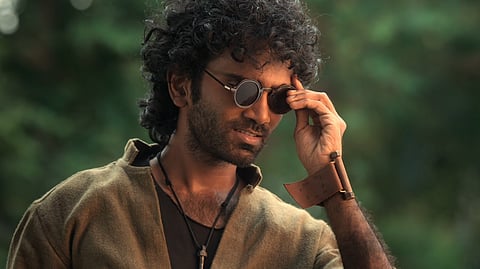
The same goes for how conveniently the film hopes to convince us about Vibes Vassey’s (Pradeep Ranganathan) backstory. We’re told that he and his father have sworn never to use cell phones after their tragic past and we see them run a detox facility for people with phone addictions. Again, the flashback here is so lazily written that it doesn’t make the case for Vassey having to break a personal oath when he downloads the LIK app.
Ravi Varman’s ultra-colourful world-building and Anirudh’s stellar music cannot do much after that to make us care for these people and their love story. SJ Suryah as the evil tech guru feels repetitive as the OTT comic book supervillain. With very little adding to our understanding of the other characters, including Vassey’s father and his best friend Kalki (played by Gowri), the film rarely engages us beyond the surface. What’s worse is how the jokes never land. For all the talk of the future, the film feels ridiculously old-fashioned in its values and the way it treats the character played by Yogi Babu. He becomes the butt of all jokes yet again ,and nothing seems to have been done to give him the slightest bit of humanity. Finally, with the film already explaining what it’s trying to say within the first hour, we simply have to wait out the remaining screentime hoping it dazzles us with something fresh. For all its ambition, LIK is a futuristic movie with medieval problems.