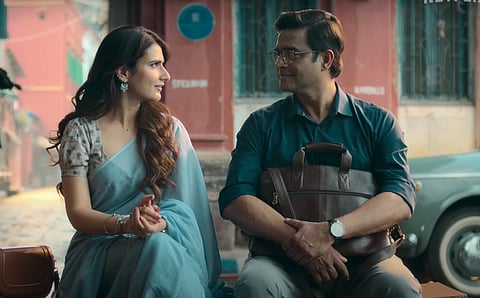


Aap Jaisa Koi is what happens when Badrinath Ki Dulhania (2017), Vicky Donor (2012), 2 States (2014) and Rocky Aur Rani Kii Prem Kahaani (2023) have an awkward college reunion at a restaurant only for everyone to leave without paying the bill. The rest of the gang — Dream Girl (2019), Meenakshi Sundareshwar (2021) and Mrs. (2025) — arrive very late, so the restaurant manager detains them instead. Aap Jaisa Koi is also what happens when playful Bollywood fare is strained through the streaming algorithm. There’s a functionality about the film that flattens the big-screen fluidity of romance, (in)compatibility, warring families and dramatic sermons. Beyond the performative premise of a small-minded man courting a free-thinking woman, the cross-cultural romcom fails to retain the wit, narrative scale and acting sparkle that mark this genre.
The story unfolds in binaries: old v/s young, tradition v/s modernity, town v/s metro, sexism v/s sexual agency. Throw a stone and you’ll hit a contrast in worldviews or opposites-attract cliche. The 42-year-old male protagonist, Shrirenu Tripathi (a shaky R. Madhavan), teaches Sanskrit in Jamshedpur; the younger female protagonist, Madhu Bose (a shaky Fatima Sana Shaikh), teaches French in Kolkata. “If you read Sartre and not Kalidas, you’re missing out,” our chaste man insists. His voice is described as ‘Gulzar meets George Clooney’. He is a virgin — a sweet incel of sorts — after being cursed during his school days; she’s had her share of toxic boyfriends. They are an arranged match made in hell: she’s charmed by his middle-aged bumpkin-ness, he’s bowled over by her frankness and sleeveless blouses. When they do a jugalbandi, she plays the piano and he strums a sitar. She is his live-action fantasy; he is her shot at reality.
The disparity extends to their families. Shrirenu’s gang-gang features a patriarchal brother Bhanu (Manish Chaudhari), Bhanu’s neglected housewife Kusum (Ayesha Raza) and their stifled daughter (Shriyam Bhagnani). (Bhanu is regressive in a pro-establishment way, dropping a “caste is past” comment while considering the new match). Madhu’s fam-fam features a divorced uncle named Joy (Shubhronil Chatterjee), an art-loving mother (Anubha Fatehpuria) and grandmother (Beena Banerjee), a former-actress aunt and other characters that do the staple Hindi thing of staging Bengali-ness as a condition. When one of the Tripathi’s switches sides, this person acts like they’re ‘infected’ by the Bose’s, not inspired by their culture. Using Bengali households as Bombay-film shorthand for wokeness, morality, progressive ideals and soft-masculinity is not new, but rarely has it been as devoid of joy (pun intended). An intro-montage of Madhu’s home feels like Kolkata’s “G.U.J.J.U.” moment (you remember Kal Ho Naa Ho) — only here, the caricaturing overpowers the affection. They’re treated as exotic concepts; the only evidence of Madhu teaching French, for example, is her repeating the word “breathtaking” during their banter.
There’s also the Bollywood-homage habit that shapes so many new-age Dharma Productions. The film opens with a 1998 Christmas party, where a bunch of teenagers are in the throes of the newly released Kuch Kuch Hota Hai. Madhu’s ‘unconventional’ choice in men stems from the fact that she finds Ashok Kumar hot — a detail that’s reverse-engineered into the story through a Chalti Ka Naam Gaadi (1958) movie date. So he is her Kumar; she is his Madhu-bala. The title Aap Jaisa Koi refers to an online sex-chat app that becomes a deal-breaker for the couple, but the subtext is obvious. It’s the name of the chartbusting Qurbani (1980) ‘item number,’ where a swaying Zeenat Aman went on to symbolise the coexistence of both male gaze and female agency.
I get that the intent is to show how India borrows their personality and values from the movies they love. The relationship between truth and pop-culture is one that’s been mined by successful post-liberalisation producers like Aditya Chopra and Karan Johar for years. When others imitate them, there are multiple degrees of separation; a parody of a parody is called (bland) reality. Shrirenu probably uses cinema as an escape and education because of where he lives. He’s a target audience of on-screen misogyny. When he imagines lust and betrayal, it’s always masala-coded imagery: pretty women resembling air-hostesses, or men chasing a sari-clad Madhu. The visual innuendo for his orgasm, too, is a chimney breathing fire in his Steel City. Madhu’s fandom is inbred; it happens by virtue of the generation she belongs to. But there’s a difference between impressionable characters in a film, and the film itself being derived from fiction.
The first line of the review implies this, but there’s more. Most of the cast seem to be based on cinema instead of life influenced by cinema. Someone like Bhanu is the product of too many Udaan (2010) reruns. It’s not that he’s watched the Jamshedpur-set drama and internalised Ronit Roy’s role; it’s that the makers have. Similarly, Bhanu’s long-suffering wife, daughter, and even Madhu’s entire family are consequences of Rocky Aur Rani Kii Prem Kahaani reruns. The arc of an ailing grandmother fast-tracking a resolution and uniting people is the result of Dilwale Dulhania Le Jayenge and Kabhi Khushi Kabhie Gham reruns. The hero’s best friend going “kick you in the balls bro” is a descendant of Badrinath’s pal being the comic relief with a conscience. Even the film trying to subvert the formula — where an unseen ‘senior’ love story catalyses the youngsters — has a Rocky Aur Rani-sized hangover.
Which is to say: forget life, even the Bollywoodization is second-hand. The social commentary comes with invisible hashtags. For a film centered on an app, it’s almost fitting that every second scene looks like it’s tweeted, not composed. As a result, you get dialogue like “You touched me without touching me” and “I woke up the day I mistakenly typed ‘I’m in my way’ instead of ‘I’m on my way’” and “I don’t hate you, I just can’t love you”. You get a couple looking uncomfortable when they try dirty-talking (calling each other “daddy” and “mommy”). You have a cringey punchline to this scene — an elder in tears when she walks in on them but interprets it as a sign of them missing their actual dad and mom. You get a hummable soundtrack, but the music works better as an aesthetic than within the film. You have an appropriation of a love story, not a love story.
When Shri reveals his colours, it’s not that a default-feminist like Madhu chose him without an inkling of his chauvinism — his transformation just feels theoretical and sudden. If the idea is to show him as a (gentle) slave to his heritage, the politics are lost in the film’s decision to make him an unlikable and irredeemable character. The end-credits tribute to Jamini Roy paintings is empty. Even the performances — Madhavan sometimes descends into Rehnaa Hai Terre Dil Mein (2001) mode; Fatima Sana Shaikh is mis-filmed after her striking turn in Metro…In Dino — are burdened by the story’s preoccupation with stories. Given the starting-block troubles of Aap Jaisa Koi, a tiny continuity glitch kept me awake at night. Shrirenu is introduced as a guy so lonely that he speaks to a pet mouse called Pande (this is not an innuendo). But Pande is forgotten once Shri’s journey with Madhu starts. Don’t rodent lives matter, too? It’s like watching Ratatouille gatecrash the aforementioned college reunion to confess that he was the chef all along. But nobody cares. The bill remains unpaid.