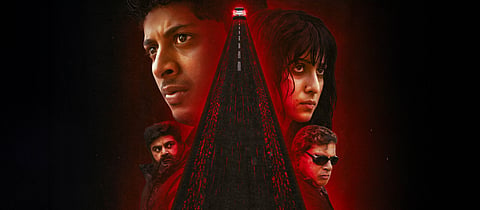


Rich Girl meets Poor Boy. An affair brews. She is a powerful politician’s daughter; he is her driver’s son. They elope. A fleeting romance mutates into star-crossed love. Her family is not impressed. The sinister search begins. You know this young couple is doomed, because the trauma of watching the first segment of Dibakar Banerjee’s Love Sex Aur Dhokha (2010) and Nagraj Manjule’s Sairat (2016) is still fresh. It’s a tragedy as old as time.
In the six-episode series Black, White & Gray – Love Kills, though, this familiar yarn is reframed as a scathing examination of society and its abusive affair with storytelling. Here, the same tale goes thus. An independent British journalist named Daniel Gray has spent two years filming a documentary about an unsolved case. It revolves around an alleged serial killer from Nagpur who was accused of murdering 4 people: including the girl he ‘kidnapped’ and a senior cop. The journalist interviews several people from the time: the hostile investigative officer, a female constable, the girl’s best friend, the hitman hired by the politician, eyewitnesses, the family members of other victims, the accused’s old parents, and finally, the absconding man himself. These interviews are meshed with ‘dramatic recreations’ — or cinematic interpretations — of those fateful few days. Slowly, the bigger picture of a compromised India emerges: societal complicity, confirmation biases, power abuse and a post-truth media landscape.
In other words, this is a “true-crime mockumentary”. The grainy CCTV footage is fake; the evidence is designed; the interviewees on camera are actors; those playing them in the recreations are performers, too. This form chosen is fascinating for many reasons. For starters, it reveals the inherent flaws of a popular streaming algorithm. By being a fictional imitation of the addictive true-crime nonfiction ecosystem, it becomes a critique of a ‘genre’ that’s been templatised and over-staged by OTT platforms. Sensationalism shapes the tone. The details are uncanny: episodes ending with a bombshell or twist, probing camera angles and edits, provocative questions, loaded reactions. The story is inseparable from its packaging. The excavation of this relationship between reality and adaptation is a timely one.
The dramatised parts have the license to be pulpy (a catchy title sequence, set pieces scored with remixed Christmas carols, heightened sound cues) and even implausible. For instance, a character presumed dead comes alive out of nowhere; this character then behaves a little too conveniently (and weirdly) for the foreseeable future. But the show can get away with it because the narrator’s memory is perhaps influenced by the movies he consumes. Any plot holes can be attributed to conflicting accounts of unreliable narrators. The convergence of different stories — an innocent Malayali driver, a young villager, an inspector with eye problems, a viral reel — is replete with manufactured tension. Even the social commentary — where the passage of time allows the interviewees to introspect on themes like womanhood, blind spots, compliance and marginalisation — is part of the formula. Every time a person hints at religious or caste discrimination, they become cagey and backtrack. They don’t have to sound natural because, in a way, nobody is allowed to — it’s also what the medium demands.
The opening episode echoes a culture of narrative distortion. It shows us the story that a nation tells itself in prime-time vignettes. The choice of shots feeds our notions of class rage: a lusty couple, a suspicious-looking guy from a disenfranchised background, a condom used as rubber gloves, bloody fingerprints on a car, a body doused in diesel, a trail of irrefutable evidence. All of it points to a crime of passion and a monster in broad daylight. The next few episodes skillfully fill in the gaps, blurring the lines between perpetrator and victim while exposing our culpability in an age of media trials and selective facts. I like that the storytelling reflects the way most of us are wired to think. The title of the series is corny, but it alludes to the erasure of context in the framing of public narratives. Accidents stem from fear, and fear is an undercurrent across episodes. The couple’s night turns to hell during a hotel raid: it’s the threat of being caught by an unforgiving system that snowballs into an avalanche of misfortune.
There are other neat touches. Like the documentary maker being a white outsider who sees through the exoticism, and does the journalism of courage that none of his Indian counterparts can (the right-wing anchors demand rage, the left-liberal ones are shown to be covertly phony). Ironically, it’s the Western gaze that compels him to be subjective in a field where objectivity is a sign of weakness. He claims to take no sides, but it says something that the recreations — and majority of the episodes — unfold from the perspective of the accused. His empathy lies with those at the bottom of the food chain. The investigating officer even likens his film to the “humanisation of terrorists” and “propaganda”. There’s also the fact that the couple stays unnamed amidst the chaos. You barely realise it, which is no small matter for a series centered on people reduced to headlines and political labels. They’re only black and white — “accused” and “victim” — bereft of the identities they try to forge for themselves.
The clever casting tells its own story. The more mainstream faces — Tigmanshu Dhulia, Deven Bhojani, Palak Jaiswal, Anant Jog, Kamlesh Sawant — are reserved for the recreations. It’s as if the ordinary people being interviewed imagine themselves in grander pop-cultural shades: as ‘characters’ who puncture their own anonymity. The recognisable ones are also listed as the primary cast members. To their credit, they behave and move like they’re one degree of separation away from authenticity: like actors playing actors. For instance, Bhojani (as the hitman) almost looks like a figment of someone’s imagination; Vinod Wanikar, his ‘real-world’ counterpart, sounds perfectly elusive. This duality is best evident in the staging of the protagonist. The boy on camera is superbly essayed by Sanjay Kumar Sahu, while the story avatar is brought to life by Mayur More; the former is relatively unknown, the latter is the hero of the Kota Factory franchise.
A lot of this feels like an indictment of the commercial parameters of nonfiction. Most docudramas are so preoccupied with showing (rather than suggesting) that they forget to read between the very lines they endorse. They adopt the glamour and distractions of fiction, the politics and insinuations of mythmaking. Everyone seems to be playing a role, including the makers who use creative ambiguity as an excuse for moral ambivalence. But once in a while, an audacious series like Black, White & Gray comes along and breaks the fourth wall. There’s a conscious gap between its depiction of reality and the grammar of truth. The dissonance evokes a potent portrait of an age in which reports of oppression are forced to look like reconstructions of itself; where storytelling ‘lies’ in the eyes of the beholder. After all, love may kill but it’s hate that survives.