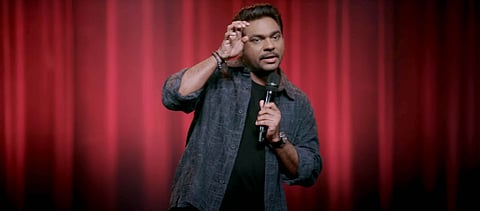


Watching a Zakir Khan stand-up special is like watching that funny friend from your childhood actually find his true calling. It’s sort of moving, because you know for a fact that none of those friends took their talent seriously. Society simply reduces them to a personality type — the witty guy, the joker, the attention seeker, the mischief monger, the crowd pleaser, the yapper. If anything, they barely recognise it as a talent. Khan’s sets often feel like an authentication of such transient, everyday humour. His languid delivery expands the most ordinary details into mini-narratives of being alive. Which is to say: Zakir Khan isn’t a comedian; he’s a very good storyteller with comic timing. He isn’t really funny; he’s funnily real.
Like Varun Grover, he can read out a restaurant menu and accomplish more than most Bollywood comedies. And he makes sure that his Hindi-language delivery — sprinkled with dashes of Indori Urdu and spoofy English — remains the protagonist. You hear a successful urban entertainer at the top of his game, but at no point do you stop listening to a small-town Indian punching up, rechecking his privilege and chuckling at the idiosyncrasies of social hierarchy. “He’s made it,” you remember, every time he mines his aimless-drifter years on stage. “Good on him,” you think, every time he humanises his struggle through an assortment of light-hearted anecdotes. Delulu Express, his fifth stand-up special, extends the evolution of this storytelling. It isn’t as adolescent and boyish as Haq Se Single (2017) and Kaksha Gyarvi (2018); it doesn’t have the coming-of-age poignance of Tathastu (2022); it isn’t as culturally intuitive as Mannpasand (2023). But that’s the thing about reaching adulthood — it’s just more surefooted. It’s a different stage, not a different person.
It’s hard not to imagine Delulu Express as a slice-of-life film. As per its title, it revolves around train journeys, both literal and figurative. A 23-year-old Khan, fresh from three years of joblessness, is traveling ticketless from Indore to Delhi for a last-minute interview. The elements are familiar: a wisecracking rickshaw driver, colourful passengers, his ‘simpleton’ best friend Kuntal, a sleeper-compartment meet-cute, a Dhoni-ticket-collector joke, a toxic boss, the anxiety and humiliation rituals of a first job, a stolen bag, a home visit, and a heartfelt skewering of corporate culture. The streamer does him no favours, though. A shaky multi-camera edit and an awkward railway-station prologue aside, the muting of expletives nearly blunts the musicality of Khan’s words. Stand-up performers have it hard enough; oppressive censorship rules put them at the risk of changing the way they think and express themselves.
Fortunately, the fabric of Khan’s voice stays intact. His ‘Zakirisms’ now have the cumulative nature of life experience: the callbacks are more sophisticated, the relationship with a live audience (and their reaction shots) is part of the conceit, the little tangents are smarter, the pauses are calmer, the references to past specials are laced with hindsight, and there’s the courage to build scenes without expecting continuous laughter. Even his divisive ‘sakht launda (stud boy)’ persona — where a grassroots masculinity and a general red-bloodedness take over — is not diluted by wokeness. It starts from a default space of understanding that men are flawed and primal creatures, often baffled by the complexity of heterosexual bonds.
When he wonders about women, he’s the punchline. His blind spots are more or less written into the material — unlike, say, a Luv Ranjan movie, where casual misogyny is reverse-engineered into flashy rom-com tropes. There’s always the notion that Khan knows he’s a product of a sexist and patriarchal environment — he doesn’t pretend to be better, but his tone is more confessional. When he makes fun of others, he’s essentially making fun of himself. The framing makes all the difference, too. An uncle-level cliche — like a girlfriend exhibiting a full range of emotions when a text message goes unanswered — turns into a smooth linguistic gag: “Yeh jo tehl aayi tum akele…isme mujhe bhi saath le chalti (this walk that you’ve taken alone…you should have taken me along)”. At this point, I’d be lying if I said I didn’t side-eye my partner, who seemed to react with a worryingly conspiratorial smile.
Khan sometimes slips into Kapil Sharma mode, especially when he thickens his voice to punctuate a reaction. But Delulu Express largely sticks to its track, mixing modern relatability with dudebro satire, and the art of millennial scrutiny with the commerce of brand recognition. It’s not laugh-out-loud (“LOL” I believe) so much as grin-out-loud (“Heh” I believe). The engineering-jock humour and Salman-Khan-fanbase service are almost affectionate. It’s all harmless and low-stakes, an escape from the lingering paranoia of offence and intolerance. Perhaps that’s the point of a Zakir Khan show today. At a time when India’s stand-up comedy scene is burdened with the pressure of doing what India’s cinema and journalism cannot, it’s easy to criticise Khan for not centering his Muslim identity and cracking political puns.
The truth is that such expectations are unreasonable; even Kunal Kamra admits that his fate would be bleaker if his surname were different. Someone like Khan need not inherit the responsibility of dissent merely by virtue of who he is. More importantly, there’s the fact that Khan normalises this identity by choosing to be the star of his own stories. In his case, the very act of self-referencing becomes a political one. His auto-fictional style — a family steeped in Hindustani classical music heritage; passing mentions of Eid and other traditions; honest jibes at a regressive domestic setup; a generational gap and dysfunctional relationships — does a disarming job of melting biases and boundaries. The informal owning of his roots refines the diversity of our pop-cultural lexicon. In some ways, turning his personal history into fodder for Indian commentary legitimises the secularity of being Indian. The political message of Delulu Express is that it exists like everything else and co-exists with everything else. It’s that democracy may not be worth fighting for if we forget what life itself looks like — a long, droll train journey between destinations.