

It often takes no more than five minutes to tell that a ten-episode series is going to be … not good. Yet, it’s my job to watch the whole thing. I can’t just abandon it the moment I realise it’s fundamentally flawed. So, I spend a day or two watching the next 395 minutes, hoping against hope that a miracle changes my mind. But, of course, it never comes—the craft is all wrong, the writing is dated, the music is uninspired, and the acting is everywhere. Yet, when a series is so long and stubborn and voluminous, one tends to develop a strange attachment to it. There’s no escape, so I simply make peace with—and normalise—the mediocrity at hand. It’s a reluctant bond, the kind you have with a month-long cough. But it’s a bond nevertheless, and when it ends, a part of your life ends.
That’s what Doctors became to me.
Its ten 35-to-40-minute episodes play out like a B-movie version of Mumbai Diaries (2021). But now that it’s over, I don’t know what to do with my mind. Doctors is, well, about a team of doctors and aspiring surgeons at a hospital called the Elizabeth Blackwell Memorial Center (EMC). It looks like a specific multi-storied hospital in a Mumbai suburb, but the city here is irrelevant; it’s more of a nameless township where the only non-hospital shots happen at a bowling alley.
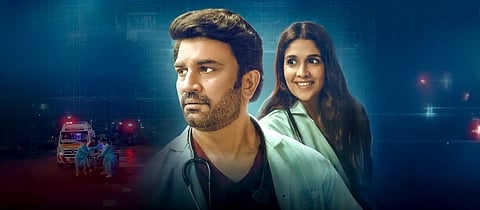
The characters are straight out of an early-noughties ‘youth’ movie trapped in a medical drama. Each is a genre type: the first-bencher with piercings, the token Muslim topper, the chill one, the rags-to-riches one, the troubled one. EMC may as well be the college from Rok Sako Toh Rok Lo (2004), which is also to say that this series has the resources but not the sensibilities. The central track revolves around maverick bandana-wearing surgeon Ishaan (Sharad Kelkar; trying to do a Mohit Raina from Mumbai Diaries) and a new resident, Nitya (Harleen Sethi), who joins the team to take revenge on Ishaan for messing up her brother’s surgery. Her plan is to get him suspended forever, but naturally they fall in love instead. Their feelings come as an unexpected twist because the screenplay never once hinted at any sexual tension.
That’s a running theme in the series—everyone is either an ex, a flame, a lover, a fling, a rebound or all of the above. When in doubt, have an affair. When in more doubt, find a soulmate. Nitya and Ishaan ‘unite’ but Ishaan is engaged to rich girl Lekha (Teena Singh), who breaks up and randomly proceeds to bed a young resident (“I prefer sex; my place, I’ll drive”); another resident named Roy (Vivaan Shah), who holds a candle for bestie Nitya, sleeps with colleague Nahida, who has a substance abuse problem. Keep up with me. At one point, a male character is revealed to have history with Lekha, queer undertones with Ishaan, but then chooses to have romantic feelings for the wildest subordinate of the lot. It’s totally out of the blue, but what do you do? So many options, such little time.
Needless to say, none of these relationships are earned—they happen because it’s cool, and it’s a cool setting, and it’s a show about serious people who are also cool. You get the gist. Never mind that most of the bosses seem to be having raging affairs with their young residents. It happens, of course, but the series trivialises the skewed power dynamic by never acknowledging it.
The Hinglish banter (“fuck off ho jaa, yaar”) sounds as though much of the dialogue and scenes are derived from other fiction rather than real life. You have seniors like Ishaan drop wisdom-cookie gems like “good doctors don’t run away from their feelings” to Nitya, even though he knows she’s out to ruin him. He can’t help but be a predatory mentor. The tone-deafness is almost cute. For instance, the second Nitya discovers that maybe Ishaan wasn’t at fault for her brother’s botched surgery; there’s no middle ground: she straight-away kisses him.
The music goes from pensive to sappy. Years of resentment and hatred melt away in a microsecond. Human nature is reduced to an electrical switch. There’s a track that revolves around a resident, Neel, losing his sanity and being admitted to a psych ward because his colleague betrays him. This chap goes about his life happily but only feels guilt when he sees Neel; the clunky transitions would put Manchester United’s current midfield to shame.
There are other problems. Some of the shots can’t hide the fact that a few lines were added in post-production. There are extensive scenes in the operation theatre, and the surgeries are designed as if they’re an extreme sport. This desperation to ‘jazz’ up medical procedures—visually and narratively—is one of the show’s many undoings. Several shots feature blood, skin, bones, brains and internal organs, but a lot of the gory biological prosthetics look like a messy jam sandwich. The artificiality is jarring, yet the camera insists on flaunting the technical details. It doesn’t help that none of the doctors look like they actually work multiple shifts; they’re fresh as daisies, faces always touched up and glossy, and the only ‘stress’ visible is when they sneak out for a smoke onto the terrace.
There’s also the one-crisis-per-episode format, which isn’t new, except Doctors simply uses these emergencies (cue residents running to an ambulance) when the emotional moments paint themselves into a corner. Some of the situations are problematic at best. A doctor sings a Bhojpuri song with a patient in the middle of his complicated brain procedure. Conjoined twin sisters named Monika and Sonika refuse to be separated, but rely on a braindead boy being an organ donor, only for his parents to be lectured (and shamed into giving consent) by a doctor who vents on them after a traumatic phone call. A famous cricketer begs a resident to abort his injured girlfriend’s pregnancy (he agrees). A Sikh lady begs another resident to euthanise her and free her of the pain.
Evidently, the doctors are not too competent either. Forget that a patient dies every other minute. The conflict-of-interest rulebook is torn to shreds (#EMCSupremacy). Ishaan freely operates on his estranged stepfather. He then operates on his former best friend after causing nerve damage the last time. Some of them operate on a senior doctor who is dying of cancer. The residents watch the surgeries from the viewing room but react like rowdy cricket fans. When Neel lashes out at the others for being able to snap out of tragic scenarios, he isn’t wrong. It’s not that he’s psychologically unfit; he’s seeing them behave like the series wants them to—bereft of continuity, abruptly, like people who know that no two scenes are shot in order. For a show that tries to bat against the desensitisation of the medical fraternity, the characters look as if they’re playing disjointed versions of themselves. Irony forgot to use anesthesia.
Doctors also rarely frames EMC as a window into society and its social fractures—it’s politically inert, simplistic, and isolated from the India it claims to save. It has opportunities for commentary—like receiving victims of a police shootout, or bumping a wealthy patient up a donor list and letting a middle-class one die—but the staging is about as complex as the VFX heart in the opening frame. It says something that the same actors reduced to awkward props here are twice as effective under good directors (Sharad Kelkar in The Family Man; Harleen Sethi in Kohrra; Sarah Hashmi in Bebaak; Niharika Lyra Dutt in Paatal Lok).
It’s true that I’ll miss Doctors. But that’s only because I need some treatment: How else will I account for 400 lost minutes of my life?