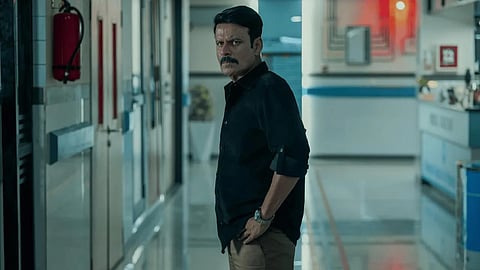


Gajab Raat is a film about one eventful night in New Delhi, the capital of what many say is the world’s biggest democracy. A corrupt cop, SI Ajay Nirvit (Manoj Bajpayee), is wondering how to fill his coffers when a high-profile case falls into his lap: a young and grievously injured woman (Aditi Sandhya Sharma) flings herself out of a moving car in front of Connaught Place’s PVR Plaza. Before Nirvit even reaches the spot, images shot by late-night moviegoers go viral in a very Bollywood-depicting-social-media way (flying tweets filling the screen).
By the time the ambulance arrives, he is dealing with a fearsome social activist (Shraddha Das); he has gotten calls from higher-ups; no politician wants “women’s safety” to be an issue again. By the time the victim enters surgery in a curiously empty hospital, the important people who want her dead crash the party: a shady CBI officer (Akshay Oberoi) sweet-talks Nirvit, who’s still desperate to leverage his sudden spurt of power. Another CBI officer offsets the previous one. A handover of the case is discussed for ulterior motives. Nirvit becomes a shady broker of sorts, but he keeps wondering: Why is this comatose girl ruffling so many feathers?
Prolific screenwriter Ritesh Shah makes his directorial debut with this film, but Gajab Raat has the unmistakable stamp of co-writer and producer Neeraj Pandey. It’s a tired joke, but take out the slow-mo walking and entry shots, and the two-hour-long thriller would’ve been a solid 30 minutes shorter. The sensationalist style — combined with a trademark fast-paced score that’s at odds with the wry spirit of its protagonist — creates an illusion of urgency. The non-stop action is the equivalent of Aaron Sorkin’s dialogue; you are made to feel that the plot is moving, but it’s actually the camera that’s in motion. There’s also the penchant for speaking in metaphors and fables; if one man conveys his point with “Once upon a time there was a king,” pat comes the reply “Once upon a time there was an elephant…”. Being direct is not for Indian men, is it? Jokes aside, this is a storytelling template that was normalised by A Wednesday (2008), and the legacy has crossed over to streaming dramas.
Gajab Raat does a few things well. Manoj Bajpayee can out-act half the industry with his forehead alone, and his SI Nirvit is a worthy example of a crafty system-gamer at the crossroads. The background music isn’t on the same page as him, yet he wages his own battle. Nirvit is addicted to deadpan lies (three different answers to “where are you from?”), his eyes are shifty, his gait is performative, and thus emerges the rare portrait of an amoral man who is efficient at his job. We’re wired to judge him — a womaniser, a scoundrel, a cheat with a soft spot for sex workers and bribes — but he throws us into an art-versus-artist loop. As he wades deeper into a crowded night, his transformation is inevitable, but the film doesn’t sacrifice his greyness at the altar of change. He remains semi-rotten even during a redemption arc: a balance that might’ve collapsed in the hands of a lesser actor. The stakes are high, but it’s strangely satisfying to see a crooked cop betray his own nature for one night only. You can tell that he might return to his ways the next morning. And it doesn’t matter.
At some point, though, it becomes apparent that the film hesitates. It shies away from its intended effect. It’s not just the famous title row: initially named Ghooskhor Pandat (“Bribe-taking Brahmin”), it settled for Gajab Raat after targeted online trolling and predictable political outrage. It’s also the big conspiracy at the core — which in turn defines the identity of the girl in the hospital. Without giving too much away, let’s just say the timing is awkward. Given the age we live in, it’s almost a wish-fulfillment and image-makeover exercise: an apathetic Delhi policeman acquiring a conscience and defying ‘orders from above’. A conspiracy that may or may not go up to the top and demand resignations. A culpable system that may or may not confess how Gen-Z newbies are doing their job better than them.
Once the revelations begin, there are lip-syncing and dubbing and editing issues, which suggests that perhaps the original plan may have been altered. The film loses confidence in its own voice. For better or worse, the third act of Gajab Raat cannot be seen in isolation. It looks watered down but also expressive, evoking an alternate reality where democracies still respond to wake-up calls; where those running the nation are held accountable for suppressing the truth; where authorities in the capital answer to nobody but their own heart. It’s naive and sweet in a way, but the idealism can offend those who’ve not been living under a rock this year. Watching it is disorienting, because it feels like the screenplay is a couple of steps behind the real-world situation. The film-making works overtime to sell the dangers. After all, India was not built in a day. But it can be dismantled in a night of knowing — and seeing — nothing.