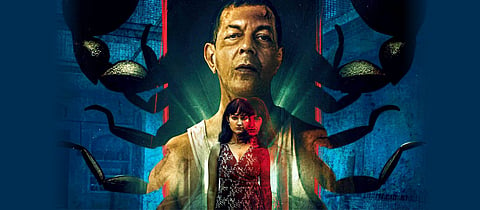


Let’s start with a modern horror story. When the first season of Sacred Games dropped in 2018, there was a surge of hope for a newer dawn of storytelling. The OTT space felt primed to embark on go-for-broke adventures that Hindi cinema and television couldn’t: take risks, platform untapped talent, challenge the mainstream, exhibit genres and languages. But the rapid and predatory privatisation of this medium meant that — save for a handful of titles every year — the hope remained a mirage. Studios, flowcharts, eyeball races and formulas turned the streaming space into a land of the living dead, where art became the flesh-and-blood exception and not the zombified norm.
Every now and then, a show comes along to encapsulate those early days of promise. A show so daring that its very existence evokes flashbacks of a survival thriller — one where it escapes the cracks of a system designed to prey on its freshness. A show that marches to its own beat without caring for catch-phrases like “bingeable,” “second-screen viewing” and “addictive”. Khauf (“Fear”) is the kind of show that Indian streaming was always supposed to champion — it’s ambitious, original, inventive, messy and an eerily layered reminder of how supernatural stories are rooted in the fear of natural living. It’s fitting that the two titles to resist conventional pattern this year — Black Warrant, now Khauf — are created by Vikramaditya Motwane and Smita Singh, the co-director and co-writer of Sacred Games respectively. This may not be a second beginning, but it’s a reimagined one.
Khauf is set in New Delhi. The year is 2017. In a matter of minutes, it registers that any supernatural activity might pale in comparison to the everyday horrors of being a woman in a fundamentally unsound place. A ghost called The Male Gaze lurks in broad daylight. No ghoul can hold a candle to the terrifying reality of the opening shot: a girl getting off a rickety DTC bus in a post-Nirbhaya India. Or a laser light tracing her body in a dark bylane. Or the guard of a working women’s hostel shaming her for returning so late. The you-asked-for-it vibe is ripe as the 8-episode series jumps 6 months into the future and centers on Madhuri (Monika Panwar), a young graduate from Gwalior who arrives in this big city in search of ‘freedom’. The world is at her bruised feet, or so she thinks.
But Delhi quickly quashes her dream like the streaming ecosystem ended ours. The city is haunted for small-town female aspirants: it’s more of a reckoning than an escape. The grammar of liberation is compromised. A driver’s invasive eyes blink in the rearview mirror of a rickshaw the moment Madhuri embraces her boyfriend, Arun (Abhishek Chauhan). When they start kissing in his cramped apartment, he gallantly offers to “wait” — but it’s clear he doesn’t really mean it. Madhuri opts to stay at the cheap women’s hostel on the outskirts: more specifically, in room 333 (half of 666, the devil’s number), which has been locked since the death of its previous resident, Anu (Asheema Vardaan). The hostel is no oasis; it’s enveloped in woods and wilderness, and a narrow path from its backgate leads to the nearest signs of civilisation. Madhuri feels like a stranger in more ways than one, because Anu’s friends — a pregnant Rima (a mercurial Priyanka Setia), Naga migrant Svetlana (Chum Darang), former call-girl Komal (Riya Shukla) and stuttering rich outlier Nikki (Rashmi Zurail Mann) — start to intimidate her. They haven’t left the premises since the tragedy; a mysterious entity prevents them from stepping out.
Madhuri finds work at an insurance company, but her commute is riddled with male micro-aggressions: semen stains on her shirt after a bus ride, groping in a deserted subway, lecherous stares, comments on the brightness of her lipstick. The ghastly happenings outside collude with the ghostly happenings inside. Even the green-flag energy of Nakul (an intuitive Gagan Arora), the not-all-men-coded partner of a colleague, is steeped in moral uncertainty: Madhuri suspects that Nakul was the masked student who sexually assaulted her in college. The broader world of Khauf holds an assortment of connected arcs. There’s the strict but sensitive hostel warden, Gracie (Shalini Vatsa). There’s her best friend, constable Ilu Mishra (Geetanjali Kulkarni), troubled by the disappearance of her toxic son (a scene-stealing Satyam Sharma). There’s a psychiatrist (Shilpa Shukla), whose self-serious presence becomes a red herring. And there’s a hakim (a worryingly authentic Rajat Kapoor), whose ‘practice’ is a front for a hokey serial-killing spree.
As a genre portrait of normalised violence, Khauf is finely staged and detailed. An aerial view of the hostel in the woods resembles a woman’s gender symbol (a circle with a small cross) as well as a womb that’s running out of nutrients. A poster of a signature Shah Rukh Khan pose hangs in the room — like a shrine of Delhi alt-masculinity kept to ward off its sinister siblings. An early scene of Madhuri watching Nosferatu (1922) hints at the shaman’s rotting physicality, metallic voice and dracula-lite intentions. There’s something to be said about the subtext of a weak man seeking the ‘souls’ of assault survivors to gain strength. There are hints in the duality of every condition. The madness that defines a woman in denial about her boyfriend’s abusive past is no different from the insanity she attaches to the girl who accuses him. Madhuri is soon possessed by a paranormal force, but the men overcome by lust look more possessed; the former is a vessel capable of being exorcised, the latter is a spirit incapable of eroding. A rod is a weapon of self-defense, but India’s post-2012 vocabulary debases it into a chilling Delhi-coded threat.
Madhuri’s trauma takes a toll on her relationship with Arun, who somehow manages to make it about himself: he works out in the gym because he’s guilted by his failure to protect her that night. His feelings for Madhuri are sincere, but being her soulmate doesn’t absolve him of the symptoms of a distinctly gendered illness. At different points, he drunkenly forces himself on her, pins her against a wall when provoked, and gaslights her into doubting her own lucidity (when she complains about getting attacked and blanking out). But the screenplay refuses to vilify him, a perceptive way of proving that — for better or worse — someone like Arun is the lesser evil in a country desensitised to casual misogyny.
Pankaj Kumar’s camerawork combines with Nitin Zihani Choudhary’s production design and Alokananda Dasgupta’s score to amplify the dread of regular spaces. The stale blues of the hakim’s old-city ‘lair’ and the echoey corridors of the hostel internalise the male gaze without fetishing it. After School of Lies (2023), this is the second collaboration between a female writer and a male cinematographer-director to feed a story’s conflict between seeing the complicity of a setting and believing it: the writing intimates, the lensing interprets. For instance, there’s almost a sense of disbelief when the camera detects a society that’s rigged to redraft womanhood as more of a culture than a state of being: a Punjabi landlord evicting a tenant for planning a party, a shaman luring a child inside, or a sweet Sikh driver switching shades the second he sees a girl smoking in his vehicle. Patriarchy knows no religion, and the craft keeps coming to terms with the secularism of male entitlement. A chaotic finale in the ‘womb’ (Kumar also shot Tumbbad) loses its way, but it commits to the cultural ambiguity of the margins between myth and conjecture. The possibilities outweigh the lack of clarity.
The show’s refusal to discriminate between timelines — the Anu-era flashbacks play out before Madhuri reappears ‘6 months later’ — implies that trauma transcends primary and secondary narratives. Abuse is a timeless cycle; its repercussions stem from a haunted marriage between the future and the past. The cast is exemplary all around, especially Geetanjali Kulkarni as Ilu, a feminist soldier weakened by the supernatural powers of motherhood. Ilu’s quest to find her son turns her into the sort of middle-aged woman who’s wired to blame everyone else — the hakim, warden, other girls — for his defects. Monika Panwar delivers a remarkably complex performance as Madhuri, a small-town dreamer trapped in a big-picture nightmare. She absorbs the pressure of having to play victim, hero, medium and menace at once. Her pairing with Abhishek Chauhan’s Arun unfolds like a geographic sequel to Vijay Maurya’s charming Mast Mein Rehne Ka (2023), a film where they play strivers whose romance is tested by the anti-romanticism of Mumbai.
A measure of Khauf’s fearlessness is best defined by the vision of everything it chooses not to be. A lesser team might have flattened it into a cutesy collection of tropes: a hostel housing an army of diverse rebels, musical interludes about sisterhood, a colourful portrayal of Delhi, a shaman as a solitary villain laying siege on the property. It’s what we are conditioned to expect as a society attuned to the algorithm of performative wokeness and social entertainment. But the triumph of Khauf lies in how it toys with our notion of another popular theme. It confesses to — and excavates — the frailties of the rape-and-revenge motif.
The template is a staple of horror cinema. It’s based on the absolution of justice: a woman returns in some form, or women unite in many forms, to avenge the brutality inflicted upon them and theirs. Whether it’s fantasy (Bulbbul), Bollywood masala (Khoon Bhari Maang) or the cinema of dysfunctionality (Big Little Lies), it requires them to react in the very language that threatens to destroy them. It requires their trauma to be their superpower. In other words, women must become extraordinary tales to balance the scales of gender parity; they must become fiction to conquer reality. Khauf first teases this reading by staying vague about the source of the cursed room. One is led to assume that, as usual, it’s a victim’s restless spirit looking for a release. A cloud of intrigue hangs over the role of the hostelites in Anu’s death. Everything points to some degree of culpability: is Anu protecting them from Delhi or punishing them for something they did? Basically, we are encouraged to blame women for their own suffering.
But when the backstory is revealed, Khauf becomes a rare series that mines the post-credits consequences of the motif. By framing the psychological toll of defiance as the actual horror, it exposes how most movies burden the act of female survival with the emotional baggage of heroism; how their rage is treated as a reductive subset of cou-rage. Stories are validated by vengeance, life is not. There was a flurry of rape-and-revenge thrillers in the years following the 2012 Delhi assault; art reached for a primal catharsis that reality couldn't afford. But none addressed the futility of this pattern. Madhuri resists the rage until she cannot; her dissent is a casualty and her trauma, a wound of conscience. The storytelling of Khauf may make us nostalgic for the good old days, but the story — its uncomfortable illusions, its subversions of agency — expands the continuity of the bad old days. If there's one truth this show uncloaks, it's that not even fiction is impenetrable anymore. The narrative contours of victimhood and revenge are no longer safe spaces. Men may end, but masculinity does not.