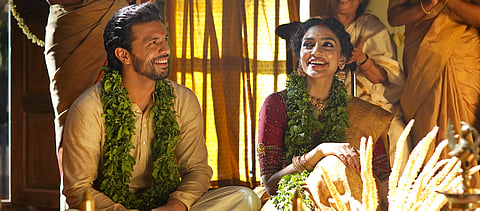


Love, Sitara stars Sobhita Dhulipala as Sitara, a woman determined to see her life as a dysfunctional-family film. If that sounds like odd phrasing, let me explain. Within the first five minutes, Sitara, a successful interior designer in Mumbai, pops the question to her successful-chef boyfriend, Arjun (Rajeev Siddhartha). It’s an impulsive proposal, but one that’s not entirely driven by love. Sitara has an unusually specific plan for her wedding. Despite her hotelier father’s offers, she insists that it must happen at the modest family home in Kerala. Nothing about her explains this departure towards traditionalism and nostalgia, but it’s non-negotiable.
The preparations begin, and the house is full of people who don’t exactly get along with each other. It’s a pressure cooker waiting to burst. Sitara idolises her free-spirited and fiercely independent aunt, Hema (Sonali Kulkarni), much to the chagrin of her home-making mother Latha (Virginia Rodrigues). There’s a history of envy and rivalry between the sisters. Sitara’s charismatic dad Govind (Sanjay Bhutiani) seems to have a happy marriage with Latha, but he is still disliked by his old mother-in-law (B. Jayashree), who is more invested in the mating habits of her cows than the lives of her own daughters. Arjun arrives with his patriotic Punjabi father, who belittles him for considering a professional future in Singapore. There’s also some tension between Sitara’s best friend (Tamara D’souza), who is a bohemian photojournalist, and her childhood friend (Rijul Ray), who is a philanthropic doctor.
In other words, Sitara willfully chooses chaos — both intergenerational and cross-cultural. It’s an impulsive decision, but one that’s not entirely driven by love. At some point, she gets so sidetracked by a family secret that it becomes frustrating to watch. You wonder why she is so troubled by something that might have happened ages ago. But the screenplay is more perceptive than it lets on. It soon becomes clear that Sitara’s ‘plan’ is self-reflexive and self-sabotaging at once. At one level, she surrounds herself with dysfunctionality to rationalise her own secrets and flaws. The imperfections of her family make her feel like less of an imposter; she hopes to pin her failures on the fact that her truth was built on a heritage of lies. At another level, Sitara opts for the emotional reckonings of this venue because she subconsciously wants her own life to implode. Her reasons to get married are far from ideal, so she designs the interiority of her punishment. It’s as if she hopes for something to go wrong so that the courage to come clean is forced upon her.
I like how the film doesn’t oversell the central love story. It’s hinted that Sitara and Arjun have had a torrid on-off relationship for years. All we see, though, is the inflection point; their romance is in the past-continuous tense. It’s more comfortable than new; he casually squeezes her butt, and their kisses are more about assurance — the kind that defines a couple that keeps rekindling their feelings — than affection. Dhulipala plays Sitara as an alternate-universe version of Tara, her Made In Heaven character whose marriage is both her undoing and coming-of-age journey. Even Sitara’s path to moral accountability is tethered to the pressures of contemporary womanhood (her name, too, means “star”). There are also echoes of Alisha, Deepika Padukone’s Gehraiyaan (2022) character, who turns into the very people she tries to leave behind; her trauma becomes a genetic condition. The film’s title, too, implies that Sitara’s sense of love — like her family’s — is akin to a signature without a letter.
But Love, Sitara falters when it really matters. The first hour is the breezy calm before the storm: dining-table banter, crossed wires and little frictions. Some of it is a little too on the nose. Take, for instance, Hema’s awkward behaviour in public, which is designed to prove that she’s an outlier; at one point, she sings ‘Saare Jahan Se Acha to mock Arjun’s father and his India-is-great attitude. Similarly, the old matriarch is reduced to a cool-grandma caricature; a sex joke and “what is porn?” faux pas are never too distant. But, it’s the final act that derails the film. Once the first showdown unfolds, the narrative morphs into an endless montage of conflicts, sad music and consequences. Every character confronts their demons in perfect sync with each other. The story starts telling instead of showing.
One of the big confrontations even resorts to the retro thunder-and-lightning trick; dried leaves fly across the characters’ faces as they yell and collapse on the ground. The dramatic pitch brings to mind director Vandana Kataria’s first film, Noblemen (2019), a Shakespearean boarding-school mood piece that — unlike Love, Sitara — refuses to double as a social entertainer. The self-consciousness bleeds into the writing. The naturalism of dialogue in the early parts of the film makes way for mainstream exposition dumps; the subtext of a script (“you taught us to speak the truth, but you’re lying to yourself”) is turned into actual conversation. A voice-over (“all happy families are alike, but every unhappy family is different”) stops short of tattooing ‘dysfunctionality’ on the film’s forehead. One woman literally spells out her character sketch — the monologue sounds like notes from a therapy session — in an attempt to patch things up with her family members. There are flashbacks and playback songs, and the film remains unsure about how to resolve its complications without letting time pass.
It’s what I like to call the ‘curated chaos syndrome’. Rifts emerge with the certainty that everyone will heal, and everything will be alright, regardless of how deep the deceptions and faultlines are. The cement must dry before the end credits roll. One might argue that perhaps this ties into the theme of familyhood — you make a family by making do with them, because denial is the ultimate love language. But there’s an inevitability about the way Love, Sitara unravels. The storytelling and its equation with the audience overwrite the equations in the film. Imagine the medical-room outburst of Dil Dhadakne Do (2015). The youngsters show their hypocritical elders the mirror; it’s not a pretty sight. But here, all you can see is the reflection of the camera.