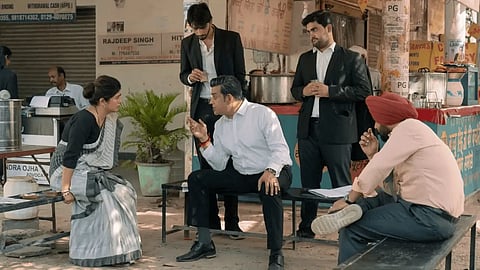


There’s something to be said about a legal ‘drama’ that chooses to be a workplace comedy in this country. In terms of the genre, Maamla Legal Hai is an odd change of pace in a storytelling culture that has thrived on a history of lofty courtroom monologues, theatrical verdicts, pensive judges, fake windows, and those signature cutaways of a blindfolded Lady Justice and her tipping scales. It relies on the novelty of watching an unserious series about an inherently serious environment. In terms of life itself, though, the satirical tone becomes a critique of a bureaucratic, disorganised and chaotic system in which justice is reduced to a jetlagged construct. It's a droll acknowledgement of how even the most important pillars of a democracy can be comically ineffective and ordinary.
I found the first season of Maamla Legal Hai to have teething issues; it didn't trust its sitcom status enough and overstaged the colour of its characters. This second season doesn't deviate from the skit-like treatment, but there's a cheerful-yet-resigned familiarity about the setting that invites viewers to shake their heads at the tragedy of a dysfunctional system. It’s more spoofy than conventionally funny, as if to say: We are like this only, so may as well laugh at ourselves. When a judge enters an evidence room to examine the possibility of rats feasting on confiscated packs of cannabis, they argue against the backdrop of a blood-splattered statue of Lady Justice. When a newly elected district judge says his oath to be sworn in, an inopportune ‘cough’ during his speech complicates the formalities of his appointment. When this lawyer-turned-judge politely smiles at a lawyer in the corridor, the harmless gesture leads to allegations of favouritism, bias and conflicts of interest. When the respected judges lock themselves in their chambers to go through promotional short films, they end up playing pen-wrestling games to kill time. When the judge craves to be invited to a veteran’s retirement party, he colludes with the bar president to manipulate the ‘lowly’ foyer lawyers into shifting a condolence meet. When a lawyer sees her assistant catfishing her rival as an “online girlfriend,” she takes over the account after feeling sorry and detecting the loneliness of the divorced man.
It’s hard not to get comfortable with this playful cynicism of the space. It’s not that the quirky mundanity of it all is fetishised; the joke is on everyone (including the audience) for seeking pockets of purpose in a traditionally glorified environment. The series is especially watchable between the intent-and-theme parts in the case-per-episode format: when the players are simply navigating the eccentricities and petty conflicts of day-to-day existence. Every other scene is a rejoinder to our perception of how a busy court operates. Season 2 takes off after its protagonist, advocate VD Tyagi (Ravi Kishan), is promoted to district judge at Delhi’s rickety Patarganj court. His arc is a crowd-pleasing one — he goes from loving the aura of being a judge (he does Munna Bhai M.B.B.S things for the judgeship, like “caring” and socialising with subordinates) to missing the nuts-and-bolts challenges of running his ragtag team of advocates. His grand vision of passing great policies is dashed; he slowly gets disillusioned with the burden of making and breaking lives according to the black-and-white rules of the law. The others keep hustling, too. There’s Sujata Negi (Nidhi Bisht), the former foyer boss who grapples with office politics in the chambers. There’s her love-and-hate rival, Mintu (Anjum Batra), the new bar president and Tyagi’s best friend. There are the minions named Law and Order, who continue on their merry way to nowhere; Law even has a brief ‘courtship’ with the elite Harvard-returned Ananya Shroff (Naila Grrewal), whose South Delhi accent and politically correct reactions serve as a narrative surrogate for the woke urban viewer as she fights to win her first case. There’s the ubiquitous monkey repeller, and there’s the court manager, Vishwas Pandey (Anant V Joshi), who struggles to balance his personal life with a blossoming friendship at work. The latest entrant is an experienced judge (Dibyendu Bhattacharya), whose bond with Tyagi is tested towards the climax in a contrived twist of faith.
Ravi Kishan is stiffer than the first season because Tyagi’s transformation is a bit too written. But it helps that Kishan is playing a character who must ‘perform’ and subdue his natural instincts. There’s a sense of gravity about his position that the morally flexible Tyagi is inequipped to handle; he doesn’t have as much screentime, so the writing uses his face too much as a reflection of the man’s epiphanies. Every other moment features him realising something new, like an Amar Chitra Katha character. The rest of the cast is fine when they aren’t creaking under the weight of sudden messaging and conscience. I particularly like Anant Joshi’s energy as Vishwas, the one guy who doesn’t have the luxury of a tangible payoff. The series does inherit some of the previous season’s sins. The cartoonish sound cues undermine the satire, almost like it’s trying to fool the viewer into believing this is a slapstick comedy. The abrupt switches in emotion are signified more by the simplistic background score than the low-stakes screenplay.
Mainly, not all of the peculiar cases — most of which are inspired by Hindi newspaper headlines — land in sync with the flimsy tone. The show visibly struggles to not trivialise the weighty ones: like a hammy landlady reversing sexual harassment allegations onto her male tenant (a few “men’s rights” puns don’t sit right), a messy family-dominated divorce proceeding between a frustrated wife and her meek husband, or a closeted man going through a property dispute with his estranged wife. Here’s where the film-making bites off more than it can chew; the stereotyping of these clients and situations give 1990s-Bollywood vibes, where things like misogyny and homophobia were regularly mined for bottom-tier laughs. But this one time, it’s the gist of these cases that matters more than the execution. It’s similar to the standup sets and talk-show hosts who just ‘narrate’ the news, and the jokes write themselves. The point being: reality today is so absurd that fiction is on the brink of extinction. Maamla Legal Hai Season 2 is occasionally guilty of searching for fiction in the follies of truth. But every now and then, it settles into a self-descriptory rhythm. Lawyers act like bumbling humans and humans wade through the farces of law and (dis)order. Somewhere between “We are like this only” and “Only we are like this,” the show finds its feet.