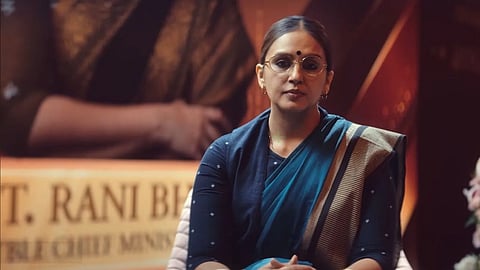


Maharani, on its fourth season, is no The Diplomat or House Of Cards—the obvious reason being the budget, which is perhaps a fraction of the Netflix specials, which cripples the imagination of the writers and the possibility of its characters. The story of Rani Bharti (Huma Qureshi), from the illiterate wife of Bihar’s chief minister, to becoming his proxy, to becoming his competitor, to becoming his alleged murderer, finding her own voice in the muck that is state politics, does not have the delicious sweep and urgency that political dramas are generally known for.
But, perhaps, Maharani wants to do something else—dwelling in the realm of rhetoric and not action. I am not sure how much of this choice is dictated by the economics of storytelling, versus the desire to use this particular mode of storytelling. The show has, over the seasons, built a pace that isn’t quite nervy, even as the situations demand that energy, but neither is it lethargic, like its debut season. It is a pace that builds towards moments where characters can speak in aphorisms and folk tales, Panchatantra and Buddha, village idioms and city winks. But some of the stories, these idioms, exceed the point they are trying to make, and especially in parliament speeches and showdowns, you see the reach exceeding the grasp, because the writing simply isn’t meaty enough, and the delivery isn’t rousing enough, though there is something at the heart of the show that keeps its engines running—a desire to keep growing in stakes. In the fourth season, Rani Bharti’s eyes wander off from Bihar, to Delhi.
This season begins with a powerful recognition—that power is lonely. Lines are being read, written by Aurangzeb, speaking of the “patthar dil” you have to become, to pre-kill yourself to inhabit this power. The person reading it is Prime Minister Sudhakar Srinivas Joshi (Vipin Sharma) whose coalition is falling apart. “Busy nahin, lonely. Mein iss desh ka sabse akela insaan hoon,” he notes. (I am not busy, but the loneliest man in the country) He is forced to reach out to Rani Bharti to keep his majority intact. She swats him. He humiliates her. She decides—Delhi is her revenge. The question of why some people desire power is answered by the simple decision Rani Bharti takes to up the stakes—power is the only response to powerlessness; megalomania is the only response to oblivion. There is no ideological center that moves these characters, though sometimes, it is tacked on to give the illusion of ideology. Rani Bharti, at one point, tells her son studying in the UK (Darsheel Safary) that she continued in politics to keep her family safe—and something about the delivery, the neatness of reason, rings false. Rani Bharti, for all her charms, is that megalomaniac. The show, even as it allows for this conclusion, doesn’t really sit with it.
Her hot-headed son Jaiprakash Bharti (Shardul Bharadwaj) and her calm shadow of a daughter Roshni Bharti (Shweta Basu Prasad) will test Rani Bharti’s political line. She will want to bring them into important portfolios, shoving them into powerful positions, something her reliable allies, Kaveri (Kani Kusruti) and SN Mishra (Pramod Pathak), will soon take umbrage to.
Is Rani Bharti wrong? Qureshi’s performance is thick with confidence, even her affectations now feel like it is part of the character’s deliberate movements and not Qureshi trying to forcefully reach out to inhabit the character. She never lets up a hint of doubt, and you wish the show allowed her to be more vulnerable, but the show, as though dictated by Rani Bharti’s desires, will only let us see what she wants us to see. When characters stray from her path, they are forgotten by the show. There is a sense that they exist only when they come into Rani Bharti’s orbit—you don’t get a sense that they are living a life otherwise.
Besides, the virtuous characters are so measly—their virtue sometimes feels like resentment, that they didn’t get the power they were promised—that the show’s refusal to state coherently what it feels about Rani Bharti might be its biggest strength. An unresolved show with messy borders produces a portrait that is fragile. This is a welcome incoherence, especially in the streaming landscape strewn with moral certainty.
There is something meta about watching four seasons of Maharani, where with each season, as its protagonist, Rani Bharti, becomes more assured, clean, and certain, so does the show’s vision. What began as shaky, inconsistent, and sometimes, comically expressionistic—Rani Bharti constantly fumbling her speeches in the first season, for example, and those forceful, stiff hand gestures—has now become someone who can stand up to people to defend her controversial opinions, inhabit her megalomania in a world that constantly provokes her to be a step ahead of everyone.
This season, directed by Puneet Prakash, has a more patient gaze, the camera lurking for longer, the pans more ambitious, the gazes more stirring, and even as one wished the patience was girded by a more potent, rooted storytelling—one where the forcefulness of the twists is not felt so obviously; one where characters felt like people and not plot points—the patience is a sign of yet more seasons, where both the craft of Rani Bharti and her sculptors will be put to test.