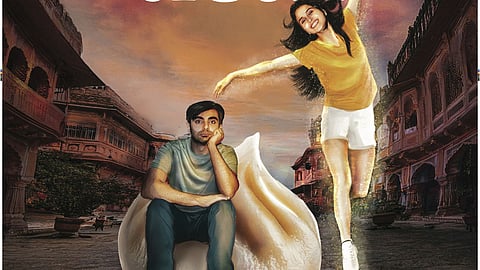


Momo Deal opens with the voice of a dead girl at her funeral. Except it’s quirky. This young woman, Mahima (Anushka Kaushik), is reading out her own wishlist for the funeral — the way any manic-pixie hall of famer like Jab We Met’s Geet might (we learn that her favourite song is “Tumse hi”) to lighten the mood. One zoom-out of the camera reveals that none of Mahima’s wishes have been followed, especially the one that demands her best friend Naman (Akashdeep Arora) to weep loudly at the front. Naman is instead numb. His deadpan face suggests he’s an action hero who can’t act, but he’s something more common: an Indian man who can’t — or won’t — express himself. He refuses to cry. Dheeraj Jindal’s 13-minute short then features a late-night conversation between Naman and the ghost of his newly-deceased bestie. They walk the streets of their hometown, Jaipur, and exchange difficult emotions.
A lot of genre storytelling revolves around the human desire to make sense of grief — or at least the depressing permanence of it. All sorts of allegories are used to investigate complex feelings, without always making a statement. The horror hit Weapons did it recently, adapting what is visibly the American anxiety of school shootings and a community aftermath into a supernatural small-town thriller with a ‘resolution’. The cultural meaning lies in the eye of the beholder, but Indian counterparts don’t have the luxury to be too dense or clever about such themes. South Asian society has a notoriously performative and escapist relationship with grief — one that is rooted in either total denial or complete surrender. There is no middle ground; being ‘authentic’ is almost a crime. So the genre stories told here end up being more direct and simple, almost to offset the delusions of life itself. The subtext becomes the text.
Momo Deal is an example; the two characters spell out their conflicts to one another in an effort to address the everyday invisibility of losing a loved one. It largely works. Beneath all the simplicity lies a semblance of social identity. For starters, I like that there are no romantic undercurrents. Losing a friend is the most neglected language of pain, and any movie that chooses to depict this over the more mainstream voids (parents, spouses, pets) deserves credit. Even when Naman confesses that he only pretended to like momos for 7 years because Mahima did, it’s poignant because of how platonic and no-agenda it is.
Secondly, I like that there are hints of dissonance between Mahima’s free-spirited personality and a patriarchal setting that treated her as a misfit. For instance, it’s not a coincidence that no demand on her wishlist is met; even in death, she is denied a sense of agency. It’s why she’s so gleeful when she realises that she can finally wear hot shorts in public without any scrutiny. Naman is frustrated with her mainly because she did things on her own terms — like jogging on the street and therefore dying in an accident that was someone else’s fault. The film stops short of implying that the world had no place for someone as individualistic as Mahima, but it’s Naman who realises the inherent bias and selfishness of his own frustration: he wanted her to shrink herself and live ‘safely’ to survive. Maybe everyone did. That’s why when she remarks that it was her time, you believe it. It was inevitable. There’s something to be said about a woman paying the price for not conforming to an orthodox gaze.
More importantly, the central conflict of Momo Deal is sweet — even if a bit trite. Initially we assume that Naman resists a good cry because he’s a man in a country that sees expression as a sign of weakness. But political is personal: Mahima had playfully promised to haunt him if he resists it. He misses her so much — and is so unfamiliar with the vacuum — that not crying is his last resort to summon her back. It’s his chance to deliver a proper farewell. A figurative threat is translated into a literal plot point. She admits that her soul is stuck (“like a helium balloon waiting to fly off”) because of his poker-faced stunt. The fact that her presence itself brings him to tears is a neat device of closure. It’s what fiction is meant to do when reality offers no narrative. The performances are alright, but you can tell that Mahima is a cliched Bollywood livewire because short films have to use shorthand to exhibit the toll of a bond — or an entire lifetime. Broad strokes are the only way to show that Mahima is worth longing for. It’s the only way to establish the stakes.
Perhaps not all of this is intentional and I’m reading too much into a modest film. Or perhaps the concept hits too close to home because I’m still struggling with the grief of losing a close friend. Earlier I’d find these themes in movies because I was curious to understand them; now these themes find me because I’m not sure they can be understood. I could find faults with such a film, too, given the simplification and ‘promise’ of light at the end of the tunnel. But Momo Deal, with all its obviousness, doesn’t alienate the average viewer. And maybe that’s all it comes down to, particularly with emotions that conspire against those who acknowledge them. Being seen is the first step; being heard is a battle for another day. Not being alienated, or alone, is a decent deal for now. I’ll take it.