

For most of its 8 episodes, Musafir Cafe has the aesthetic of streaming television from the 2015-16 days (also known as the Little Things age). This natural-artifice aesthetic thrived when YouTube was still the platform for millennial motifs wrapped in modest productions: relatable DIY ‘content,’ relationship-core characters, designer dialogue (“travelers don’t just change places, they travel within themselves”), a gooey soundtrack and title montages, pastel-coloured narratives and branded locations. As watchable as these shows were, they were almost indistinguishable from each other. Given the current onset of true-crime fatigue, this romantic drama might feel either dated or nostalgic — or both at once.
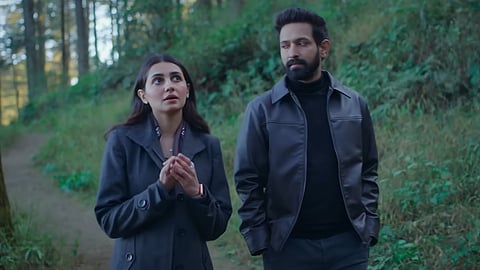
It opens in the hills of Mussoorie with a voice-over by Preeti (Mahima Makwana), the co-founder of a utopian cafe. She’s a blogger who should be an author; she skips to work like the protagonist of a musical tourism advert. Preeti speaks of her partner in life and business, Chander (Vikrant Massey), who charms customers with his food and hospitality. But he has a stubble, so you know he’s been through a lot. Preeti alludes to a love story from his past — an ex-girlfriend who still rules his heart. The one that got away. Their seemingly perfect existence is juxtaposed with Chander’s life from 8 years ago: as a clean-shaven logistics engineer in Bhopal whose path crosses with Sudha (Vedika Pinto), the kind of mercurial girl that compels smitten boys to ask in amazement, “kya ho tum, yaar?”. The two timelines run in parallel; you soon realise that 2018 Chander and 2025 Preeti are similar types of companions: in awe of cooler partners, and wired to be defined by the relationships they’re in.
Based on Divya Prakash Dubey’s book of the same name, Musafir Cafe has some very affected storytelling. (I used to call it Instagram storytelling or post-it-note filmmaking, but that’s a bit uncharitable in this context). Like a teenager who’s imitating all their favourite movies, the series is sweet and naive in equal measure. The whole thing seems to be influenced by pop-culture of the mid-2010s. The cinema of Imtiaz Ali looms large over the tale of Chander and Sudha: her Jab We Met-style persona (she’s from Ratlam too), their Socha Na Tha-style meet-cute, his Tamasha-style conundrum (a nine-to-fiver jolted out of settled ways), his Love-Aaj-Kal-2-style circumstances, his suppressed dreams of a mountain life, his small-town approach to heartbreak and companionship, and so on. Their arrangement sprouts out of the most movie-character moment. She randomly moves into his place after fighting with her flatmate, and suddenly they’re a live-in couple. They barely know each other, but she does it cutely, so I suppose it’s fine.
There’s a bit of Meri Pyaari Bindu in their differences and her manic-pixie aura, a bit of Haseen Dillruba in his angst and disillusionment. Their conflict is internal and gendered — Sudha treats love as a compromise of hard-earned identities, Chander treats it as a bargain to belong. There’s a dollop of La La Land as well — in the background score; in the way she names his future cafe; in the trope of how the most important relationship is often the one that doesn’t last. Preeti is the equivalent of the woman Sebastian probably dates after his Happily Never After with Mia. But she’s a solo explorer who’s sacrificed her own restlessness to be with him; a handsome admirer keeps reminding her of the wings she’s clipped off.
A couple of years ago, the false notes of this show might have felt like deal-breakers. Like the sanitised edges of the premise. Like the camera-conscious performances of Vikrant Massey and Vedika Pinto. Chander looks like he’s pretending too hard to be innocent in the early Bhopal parts; Sudha is cloyingly over-expressive in these honeymoon-phase portions. Like their curated chemistry; they are exotic creatures to each other who seem to have derived all their notions of togetherness from novels and movies. Like the force-fitted song montages (even though Darmiyaan in the finale is lovely) and commercial framework. Like the silly cliffhanger it ends on. Like the complexity-for-dummies tone, Preeti’s lack of presence, and Sudha’s clumsy backstory as a divorce lawyer who aspires to empower women in Mumbai.
But Musafir Cafe also does something rare for an Indian story about relationships. It doesn’t take sides in the contest between the individualism of romance and the romance of individualism. It remains curious about Chander and Sudha without asking the audience to root for either of them. Most shows would bat for someone as spirited as Sudha: a confident woman who is determined to put her own identity above any man she loves, someone who is unapologetic about her desires. This one does, too, but it conveys the consequences of this reactionary image; she stays just as fallible as anyone else. Most stories would bat for those as emotional as Chander and Preeti — their ambition is to love and be loved, and their self-worth is inextricable from the shared world they occupy. But even they’re not without blind spots. Chander’s masculinity and victimhood come to the fore when he’s denied, while Preeti pushes them to meet almost so that she has an excuse to liberate herself. None of these characters are right or wrong, they’re just struggling to find a balance between compatibility and concession; between acceptance and egoism. The senior supporting cast — especially Adil Hussain as a warm homestay owner, and Anubha Fatehpuria as Chander’s cautious mom — supply the show’s moral ambiguity.
In that sense, Musafir Cafe is quite grown-up in its gaze of contemporary love. Despite its benign craft, it reveals that most adult relationships aren’t ruptured by lofty betrayals and seismic events. It’s often in the slow-burning divorce of priorities and perspectives: the pregnant pauses and passing silences, the hesitations in planning a future, the awkwardness of watching a movie that exposes each other’s insecurities, the inside jokes that stop being shared, the dimming of physical intimacy. It’s the sort of rupture that elicits a “but what’s the problem?” from the elders. The one showdown here captures how couples become resentful when they cannot fathom that love is severed by ‘issues’ that aren’t socially recognised. This distance is measured in memories, not mayhem. It’s a distance that haunts the manicured path of Musafir Cafe: a middling series, but a reflective portrait of how all those who don’t wander can be lost.