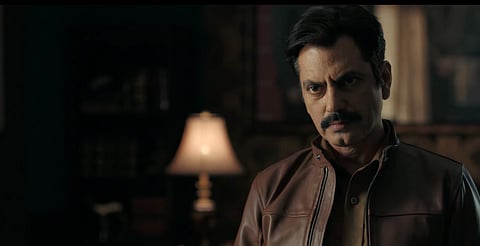


In Raat Akeli Hai: The Bansal Murders, a family that runs a journalism empire is slaughtered in the middle of the night. Five members are brutally killed in a mansion built on half-truths and media sensationalism. The three survivors include a grieving mother, Meera (Chitrangada Singh), whose devotion to a shady godwoman (Deepti Naval) makes her a suspect. She claims her drug-addicted brother went on a rampage. It’s the most logical tragedy. But Inspector Jatil Yadav (Nawazuddin Siddiqui) is not convinced. As he learned in Raat Akeli Hai (2020), the shadows are stronger than the light in rich dysfunctional families. He knows there’s more. A forensic expert, Dr. Panicker (Revathi), becomes an unlikely ally. He is wired to dig deeper because men like him know what it is to be buried. The story slowly excavates the void between the haves and have-nots. A class-rage drama poses as an eat-the-rich thriller. Jatil chases the case, but it’s really the case chasing him.
Director Honey Trehan, along with writer Smita Singh (Khauf), once again crafts an atmospheric and meticulously-staged whodunit. It isn’t as moody as the first film, but the narrative subterfuge is smarter. The themes aren’t immediately obvious — and the revelation exposes the complicity of a society that thrives on its own blind spots. Much of the Knives Out-coded film plays out like a primetime news headline that would make waves in the Bansal family’s newspapers and channels; it weaponises perception over fact. Jatil is the only one interested in the lower-case fonts below it. The devil is in the details; the film is alive to the India it occupies. Jatil’s boss takes ‘personal interest’ in the investigation because he’s a family friend. An important subplot features a speech about journalism in a chawl whose voices are often erased and edited out. Kids get poisoned in a school whose walls proudly flaunt ‘Right to Education’ campaigns. The toxic consequences of an illegal factory does not discriminate between the rich and poor. The top shot of a makeshift graveyard captures the anonymity of death and looks like an everyday version of that famous drone shot by Danish Siddiqui during the pandemic. A cop is told to solve the case keeping public sentiment in mind. A family business dispute comes into focus while the news channels steer the narrative of the investigation. A Google search for a company called PMPO briefly shows autofill results like ‘PM positive’ and ‘PM message’.
One of the film’s many merits is the way it frames its critique of faith. It can’t be too blatant about religion, so it finds subtler designs to convey the toxicity of tradition. There are symptoms everywhere. A holy sweet becomes one of the drug-injected murder weapons; the family’s subservience to the cult initially evokes comparisons to the Burari deaths. Jatil is first summoned to the farmhouse a day before the massacre to look into a case of dead crows and severed pigheads on the premises. Meera retreats deeper into her godwoman-shaped haze. While superstition is the aesthetic for the privileged, it’s the refuge of the downtrodden. Jatil’s tender relationship with Radha (Radhika Apte) keeps stalling; she assumes it’s because she has chosen to pursue education and a career, but he’s unable to admit that it’s because their ‘kundlis’ don’t match. As progressive as he is in his ideals — the first film schooled his masculinity, this one schools his middle-class bias — he struggles to overcome the crutches of his heritage. His journey of self-improvement is informed by the case, of course, because he is conditioned to judge the family for their kooky practices. Jatil’s weakness is that he’s guided by instinct and sentiment, but he finds a no-nonsense person of science in Dr. Panicker; his fictions are offset by her facts.
I like the film’s covert courage, in that it mines a country’s ritualistic relationship with social hierarchy and accountability. It navigates a system’s penchant to look for answers above while the ground burns with unclaimed truths. The identity of the killer might feel like an old suspense trope, but the writing reveals the culpability of an India where revenge has become a heroic antidote. It doesn’t shy away from where the tropes come from for the sake of wokeness; if the answers are predictable and problematic, it’s because a culture is rooted in a cycle of institutional neglect and invisibilised margins. The casting of this film is clever because it tests our preconceived notions; the more ‘showy’ characters are red herrings because they’re primed to steal the limelight on and off the camera. Nawazuddin Siddiqui’s subdued performance ties into Jatil’s status as a man who is coming to terms with his own imperfections. His name sounds like a typo, but it’s also his call to defy convention. At one point, the bald godwoman advises him to change his name to ‘Jatin’ to achieve success. The film allows him to realise that a person is defined by the statements they make and not the letters they fake;
astrology and faith mean nothing if unattached to the agency of fate. Siddiqui’s role here shares a universe with his character in Sudhir Mishra’s Serious Men (2020), a father who exploits society’s exoticised view of underdogs like him. Jatil is the other side of the same coin: the diminished fairytale refusing to become a cautionary tale.
You could say Raat Akeli Hai: The Bansal Murders takes a while to come to the point. But its structure reflects the diversions we often embrace to arrive at the most convenient headline. The film argues like a seasoned reporter, backing its opinions with evidence and glimpses of a world that exists between moral binaries. Some of the best scenes revolve around Jatil’s home life — his pushy mother (Ila Arun); a partner in her own coming-of-age arc — and his capacity to keep changing. That’s why the film doesn’t succumb to the franchise treatment; the continuity of his life goes hand in hand with the endless continuity of a nation’s contradictions. Jatil Yadav investigates a twisted household every film, but he’s also probing the one-percenters that drive the other 99 percent to the brink. Familyhood — or the lack of it — is a potent theme for a series of whodunits, especially at a time when communities and organisations co-opt the dynamic to serve the status quo. The film has such a distinct vibe and soundscape that it’s easy to distinguish from other genre entries. For once, the technical identity supplies the tone of a story that’s trying to be heard from beneath its patterns. The craft itself is the film’s politics, a nice change in an age of segregation-and-rule outrage. After all, shooting the messenger is easy because everyone else can afford bulletproof vests.