

Sometimes it takes less than a minute to realise that something is going downhill. It could be a tacky shot, a corny line, a childish sound cue or an awkward actor; broken craft is the first (and only) indicator. But when it takes less than 30 seconds to realise that an entire show is going downhill, the day ahead can be long and sobering. The politics don’t matter; the theme is futile; the genre is secondary; the bigotry takes a backseat. It just becomes impossible to engage with at a basic level of storytelling. All you can do is befriend your fate and hope for the least damage.
Salakaar is one such show. The five-episode espionage thriller opens with the intro sequence of a dreaded Pakistani Colonel in Abbottabad. The man has a fake pornstache, but the slow-mo shot of his legs arriving before him suggests that he is a key character. Minutes later, this colonel’s girlfriend — who is also his son’s tuition teacher — gets a sultry eye-entry moment. Minutes later, a senior Indian intelligence officer gets an entry shot in a living room. More minutes later, a dreaded (is there any other kind?) and cigar-smoking Pakistani leader from the past gets the slow-mo treatment too (never mind that it’s technically his third scene). At this rate, it’s a miracle that a cat in the background doesn’t get a slow-mo intro. But no animals were harmed by the film-making.
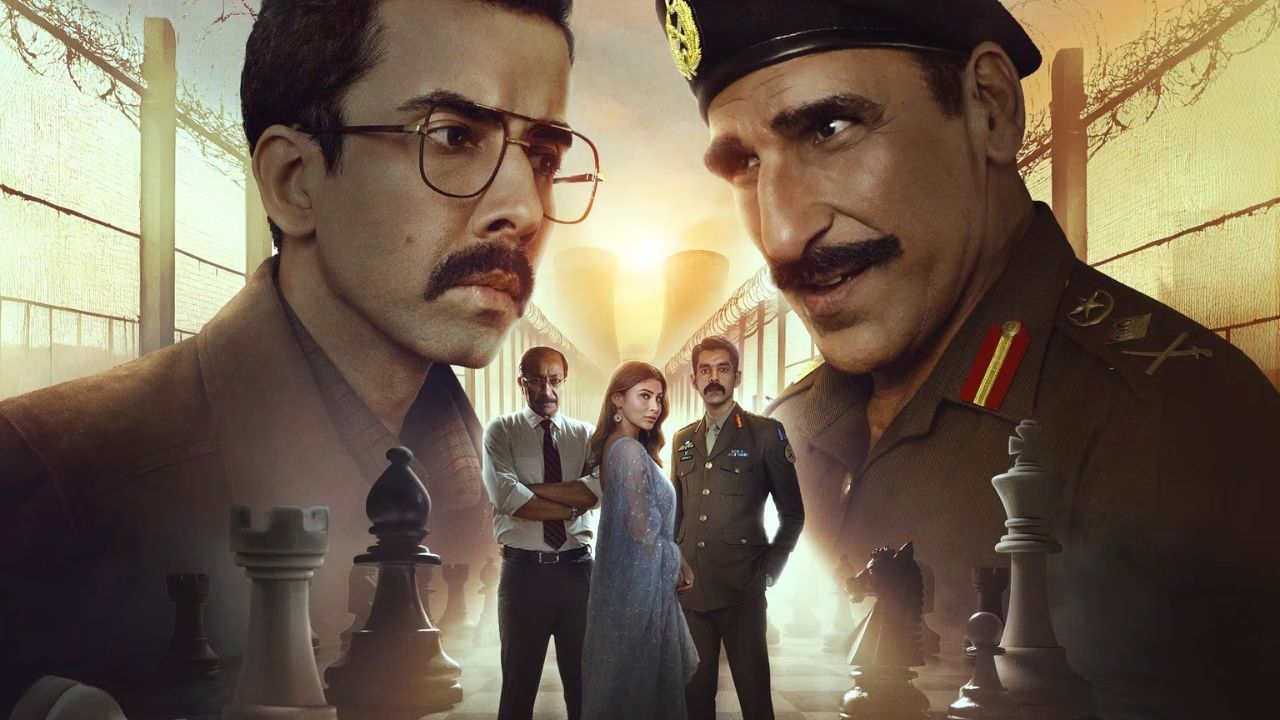
Loosely inspired by the life of National Security Advisor (NSA) Ajit Doval, Salakaar reduces much of its source material to a collection of B-movie-coded spy cliches. It isn’t competent enough to be either hagiographic or problematic. The narrative is composed of two timelines. In 2025, heroic protagonist Adhir Dayal (Purnendu Bhattacharya) — a same-same-but-different name that brings to mind the player spellings in vintage cricket videogames — gets wind of an old nuclear blueprint falling in the hands of evil Pakistani colonel Ashfaq Ullah (Surya Sharma). He quickly moves to block the purchase of uranium, while also planning to extract an Indian spy, Shrishti (Mouni Roy), who is so deeply undercover that she’s on the verge of becoming the colonel’s second wife. Ashfaq isn’t smart enough to know that Shrishti — who is a postcoital-cigarette-smoking ‘Mariam’ for him — wears AI glasses that transmit visuals back to India. Ashfaq isn’t smart at all.
Parallely, in 1978, we see a young Adhir (Naveen Kasturia) as a bureaucrat working in Islamabad who sets out to foil a secret ISI mission to build a nuclear bomb under hardliner president Zia Ullah (Mukesh Rishi). Adhir is a cool cat whose son (named Bharat of course) studies in an Islamabad school; he’s so cool that he masterminds a fake attack on the general’s grandson to win his trust. He’s a spymaster, so at least twice he fools simpleton guards with strange accents and amateur cosplay. When a story spans multiple generations, it can mean only one thing these days: everyone is connected. It is soon revealed that Shrishti is the grown-up granddaughter of Adhir’s colleague from the 1970s, and Ashfaq is the vengeful grandson of none other than General Zia. It’s a family business of sorts.
You’d think that multiple timelines are an artistic choice, especially when the show’s only neat touch features 1978 and 2025 literally colliding on a highway in sci-fi fashion. But here it’s an excuse to present two thrillers at the price of one — through two thrillers in the body of one. The first three episodes flit back and forth between eras, depending on which portion is campier. Young Adhir faces the threat of the barbaric general and his officers, one of whom brutally punches an Indian woman to death (this is shown explicitly and repeatedly to provoke us, not unlike recent Bollywood historicals). The torture porn is limited to one side of the border. The fourth episode shows how an angry Adhir fools a bunch of Pakistani soldiers at the covert plant with the help of a local sarpanch who thinks Adhir is an NGO worker so that he can eventually respond with: “No, I’m just a good neighbour”. Shrishti’s airport extraction saga in the finale lifts the climax of Argo with pride and no prejudice. Except it goes a step further, by including the pilots in a twist that could make patriotism blush.
No scene is allowed to exist without Amar Mohile’s background score, which treats every dialogue like a set piece. A thwarted nuclear explosion looks like the VFX is on an all-expenses-paid vacation in the Middle East. A straggly-haired scientist exclaims “What? That’s impossible!” twice in quick succession to his assistant. The cameo of a famous ISRO scientist unfolds like a portion of a mimicry contest. The performances are nothing to write home (or abroad) about. Naveen Kasturia plays Adhir like he’s in the Aspirants multiverse. It’s hard not to notice the irony of veteran actor Mukesh Rishi — who once immortalised the role of a marginalised Muslim inspector in Sarfarosh (1997) — playing General Zia as an ideological caricature. The suspense across both periods feels cosmetic, unlike the similarly themed John Abraham-starring Diplomat, which I now remember fondly. People speak urdu like they’re parodying and fetishising it at once.
An interesting moment shows the meat-eating General quoting Faiz only to confess that he banned poetry because he wants to radicalise the youth and not soften them; vegetarian Adhir keeps probing him at dinner like he’s the doctor in The Last King of Scotland (2006). Fortunately, the meat does not get an entry shot. A statement by the maker describes how Salakaar isn’t just a spy thriller, it’s “an emotional narrative about fractured legacies and the cost of silence; the espionage is seen not just as a mission but as a burden, a debt that passes on from one generation to the next”. Now that sounds like a great show — a long-form Raazi perhaps. A story with intuition and ambition. I have only one question: where is this story? And by that, I don’t mean which streaming platform.