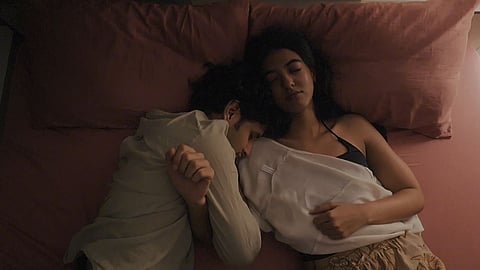


He’s a pop-culture geek, a trivia nerd, an aspiring (and annoying) YouTuber, and a relationship seeker. She’s a go-with-the-flow-er, a commitment-phobe, a covert romantic, and a situationship enthusiast. Their chatty first date ends in his smokey bedroom. He thinks they’re dating, she thinks they’re not; he needs certainty, she needs ambiguity. “I want more than just animal sex” competes against “Why do you care for labels?”. Most of Vaibhav Munjal’s 90-minute indie is composed of vignettes of this clash: he pines and whines, she grinds and minds. In between the escalating resentments, they find happy pockets. Their intermittent moments of intimacy unfold as if they’re fuelling themselves to survive the fights. Breakup hugs and bitter accusations fly thick and fast. Apparently Udit (Vaishnav Vyas) and Tanisha (Shreya Sandilya) are soulmates, but the whims of modern love are stopping them.
Scenes from a Situationship is the sort of low-key, all-vibes and DIY production that we used to see a decade ago. The influence of Little Things and early Imtiaz Ali is strong, almost like the characters have grown up so glued to their screens that they insist on thinking and behaving like fictional yearners. It’s partly lived-in and partly derived from cinema’s talking-couple aesthetic. One could argue that it’s stuck in a bygone era of digital storytelling, back when experiences of relatable youngsters seeking relatable spaces were a welcome change from Bollywood’s flashy excesses and make-or-break stakes. The film does have an antiquated sense of craft too: the choppy cuts, low-resolution camerawork, echoey ambient sounds, the Prateek Kuhad-coded score, the makeshift technique, the whimsical acting and the economical staging. But the raw production value strangely makes the film feel like more of an innocent throwback than something that’s unwilling to evolve. It becomes a reminder of a specific subset of have-camera-will-create spirit that faded away during India’s streaming-platform boom.
It helps that Scenes from a Situationship adopts the anti-narrative of a situationship. Every ‘scene’ is less of a phase and more of an interrogation of nonlinear togetherness. The film itself is not pleased with this concept of curated attachment, and keeps hinting that keypad emotions and social-media hyperawareness have killed the culture of companionship. It’s not the most nuanced opinion, but it’s an opinion at a time when nobody is allowed to have one. It doesn’t matter how deep the bond goes because the pattern is the same — the moment they remember why they like each other, their different expectations become an extension of their egos. It’s like they are manufacturing tension because complexity and drama are often perceived as the pillars of true love. The two characters are anything but aspirational either; Udit’s entitled masculinity wears the garb of curiosity, while Tanisha’s scepticism hides behind a show of identity. They’re perpetually trapped between the information they’ve consumed and the lives they’ve lived. Even their expressions of joy and compatibility are performative — they dance and narrate bedtime stories because the movies have taught them that big gestures are the cornerstone of romance. The spats are ugly, too, because is passion even real at all if it isn’t toxic enough?
The film ends with a salty punchline of sorts: couples like Udit and Tanisha are so wired to play roles in an age of instant validation and projected wokeness that they cannot afford to be themselves. The climax, like many moments, isn’t executed well, but it reveals the zero sum game of digital desire. The viewer doesn’t need to root for such tech-crossed partners because they barely root for each other. When love itself is the destination, conflict becomes the journey to reach there; they’re not on the same page to prove the existence of an entire book. Not all of this is deliberate, of course, because the storytelling itself is so ten years ago. The modest scale results in modest emotional intelligence. That’s the irony, though. If the film were a movie character, it’d be that blissfully sheltered protagonist who steps out of a bunker into a new world after ages only for cynics to be taken by its old-school naivety. Such are the times. Nostalgia is such an antidote today that, theatrical re-releases aside, even dated film-making feels like a breath of fresh air. Accidental simplicity is a flavour. You don’t need absolute cinema; just the memories of it are enough.