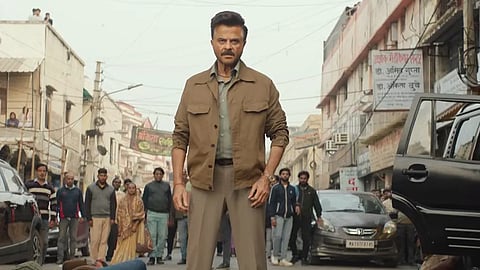


A brooding man returns to his hometown. Lots of emotional baggage. Plenty of memories of the wife he just lost. Estranged daughter. Roguish best friend. All he wants to do is live. But the town has other ideas. Nothing is right; there is chaos and oppression everywhere. A local goon makes it his life’s mission to bully our brooder. You know it’s a matter of time before the goon provokes the John Wick out of the griever. You know it’s coming. His violence is activated, so is a conscience; a personal mission morphs into a virtuous one. Subedaar stars Anil Kapoor as the scowler whose heroism is unplanned; Aditya Rawal plays the goon who summons the rampage. It’s a classic action-hero arc: scowl, scowl, scowl, explode. That’s how it usually goes.
In that sense, the film is not earth-shatteringly original. A glacial running time of 142 minutes alludes to a neo-Western setting. It’s heavily reliant on atmosphere and texture — resourceful sound design, aerial shots, echoey one-liners, a playful score, crafty transitions, nifty staging (especially the background activity), a chapter-wise narrative. The actors are effective, but the plot gets repetitive after a while; it’s a closed loop of harassment, taunts and revenge. The slow-burn loses its edge despite Arjun's (Kapoor) single-screen ways; he is either grieving his past or venting on his present. He is sucked into the social drama simply because the bad guys like terrorising their environment. His daughter has her own coming-of-rage tale going on. Arjun’s psychological struggles and pressure-cooker anger are depicted through devices used in the recent Daldal, also created by director Suresh Triveni: a perpetual glare, and the troubled character fantasizing about thrashing anyone that frustrates him (a version of the ‘dream sequence’ in which people imagine a flowery romance only to be snapped back to reality).
Some of it lands, thanks to Kapoor’s glowering screen presence. I can watch him seethe for years; his face alone is the buildup. The man and his red gypsy become a vibe. Some of it doesn’t land, because this is the kind of movie that visibly looks for things to do within a thin character-driven narrative. The angry young man is now the angry old man — and the youngsters can only poke the bear. It doesn’t help that the climax goes China Gate on us. The dialogue between characters early on is too expository; the writing isn’t creative enough to convey information without resorting to the crutch of one person narrating situations to the other. Case in point: Arjun’s friend Prabhakar (Saurabh Shukla) acts like a human voice-over when we first see them together in a car. He often speaks to Arjun like Arjun himself isn’t aware of his own backstory. By all means, sir, mansplain his own trauma to him — short of the precise time of his wife’s death, of course.
What perhaps distinguishes Subedaar, though, is the context of its hero’s transformation. As a stylistic genre piece, it’s hit or miss; the protagonist is too familiar to be entertaining. But much of the film’s interiority is derived from the identity of Subedaar Arjun Maurya: a retired Indian soldier disillusioned with an abrupt return to civilian life. Kapoor’s aura-farming turn is rooted in the man’s guilt for choosing his country over his family for years — and then realising that the country he sacrificed the family for keeps letting itself down. It’s a difficult awakening. A lot of Arjun’s PTSD stems from the emptiness of encountering a culture that abuses the concept of freedom; he is trying not to resent the people he went to war for. Many of his early moments feature his disbelief and disgust with a system that thrives on chaos and zero accountability. Almost every expression of his asks: “is this what I took bullets for?”. Almost every clash with Prince, the goon, is laced with the stillness of Arjun’s discontent. More than once, we hear Arjun thinking that the real enemies were within while he was busy shooting faceless enemies at the border. More than once, we see him trying to reckon with his flawed relationship with patriotism.
At some level, Arjun seems to be inviting the wrath of Prince (a screen-chewing Rawal) and his gangster sister (an in-form Mona Singh) so that he can channel his grief to reframe his idea of patriotism. He is almost searching for a sense of purpose, an excuse to wage a more productive war on the villains within. His sudden surge of morality is not accidental; it’s an attempt to make his loss worth it and turn his attention to the cracks posing as borders. It’s like he’s deliberately getting triggered to turn into a social greater-good hero, not just a pissed-off widower. I like that the film’s commentary emerges through genre tropes. The meta-ness is palpable in the casting. Kapoor gets the brief; Maurya’s retorts to the antagonist are loaded with the language of a senior schooling an entitled upstart. The journey of the character sort of reflects the legacy of a veteran Bollywood star who ‘returns’ to see an industry that sacrifices tradition at the altar of young nationalism and masculinity.
His daughter Shyama’s track cements the themes. The college-going girl is harassed by boys named Ranveer, Ranbir and Kaushal (the ‘Rajpal’ in the group is passive); you can tell that they’ve watched very specific kinds of modern movie males. She doesn’t allow any of the men in her life — her pushy best friend, her distant dad — to become her saviour. She insists on fighting her own battles. It’s an arc supplied by Radhika Madan’s prey-turned-predator performance. The little details — like the primal fear she feels when they fake an acid attack on her; or when a bottle explodes on her head — imply that she is ‘training’ herself to overcome her inherent instincts as a woman. It’s not that she’s magically brave. She’s the heroine in need of no hero, and while it might have been tempting to show the father-daughter bond repaired by his badassery, the film takes the scenic route to subvert the soldier-homecoming template. The one time he does try to take her matters into his hands, he ends up attacking the wrong person.
Given all the subtext, then, Subedaar is far more interesting than it looks. It doesn’t stick to the tried-and-tested mass formula. The title itself is a sign. It says something that, despite the superhuman strength and swag he possesses, the protagonist isn’t a retired colonel, commando or major. He’s more of a mid-level managerial officer who spent a lifetime on duty only to be disrespected for his rank by a hierarchical system that equates subservience with loyalty. A lot of orders are given in the film — by a female gangster flaunting her authority on the men who work for her; by a Mirzapur-coded ‘prince’ who gets off on humiliating those around him; by a hustler (Faisal Malik) who’s sick of babysitting his masters; by a spirited college-goer who threatens to expose her abusers; by a body that threatens to disobey its heart; and by a former soldier who’s stopped taking orders and marches to his own beat. “Jeene do (let us live)” is a potent war cry then; it’s an act of survival in a society where imposition is seen as the ultimate flex. It’s not some lofty triumph of good over evil; there’s no lyrical statement about rising and dissenting. Sometimes it’s just the right to be, not the pressure to become. After all, agency is the only freedom in a culture shaped by the language of following.