

A high-profile summit between Delhi and North-East India — the ‘mainland’ and the ‘margins’ — is around the corner. Nagaland is the sensitive face of this summit. The region is divided between rebel factions who distrust the centre and older statesmen who bat for peace and integration. A veteran leader is killed. Officers from outside arrive to lead an uncertain investigation featuring political strife, local divides, drug dealers, foreign forces, covert business interests, historical trauma, traitors, scapegoats and shifting loyalties. A secondary character dies, making it personal for the grief-stricken protagonist; his allegiances are questioned, and he is suspended. There is a mole in the midst. A little orphan searches for belonging. A conspiracy unfolds beyond borders and within governments. Our hero in a dysfunctional marriage must clear his name without compromising on his moral fibre. But enough about Season 2 of Paatal Lok.
The Family Man 3, which arrives four years after the second season, shares an eerily similar universe with Paatal Lok 2 — both are parts of celebrated franchises with overlapping talent, and a rare balance of social depth and cinematic value. The latter had a first-mover advantage earlier this year, but did it really? Modern Hindi cinema’s preoccupation with the Seven Sisters is a telling trend. The North-East and its conflicts have become the latest vessel to explore anti-establishment angst, public perception, post-truth reportage, IT cells and victimised minorities. This narrative wave isn’t surprising, given the complications of telling a Kashmir story these days. Perhaps the politics of being Indian is safer, or less sensitive, than the sanctimony of censuring the enemy. But to reduce the North-East to a surrogate would be to erase the plurality of oppression. To be fair, The Family Man has moved with the (anti-clockwise) times since 2019: it was bound to go east after tackling Islamophobia and radicalism in Season 1, and LTTE-coded militancy in Season 2. It’s just that the setting is no longer novel. If we try to recall the storylines and set-pieces of The Family Man 3 in the future, chances are scenes of Paatal Lok 2 might flash in our heads instead.
The season opens with a powder-keg moment: an incredible one-shot sequence in which the camera weaves through a cultural program and the planting of a bomb in the crowd. Cue title credits. The first two seasons made a trademark out of these oners, but they were usually action-packed shootouts scattered across the middle of the show. Season 3 breaks protocol, of course, almost as if it’s persuading us right off the bat before things get formulaic. And they do. After this coordinated terror attack across 7 cities — the worst in decades, we are told — the stage emerges. PM Basu (Seema Biswas) is on the brink of a historic peace summit, Project Sahakar, with rebel leaders of the North-East. But this means that a lucrative weapons deal with a billionaire gets stuck in cold storage, much to the chagrin of her cabinet. The players are not pleased, so in comes Meera Easton (Nimrat Kaur), a sultry ‘broker’ who spends her days purposefully walking around London on her phone and hatching plans to destabilise the North-East.
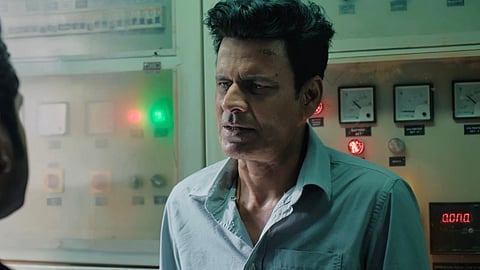
She remotely hires a drug kingpin named Rukma (Jaideep Ahlawat) to do the job. But Rukma is no ordinary gun, and his mission is anything but simple. He makes the mistake (not sure why) of leaving TASC agent Srikant Tiwari (Manoj Bajpayee) alive in an attack. Sri has this habit of becoming a thorn in the flesh of villains way beyond his pay grade. These ones don’t take him lightly, though. Meera soon ensures that Sri’s life is systematically dismantled, both as a famous spy and an infamous family man. He is framed, forced to go on the run from his own agency, while the Naga youth leader named Stephen — the grandson of the murdered politician — faces the same fate. It’s a neat little parallel. Sri is the North-East of his household: distant, misunderstood, resentful, resilient. And the North-East is the Srikant of India: a broken family hoping to reunite, individualistic, patriotic, proud, torn between identities.
As a homegrown spy thriller, the series continues to nail the fundamental genre points. For Sri, cursing and lying is still a love language; his banter with JK (Sharib Hashmi), and his ‘excuses’ to long-neglected wife Suchi (Priyamani), express a kind of middle-class male affection that’s hard to process. The same applies to his deadpan bewilderment with his kids — their lingo, non-binary pronouns, their detached wokeness — which is funny precisely because Bajpayee rarely mines it for humour. I like that the antagonist, Rukma, is many men at once: a no-nonsense gangster, a contractor who knows his worth, a disillusioned patriot, and most of all, an aspiring family man. When Sri is asked by his teen daughter why he got married despite his line of work, he responds by asking why agents like him aren’t entitled to have a wife and kids.
That’s the core of the show as a whole — a middle-class guy with a government job that requires him to be so good at deception that his marriage is built on distrust. Yet Sri’s woes are put into perspective when Rukma, the other side of the same coin, can’t even afford that. The writing humanises Rukma without trivialising his crimes. You can tell that, despite resisting it, he yearns to forge connections; it’s almost as if he’s not only chasing Sri for revenge but also to punish him for not making the most of the home he has. Ahlawat is such a natural fit that not once are we reminded of his Paatal Lok hero despite navigating the same environment; he turns Rukma into someone at odds with the very masculinity he is wired to flaunt.
The series similarly treats other characters that we are conditioned to box into moral brackets. Meera, for instance, is in the same boat as Rukma; their chemistry may appear strange at first, but it makes big-picture sense. There’s also Yatish (Harman Singha), the cocky TASC agent hired to hunt down Srikant; it’s not easy to root against him because he, too, has layers. At some point, two star-crossed bonds seem to be blossoming simultaneously in a land where belonging comes at a premium. There are no “bad” people as such; there are only people struggling to be good. The show has some nifty details — like the North-East’s progressive relationship with music being established through a kid named after Bobby McFerrin, or a leader quoting “a poet” (Bob Dylan) in the opening shot. Suchi’s therapy app, ShrinkMe, is nicely tied to a bureaucratic war and the banning of Chinese apps in India: a thread that peaks when a TRP-hungry reporter invites her to a panel and exposes her own broken home on live television.
I also like that Sri’s estranged marriage with Suchi has no easy solutions. Their detached routine suggests that they’re going through the motions; it’s an open secret. Her one moment of infidelity doesn’t exist in isolation; the husband doesn’t feel like a victim because he knows that the righteousness of serving his country — and therefore ‘cheating’ on her — left her with no chance. Ironically, the one thing that tore them apart is also the thing keeping them attached in this season: his job. Now that she knows of his work, her concern becomes an expression of intimacy. The prospect of his death flusters her; she panics the second his phone calls are delayed, even if it’s to hear of his fake whereabouts. The lies suddenly don't matter as long as there's a voice that tells them. The stakes of watching Sri save the day are high because we know the price: his family. He inflates his loyalty to the country because he needs to believe it to justify his sacrifice. But the loyalty becomes complicated this time. Season 3 brings the Tiwaris together in whatever capacity, almost as if he's rebelling against an institution that questions his integrity; his family is his rebound relationship. His mission is no longer as tethered to the spectacle of duty. He’s still patriotic, but when in a crisis, his priority is to free Indian hostages, not because they’re soldiers but because it weakens the villain he’s pursuing.
Yet, there are aspects of The Family Man 3 that make it lesser than previous seasons. The muscles may be there, but the midriff is flabby. It zooms out too much to focus on the various power players and deals; even if the intent is to show that people like Rukma and Srikant are pawns who are refusing to be checkmated, it doesn’t make for the most engaging watch. While the human portions have always been a strength, it stumbles a bit in terms of the macro premise. I don’t mean the actual plotline or the overfamiliar themes. It’s the exposition: the way it conveys information through clunky exchanges and staging. The first two seasons wove these bits into larger pieces and reactions (remember Sri philosophising about terrorism with the Tamil team? Or Sri expressing the guilt of wrongly labelling and killing an innocent Muslim boy?). But Season 3 feels like it’s come from the makers after a show like Citadel: Honey Bunny; the IP habits are hard to shake off.
For instance, it opens with the family moving into a posh new apartment, but the kids go out of their way to needle their dad and reveal that it’s Suchi who has bought their house (without home loans). When Sri and intelligence boss Kulkarni (an evergreen Dalip Tahil) reach Nagaland, the leader virtually spells out the situation to them under the pretext of ‘casual conversation’ and nostalgia. There are several examples — where the plot only moves through people talking and explaining things to each other; there’s no real texture to these moments apart from their purpose. When Sri is on the run with a rebel leader, a sad background score emerges during their North-East-101 chats. Even JK’s dating-app adventures feel like comic-relief moments, not a seamless part of the show’s levity.
There’s also a sense that the series tries to offer political commentary about Delhi and its culpability, but can’t go the whole hog. So it searches for diplomacy in its dissent, sympathising with a female Prime Minister who means well but is surrounded by shady (male) aides. It becomes about gender, not ideologies. She thinks and acts like she’s never been a politician before; it’s like blaming the centre without incriminating the nucleus. But one might look at these choices as a mix of the show’s vision of democracy versus the democracy we live in today: a blend of utopia and dystopia. Bloodthirsty anchors keep mocking the PM and demanding accountability on primetime news; it’s an alternate universe in which the media pushes the agenda of the opposition party. The twists in the show are another problem. A passing scene early on in Delhi explicitly hints at who the traitor in the system is; the discussion is so specific that the motives are exposed. Ditto for the return of TASC agent Zoya Ali, whose brooding hostility towards Srikant and her bond with his replacement looks too spare to be true. Fortunately, Shreya Dhanwanthary’s performance adds an ambiguous dimension of grief; she forces us to trust that Zoya may not be as calculative as we are led to imagine.
It doesn’t help that the season ends on a cliffhanger — it feels incomplete and not unresolved, unlike the gas-leak climax of Season 1, which was more about emotional tension than narrative suspense. Which is to say that The Family Man 3 doesn’t dip as steeply as Delhi Crime 3, but it’s safer and more predictable than its first two seasons. The default level is higher than most shows, thanks to the stacked cast, pop-cultural awareness and sharp film-making. I still revisit stray gags and priceless Bajpayee expressions to laugh on a gloomy day. But I can’t say I’ll do the same with this one. Coming into this season after the disappointment of other franchises, I felt like Sunil in Kabhi Haan Kabhi Naa nervously opening the newspaper to check his exam results. Hope and prayers. In the film, his roll number isn’t listed; he’s failed, but chooses to show a fake marksheet to his parents. Watching Season 3 is like not finding that roll number only to discover later — much to our relief — that it’s a clerical error. It passes with distinction, not honours. The prospect of another season is not a threat. But in the modern OTT landscape, you either die a hero or live long enough to become content.