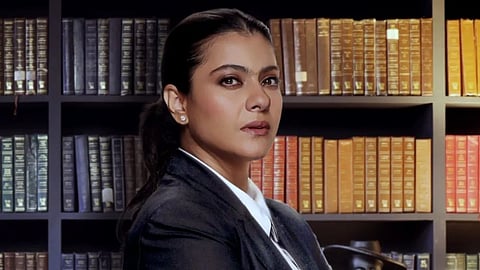


Season 2 of The Trial: Pyaar Kaanoon Dhokha is infinitely better than Season 1 of The Trial: Pyaar Kaanoon Dhokha. (Last time I read it as ‘Dhokla’ because I had skipped dinner to review the show). The Hindi adaptation of The Good Wife — where a spirited homemaker (Kajol) starts working at a prestigious law firm after her husband (it’s always Jisshu Sengupta) is arrested for a sex scandal — is not screaming at us anymore. The background score is calmer, the film-making does not shove an exclamation mark in your face (it’s no longer Pyaar! Kanoon! Dhokla!), and the writing only condescends on Gen-Z influencers (one of them purrs “obvi-yoo” and “effing” to a judge) who speak like old people imitating young people and seek validation from followers because they are unloved at home. The real-world nods are naughty: someone mentions a powerful predator named “MJ Shah” in reference to a sexual harassment case; a Bengali lawyer delivers a monologue defending migrants and queer rights in defiance of a right-wing Maharashtrian politician; a rival is raided by the ED; a creep paraphrases a Mohabattein line to expose the abusive history of a colleague; a husband goes viral for quoting Will Smith (“keep my wife’s name out of your f*cking mouth” of course) to a nosy podcaster on camera.
Being better than the first season, however, is not good enough. It took me around ten minutes into the opening episode of last season to realise that, no, this is just not it. This time, it takes around an hour. But the realisation is the same: it’s neither Guilty Minds nor Criminal Justice, neither Suits nor Aarya. The Trial has a different genre of problems altogether. It’s not just Kajol’s flat performance as the protagonist Noyonika Sengupta, or the fact that Noyonika’s personality feels limited to the dialogue she speaks, or the fact this season does cartwheels before arriving back at the beginning where Noyonika is still torn between sweet friend-simp Vishal (Alyy Khan) and her crumbling-in-slow-mo marriage, or the fact that the reaction shots look like they’re filmed in a different time and galaxy, or the fact that there is no visual diversity and Mumbai-ness because all indoors spaces look like swanky hotel rooms against a random city’s CGI skyline.
The flaws — amplified over a six-episode watch — are so basic that there’s no coming back from them. There’s the case-per-episode format, which isn’t done smartly because one case often leaks into the pre-title portion of the subsequent episode. For example, when a young massage therapist accuses a famous man of sexual abuse, the night where she visits the firm for help is built up as something that might define the whole show and its interpersonal dynamics. But it’s so hastily resolved that the viewer barely realises when Noyonika is handed a new case. The reason is that there is simply no connective tissue between arcs, scenes, subplots, relationships and microaggressions. There’s no emotional continuity because no conflict or moment is allowed to breathe; a character exits one ‘world’ and is thrown into the next, and each segment seems to exist in isolation of the other. Transitions are a myth. It’s the cinematic equivalent of watching a football team that’s a disparate collection of individuals; they refuse to pass the ball to each other and their coaches are busy admiring their stepovers.
The show is composed of many parallel tracks: Noyonika’s marital tension, her husband Rajiv’s political adventures, infighting between the partners of the law firm, the cases themselves, and a paralegal shadowy past catching up with her. The bullet-point writing switches between these tracks as if they’re entirely different shows. Noyonika could be having a spat with Rajiv or saving her queer brother from local bigots in one scene, and she’s bantering with Vishal in the next. A corrupt employee could be exposed and fired in one scene, applause in the office happens, then Noyonika’s home situation promptly appears in the next. Two colleagues could be bickering and physically harming each other, but the same scene then requires them to unite where they’re trying to nail a drug dealer. A family can break up in one scene, but the series will insist that a feel-good climax of a case immediately diffuses the pressure.
In other words, The Trial struggles to capture the flow of life; it’s as if separate segments are fused for the sake of shooting schedules and logistical shortcuts. This may sound normal, maybe a reflection of how professionals have to compartmentalize their challenges without letting them bleed into each other. But the film-making is such that it makes Noyonika act like four different women — there’s no toll of the previous day or hour on how she, or any of the others, behave in a particular place. It’s unfair to blame the actors for this absence of accumulative personalities. It’s almost impossible to engage with the actual cases because the viewer is never sure where each of the equations stand — the jump-scare here is the disjointedness of the storytelling, not the unpredictability of the story. It can get frustrating over a period of five hours, not least because it’s like having to guess where every character’s mental health is in an era where it’s hard enough preserving our own.
The stereotypes, much like the central performances, suffer from a post-Bollywood hangover. A cranky comic-relief judge, a decrepit Parsi advocate, a Gujarati-spouting divorce lawyer, a colourful gay man who is asked “why are you like this?” by his old-fashioned mom, a chain-smoking girlboss veteran, an emo influencer quitting social media in return for a settlement — it’s a conveyer belt of easy and boxable faces that reduce the complexity of urban India to an Indianism-and-Feminism-For-Dummies manual. By the end, unlike the first season which I couldn’t stand, I felt something worse for this one: indifference. Being accessible and politically aware is one thing. But being distant, curated, formulaic and dull is another. We’re back to square one — a remake in desperate need of cultural identity and direction. To stay constructive, I’ll resist the itch to make a cheap pun (about the title alluding to the viewing experience).